
Latest ThoughtThrill Projects
Explore our collection of math presentations designed to spark your curiosity.

Every Important Math Constant Explained
Pi (π) Euler’s Number (e) The Imaginary Unit (i) Pythagoras’s Constant (√2) Theodorus’s Constant (√3) The Golden Ratio (φ) The Euler-Mascheroni Constant (γ) The…
Read More
Greatest Mathematicians and their Discoveries – Part 2
A Timeline of History’s Greatest Mathematicians Ancient Mathematicians Indian and Central Asian Mathematicians Renaissance and Early Modern Mathematicians The Bernoulli Era and 18th Century…
Read More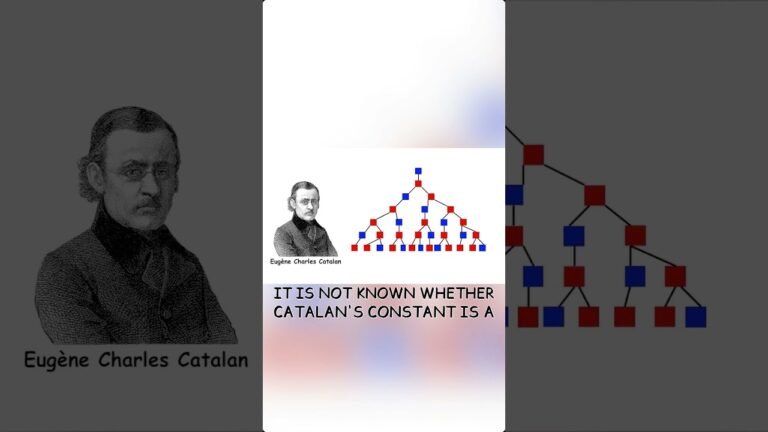
Why Catalan’s Constant Still Puzzles Mathematicians
Catalan’s constant is a well-known mathematical constant defined by the infinite series: It is named after the Belgian mathematician Eugène Charles Catalan, who first…
Read More
Every Unsolved Math Problem Explained
Notable Conjectures and Unsolved Problems in Mathematics Casas-Alvero Conjecture Riemann Hypothesis Navier–Stokes Existence and Smoothness Jacobian Conjecture Erdős–Oler Conjecture Gauss Circle Problem Kissing Number…
Read More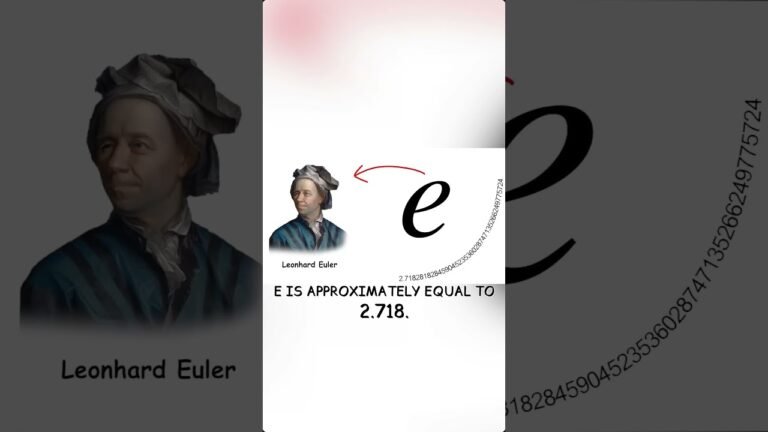
Euler's Number Explained in 30 seconds
Euler’s Number e Overview Applications Properties Overview The mathematical constant e is the base of the natural logarithm, a fundamental logarithmic function. It is…
Read More
Zeno’s Dichotomy Paradox Explained
https://www.youtube.com/watch?v=IH2uvZwglfM Imagine you are about to clap your hands. But think about what has to happen first. Your right hand has to travel half…
Read More
Every Weird Math Paradox Explained
The Hairy Ball Theorem The Dichotomy Paradox The Birthday Problem Gabriel’s Horn The Elevator Paradox The St. Petersburg Paradox Hilbert’s Hotel Russell’s Paradox The…
Read More
The Greatest Accidental Math Breakthroughs
Non-Euclidean Geometry Napier’s Logarithms Fourier’s Mistake About Heat Newton and Calculus Euler and the Constant e from Finance Henri Poincaré and Chaos Theory Gauss…
Read More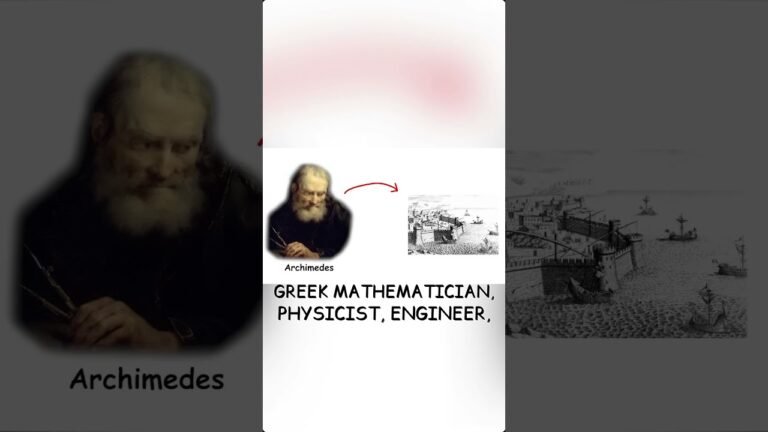
Pi Explained in 30 seconds π
Pi (π) is a fundamental mathematical constant that represents the ratio of a circle’s circumference to its diameter. It was first calculated by the…
Read More