
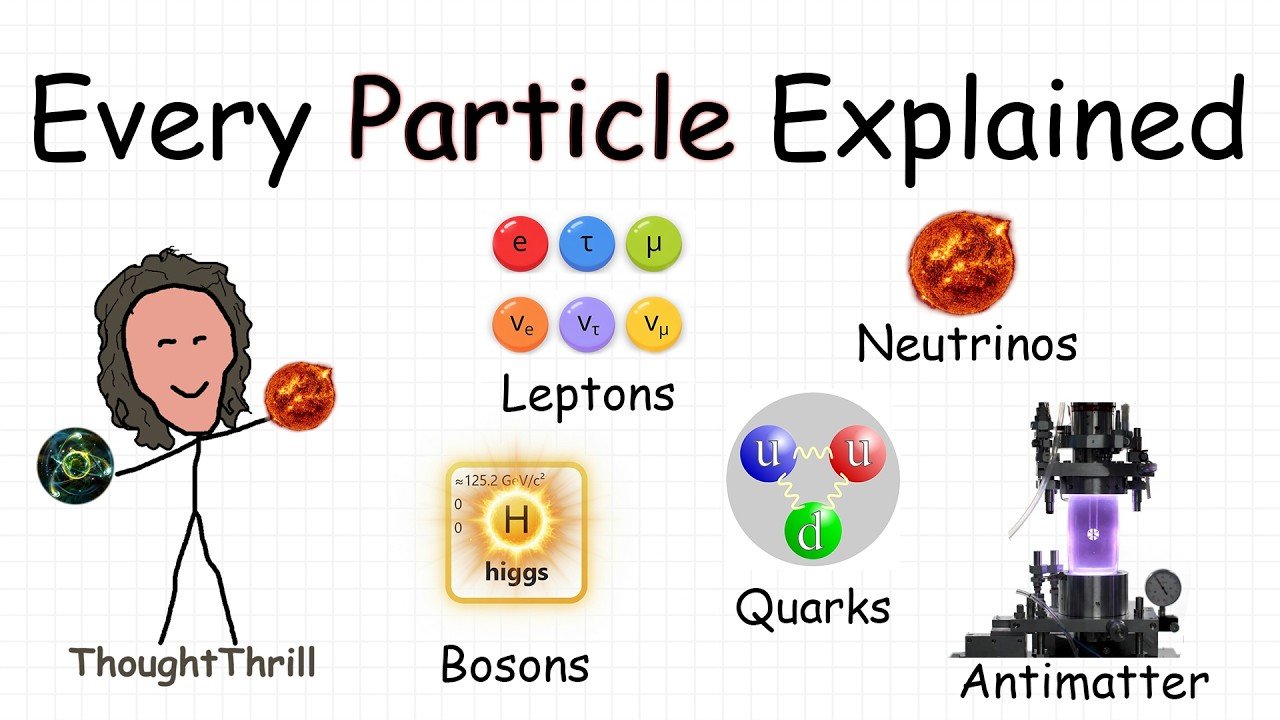
Every Fundamental Particle in the Standard Model Explained
What is everything made of?
The Standard Model of particle physics describes the smallest known building blocks of matter and the forces that govern their interactions.
It includes particles such as electrons, quarks, and neutrinos, along with the particles that carry the electromagnetic, strong, and weak forces.
In this article, we will break down every major category of particle in the Standard Model, from the particles that make up ordinary matter to the forces that hold the universe together.
Fermions Versus Bosons
In particle physics, all fundamental particles are divided into two main categories:
- Fermions
- Bosons
The distinction is based on a quantum property called spin.
Spin represents a particle’s intrinsic angular momentum. It does not mean that particles literally rotate like tiny balls. Instead, it describes how particles behave under rotations and other quantum transformations.
Fermions have half-integer spin, such as:
1/2, 3/2, 5/2, and so on
Bosons have integer spin, such as:
0, 1, 2, and so on
What Are Fermions?
Fermions make up matter.
They include:
- Quarks
- Electrons
- Muons
- Tau particles
- Neutrinos
Fermions obey the Pauli exclusion principle.
This principle prevents two identical fermions from occupying the same quantum state at the same time.
The Pauli exclusion principle is responsible for the electronic structure of atoms. Because electrons cannot all collapse into the same state, they arrange themselves into different atomic orbitals.
This arrangement produces the chemical diversity, structure, and stability of ordinary matter.
What Are Bosons?
Bosons are associated with the fundamental forces of nature.
The major force-carrying bosons include:
- Photons
- Gluons
- W bosons
- Z bosons
The photon carries the electromagnetic interaction.
Gluons carry the strong interaction.
The W and Z bosons carry the weak interaction.
Unlike fermions, multiple identical bosons can occupy the same quantum state.
This ability allows bosons to produce collective quantum phenomena such as Bose-Einstein condensation.
Quarks
Quarks are fundamental particles that combine to form protons, neutrons, and many other composite particles.
There are six types of quarks, which physicists call flavors:
- Up
- Down
- Charm
- Strange
- Top
- Bottom
Each quark has mass, electric charge, spin, and a quantum property called color charge.
Quark Electric Charges
Quarks have fractional electric charges.
Up, charm, and top quarks have a charge of:
+2/3
Down, strange, and bottom quarks have a charge of:
-1/3
These fractional charges combine to produce particles with whole-number electric charges.
For example, a proton contains two up quarks and one down quark.
Its total charge is:
2/3 + 2/3 – 1/3 = 1
A neutron contains one up quark and two down quarks.
Its total charge is:
2/3 – 1/3 – 1/3 = 0
The proton therefore has a positive charge, while the neutron is electrically neutral.
The Strong Interaction
The strong interaction is responsible for holding quarks together.
It is described by a theory called quantum chromodynamics, often abbreviated as QCD.
The strong interaction acts through the exchange of gluons. Gluons themselves carry color charge, which allows them to interact with quarks and with one another.
Unlike more familiar forces, the strong interaction becomes stronger as the distance between quarks increases.
This leads to a phenomenon called confinement.
Quark Confinement
Quarks cannot normally be observed in isolation.
As two quarks are pulled apart, the force between them becomes stronger. Eventually, enough energy builds up to create additional quarks and antiquarks.
Instead of producing a single isolated quark, the process creates new composite particles.
Quarks therefore group together in combinations with an overall neutral color charge.
Baryons and Mesons
Composite particles made from quarks are called hadrons.
Hadrons are divided into two major categories:
- Baryons
- Mesons
Baryons contain three quarks.
Examples include:
- Protons
- Neutrons
Mesons are made from a quark and an antiquark.
These combinations explain many of the observable properties of atomic nuclei and other forms of nuclear matter.
Although quarks cannot be detected individually, their existence has been confirmed through scattering experiments and high-energy particle collisions.
In these experiments, patterns of particle jets reveal the behavior of quarks and gluons inside larger particles.
Leptons
Leptons are elementary particles that do not experience the strong interaction.
They are grouped into three generations.
First Generation
The first generation contains:
- Electron
- Electron neutrino
Second Generation
The second generation contains:
- Muon
- Muon neutrino
Third Generation
The third generation contains:
- Tau
- Tau neutrino
Each lepton also has a corresponding antiparticle.
The electron’s antiparticle is the positron. The muon has an antimuon, the tau has an antitau, and each neutrino has a corresponding antineutrino.
Charged Leptons
The electron, muon, and tau all carry negative electric charge.
The electron is stable and plays an essential role in ordinary matter.
Muons and tau particles are much more massive than electrons. They are also unstable and quickly decay into lighter particles.
Charged leptons interact through:
- The electromagnetic force
- The weak force
- Gravity
They do not participate in the strong interaction.
Neutrinos
Neutrinos are electrically neutral and have extremely small masses.
They interact through:
- The weak force
- Gravity
Because their interactions are so weak, neutrinos can pass through enormous amounts of matter without being stopped.
Due to their relatively simple interactions, leptons are especially useful for studying the fundamental laws of particle physics.
The Electron
The electron is an elementary particle with a negative electric charge and a spin of 1/2.
It belongs to the first generation of leptons.
The electron has a mass of approximately:
0.511 MeV/c^2
This means 0.511 megaelectronvolts divided by the square of the speed of light.
The electron is the lightest known particle with a nonzero electric charge.
Electrons Inside Atoms
Inside an atom, electrons are distributed among quantum states called orbitals.
These orbitals are determined by the laws of quantum mechanics.
The electromagnetic attraction between negatively charged electrons and the positively charged atomic nucleus holds atoms together.
The arrangement of electrons around the nucleus determines the chemical properties of each element.
Electrons also allow atoms to form chemical bonds, producing molecules and the enormous variety of substances found in the universe.
Electrons and Electricity
Electrons are essential to electrical and technological phenomena.
In many conducting materials, electric current consists of the movement of electrons.
The manipulation of electrons makes technologies such as the following possible:
- Electrical circuits
- Computers
- Batteries
- Motors
- Communication systems
- Electronic devices
Wave-Particle Duality
Experiments have shown that electrons display both particle-like and wave-like behavior.
This phenomenon is called wave-particle duality.
One of the most famous demonstrations is the double-slit experiment.
When electrons pass through two narrow openings, they can produce an interference pattern associated with waves. However, individual electrons are still detected as localized particles.
The study of electrons helped lead to the development of quantum electrodynamics.
Quantum electrodynamics, often abbreviated as QED, describes interactions between electrically charged particles and the electromagnetic field with extraordinary precision.
Neutrinos
Neutrinos are elementary particles belonging to the lepton family.
They are characterized by three major properties:
- Neutral electric charge
- Extremely small mass
- Very weak interaction with matter
There are three known types, or flavors, of neutrino:
- Electron neutrino
- Muon neutrino
- Tau neutrino
Each type is associated with its corresponding charged lepton.
How Neutrinos Interact
Neutrinos do not experience the electromagnetic or strong interactions.
They interact primarily through the weak force and gravity.
This allows them to pass through large amounts of matter without being stopped.
Every second, trillions of neutrinos pass through the human body without leaving a detectable trace.
Neutrino Oscillation
One of the most surprising discoveries about neutrinos is that they can change from one type into another while traveling.
This process is called neutrino oscillation.
For example, an electron neutrino can later be detected as a muon neutrino or tau neutrino.
Neutrino oscillation implies that neutrinos have mass.
This is significant because the original formulation of the Standard Model treated neutrinos as massless.
The discovery that neutrinos have mass therefore shows that the Standard Model is incomplete.
Neutrinos in Space
Neutrinos play an important role in astrophysical processes.
They are produced in:
- Nuclear reactions inside the Sun
- Supernova explosions
- Radioactive decay
- Cosmic-ray interactions
- High-energy events throughout the universe
Neutrinos may also provide clues about why the universe contains much more matter than antimatter.
Force Carriers
The fundamental forces are transmitted by particles known as force carriers.
These particles are bosons.
The Standard Model describes three fundamental interactions:
- Electromagnetism
- The strong interaction
- The weak interaction
Gravity is not included in the Standard Model.
The Photon
The photon is the carrier of the electromagnetic interaction.
It has no electric charge and no rest mass.
Because the photon is massless, the electromagnetic force can act across extremely large distances.
The electromagnetic interaction acts between electrically charged particles.
It is responsible for:
- Electricity
- Magnetism
- Light
- Chemical bonding
- Atomic structure
- Most everyday contact forces
Visible light is made of photons, but photons can have many different energies.
The electromagnetic spectrum includes:
- Radio waves
- Microwaves
- Infrared radiation
- Visible light
- Ultraviolet radiation
- X-rays
- Gamma rays
The W and Z Bosons
The weak interaction is carried by three particles:
- W+ boson
- W- boson
- Z boson
Unlike the photon, the W and Z bosons have large masses.
Their high masses limit the weak interaction to extremely short distances.
The weak interaction is essential to several types of nuclear decay.
For example, beta decay occurs when a neutron transforms into a proton while releasing an electron and an antineutrino.
The weak interaction is also responsible for many neutrino interactions.
Although neutrinos have no electric charge, they can interact with other particles through the weak force.
Gluons
Gluons are the carriers of the strong interaction.
They act between particles that possess color charge, especially quarks.
Like the photon, gluons have no rest mass.
Unlike the photon, gluons carry the type of charge associated with their own interaction.
Photons do not carry electric charge, so they do not directly interact with one another under ordinary conditions.
Gluons carry color charge, which means gluons can interact with other gluons.
This self-interaction makes quantum chromodynamics much more complicated than quantum electrodynamics.
It is also responsible for important effects such as quark confinement.
The Higgs Boson
The Higgs boson is a fundamental particle associated with the mechanism that gives mass to certain elementary particles.
The Higgs mechanism was proposed during the 1960s as part of a process called spontaneous symmetry breaking.
The existence of the Higgs boson was confirmed in 2012 at the Large Hadron Collider.
The discovery was made independently by the ATLAS and CMS experiments.
The Higgs Field
The Higgs mechanism involves a field that exists throughout the universe.
This is called the Higgs field.
Different particles interact with the Higgs field with different strengths.
Particles that interact more strongly with the field acquire greater mass.
Particles that interact less strongly have less mass.
For example, the W and Z bosons interact strongly with the Higgs field and are massive.
The photon does not interact with the Higgs field in the same way and remains massless.
The Higgs boson is a quantum excitation of the Higgs field.
It can be understood as a detectable disturbance in the field, similar to how a photon is a quantum excitation of the electromagnetic field.
Why the Higgs Boson Matters
The discovery of the Higgs boson completed the set of particles predicted by the Standard Model.
However, it also raised new questions.
Scientists continue to study the Higgs boson to determine whether its properties exactly match Standard Model predictions.
Any unexpected behavior could provide evidence of particles, fields, or forces beyond the Standard Model.
Antimatter
Antimatter is a form of matter made from antiparticles.
Antiparticles have the same mass as their corresponding ordinary particles, but certain quantum properties are reversed.
These reversed properties can include:
- Electric charge
- Color charge
- Other quantum numbers
For example, the antiparticle of the electron is the positron.
The electron has a negative electric charge, while the positron has a positive electric charge.
Both have the same mass.
Every matter particle in the Standard Model has an associated antiparticle.
Examples include:
- Quarks and antiquarks
- Electrons and positrons
- Muons and antimuons
- Neutrinos and antineutrinos
Some electrically neutral bosons can be their own antiparticles.
Matter-Antimatter Annihilation
When a particle meets its antiparticle, the two can annihilate each other.
Their mass and energy are converted into other particles, often photons.
The energy released follows Einstein’s equation:
E = mc^2
This process does not destroy energy. It converts the energy stored in the particles’ mass into other forms.
The reverse process can also occur.
Under the right conditions, energy can produce a particle and its corresponding antiparticle.
Why Is There More Matter Than Antimatter?
One of the greatest unanswered questions in modern physics is why the observable universe is made almost entirely of matter.
Current theories suggest that the early universe should have produced matter and antimatter in nearly equal amounts.
If the amounts had been exactly equal, most matter and antimatter would have annihilated, leaving behind a universe filled primarily with radiation.
Instead, matter survived and formed:
- Galaxies
- Stars
- Planets
- Living organisms
This suggests that some process created a small imbalance between matter and antimatter.
CP Symmetry Violation
One possible part of the explanation involves a phenomenon called charge-parity symmetry violation, or CP violation.
CP symmetry combines two transformations.
The first is charge conjugation, represented by C.
Charge conjugation swaps particles with their antiparticles.
The second is parity, represented by P.
Parity reverses spatial coordinates, producing a mirror-image version of a physical process.
A CP symmetry violation occurs when a process does not behave exactly the same after both transformations are applied.
CP violation may have helped matter become slightly more abundant than antimatter in the early universe.
However, the amount of CP violation currently known within the Standard Model does not fully explain the observed imbalance.
The Standard Model Is Incomplete
The Standard Model is one of the most successful theories ever developed.
It accurately describes the known fundamental particles and three of the four fundamental forces.
However, it is incomplete.
It Does Not Include Gravity
The Standard Model does not provide a quantum description of gravity.
General relativity describes gravity extremely well on large scales, while quantum mechanics describes particles and forces on very small scales.
Physicists have not yet developed a complete theory that successfully combines the two.
It Does Not Fully Explain Neutrino Mass
Neutrino oscillation proves that neutrinos have mass.
However, the original Standard Model treats neutrinos as massless.
The model must therefore be extended to account for neutrino masses and their unusual properties.
It Does Not Explain Dark Matter
Astronomical observations suggest that galaxies and galaxy clusters contain large amounts of invisible matter.
This material is called dark matter.
Dark matter appears to interact gravitationally, but it does not emit, absorb, or reflect light in the ordinary way.
None of the known Standard Model particles fully explains the observed behavior of dark matter.
It Does Not Explain Dark Energy
Observations show that the expansion of the universe is accelerating.
The unknown cause of this acceleration is called dark energy.
The Standard Model does not explain the nature of dark energy.
Together, dark matter and dark energy make up roughly 95% of the universe’s total mass-energy content.
This means that the Standard Model directly describes only a small fraction of everything believed to exist.
Theories Beyond the Standard Model
Several major ideas attempt to fill the gaps in the Standard Model.
Supersymmetry
Supersymmetry proposes that every known particle has a heavier partner particle.
Fermions would have bosonic partners, while bosons would have fermionic partners.
These hypothetical particles are sometimes called superpartners.
Supersymmetry could help explain several problems in particle physics and may provide a candidate for dark matter.
However, no supersymmetric particle has yet been confirmed.
Grand Unified Theories
Grand unified theories attempt to combine three fundamental interactions:
- Electromagnetism
- The weak interaction
- The strong interaction
At extremely high energies, these forces may become different aspects of a single unified force.
A successful grand unified theory could explain why the forces and particles of the Standard Model have their particular properties.
String Theory
String theory proposes that the most fundamental objects are not point-like particles.
Instead, they are extremely small vibrating strings.
Different patterns of vibration would appear as different particles.
String theory attempts to combine gravity with quantum mechanics within a single mathematical framework.
However, it has not yet produced experimentally confirmed predictions that establish it as the correct description of nature.
The Search for New Physics
Experiments around the world are searching for evidence that goes beyond the Standard Model.
The Large Hadron Collider produces high-energy particle collisions that may reveal new particles or unexpected interactions.
Neutrino detectors study oscillations, neutrino masses, and possible differences between neutrinos and antineutrinos.
Dark matter observatories search for rare interactions between dark matter and ordinary matter.
Other experiments investigate:
- Matter-antimatter asymmetry
- Higgs boson properties
- Rare particle decays
- Unknown forces
- Additional dimensions
- Possible violations of established physical laws
The Standard Model is extraordinarily successful, but it is not the final description of reality.
Any confirmed discovery beyond it could reshape our understanding of matter, energy, space, time, and the universe at its most fundamental level.
Leave a Reply