
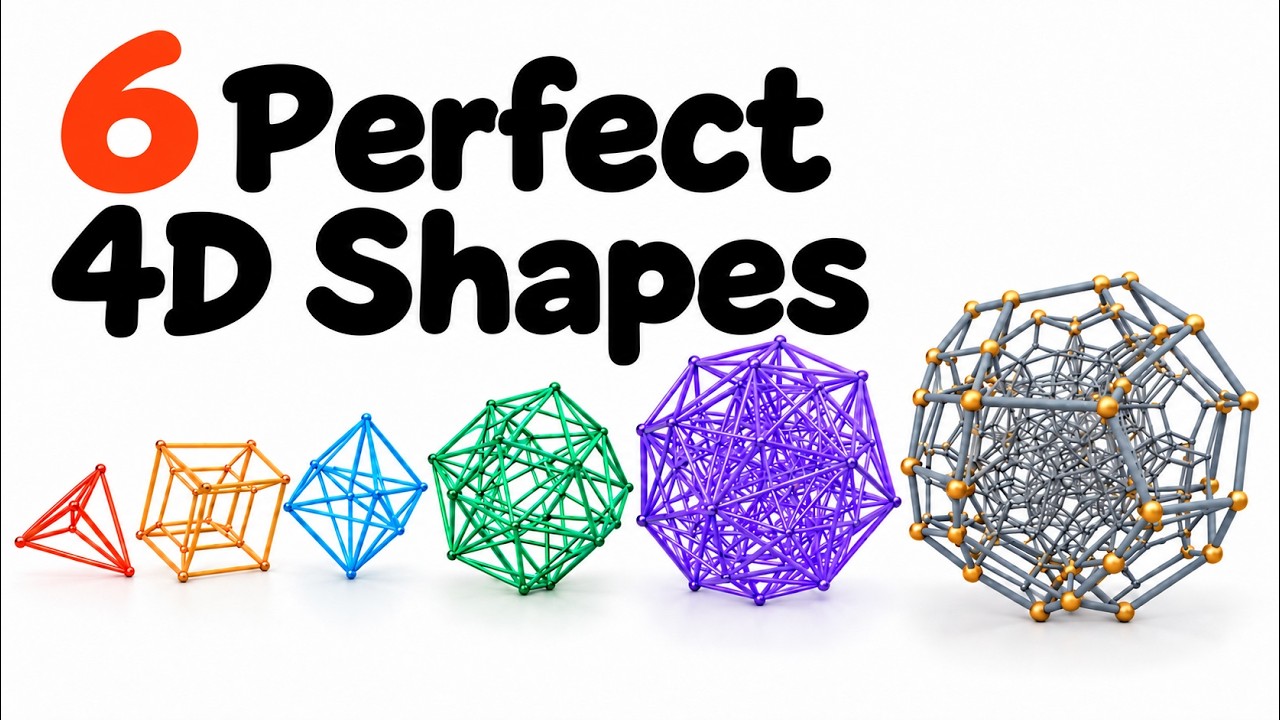
The tesseract is the best-known four-dimensional shape, yet it is only one of six perfectly regular convex shapes in four dimensions. Each is built from identical three-dimensional solids, called cells, fitted together with complete symmetry. This article walks through all six: the 120-cell, 600-cell, 5-cell, tesseract, 16-cell and 24-cell, and shows how they relate through duality and construction.
Six Regular Shapes in Four Dimensions
A four-dimensional shape is bounded by three-dimensional solids, and those building blocks are called cells. Schläfli showed that exactly six regular convex polytopes exist in four dimensions [1]. In five dimensions and above, only three regular families remain [2]. Their Schläfli symbols are {3,3,3}, {3,3,4}, {4,3,3}, {3,4,3}, {3,3,5} and {5,3,3} [3]. Five of these correspond to the Platonic solids, as explored in our tour of the five perfect three-dimensional shapes.
The 120-Cell
Take 120 regular dodecahedra, the twelve-faced solids built from pentagons, and fit three around every edge. The assembly folds through the fourth dimension, much as flat pentagons fold out of a plane to make a dodecahedron, and closes on itself. The result has 720 pentagonal faces, 1200 edges and 600 vertices [3]. Models of it make some cells look smaller or stretched, because showing four dimensions in fewer dimensions distorts the view. In the true geometry all 120 cells are identical. This is the last dimension in which pentagonal faces appear among regular convex polytopes.
120-cell: {5,3,3}, with 120 dodecahedral cells and 600 vertices
The 600-Cell
Place a point at the center of each dodecahedral cell of the 120-cell, and connect the centers of cells that share a pentagonal face. The 120 new points are the vertices of the 600-cell, whose cells are 600 regular tetrahedra. Its symbol is {3,3,5}: five tetrahedra meet at each edge, and its vertex figure is an icosahedron, so 20 tetrahedra meet at each vertex [3]. Slicing off a tiny corner at a vertex exposes that icosahedron. The 120-cell and 600-cell are duals of each other: cell centers of one correspond to vertices of the other [4]. The 600-cell has more cells than any other regular convex 4-polytope.
The 5-Cell
How many points can be placed so that every pair is the same distance apart? A line allows two, a plane allows three (an equilateral triangle), and ordinary space allows four (a regular tetrahedron). A fifth equidistant point needs a fourth dimension. Place it along the extra direction through the center of the tetrahedron, at the right height, and join it to all four corners. For edge length 1 that height is √10/4 ≈ 0.79057 [5]. All 10 edges are then equal. The result is the 5-cell, also called the pentachoron or four-dimensional simplex, with five tetrahedral cells, three meeting at each edge [5].
It can be viewed as a four-dimensional pyramid with a tetrahedral base [6]. Any four of its five vertices form a tetrahedron, and all five vertices are equivalent. A projection that puts the fifth vertex inside an ordinary tetrahedron only reflects compression of the fourth dimension.
The Tesseract
Sweep a square at right angles to its plane by its own side length and you get a cube. Sweep that cube along a fourth perpendicular direction by the same distance and you get a tesseract, also called the 8-cell. It has eight cubic cells: two from the cube at the start and end of the motion, and six swept out by the cube's six square faces. The familiar picture of a small cube inside a larger one, with corresponding corners joined, shows six more distorted-looking cubes between them. In the real shape all eight are equal.
When a tesseract rotates, the inner cube seems to pass through the outer one, but the solid stays rigid; only its projection changes. Its eight cells can also be unfolded into a connected arrangement of cubes in three-dimensional space, just as a cube unfolds into six squares. For more on this shape, see our article on what a tesseract is.
The 16-Cell
Connecting the centers of neighboring cells of the tesseract gives its dual, the 16-cell, with eight vertices and 16 tetrahedral cells. Its symbol is {3,3,4} [7]. This extends the familiar construction in which the face centers of a cube form an octahedron. An octahedron has three pairs of opposite vertices along three perpendicular axes; the 16-cell adds a fourth pair along a fourth axis. Its vertices are (±1, 0, 0, 0), (0, ±1, 0, 0), (0, 0, ±1, 0) and (0, 0, 0, ±1), and every vertex is joined to every other except its opposite [8].
A cell is chosen by picking one vertex from each opposite pair, which gives 2 × 2 × 2 × 2 = 16 tetrahedra. Four tetrahedra meet around each edge, compared with three in the 5-cell and five in the 600-cell, so one small solid yields three different structures depending on how copies meet. The 16-cell belongs to the cross-polytope family, which continues in every higher dimension [8]. Along with the simplex and hypercube, it is one of three regular families that never end. Those families are surveyed in our overview of higher-dimensional shapes.
The 24-Cell
The last shape uses octahedra. Fit 24 regular octahedra together, three around every edge and six around every vertex, and they close into the 24-cell, with 24 vertices and 96 edges [9]. Marking each octahedron's center and joining centers of cells that share a triangular face gives another 24-cell, so the shape is self-dual [9]. Self-dual polytopes have palindromic Schläfli symbols, and {3,4,3} reads the same in both directions [4]. The 5-cell is also self-dual, while the tesseract and 16-cell form one dual pair and the 120-cell and 600-cell form the other.
The 24-cell also hides tesseracts. Its 96 edges can be partitioned into three tesseracts [9], and since a tesseract has 32 edges, that is three groups of 32. The three tesseracts overlap, sharing vertices, and are differently oriented. Its vertices are the permutations of (±1, ±1, 0, 0) [9]. Among the six shapes it is the only one with no direct three-dimensional analog [9], and it does not extend to a family of regular convex polytopes in higher dimensions [2].
24-cell: {3,4,3}, with 24 octahedral cells, 24 vertices and 96 edges
Sources
- Regular polytope – HandWiki
- Regular polytope
- 600-cell
- The {\em 4DLO} and other tubing models of $S^3$ symmetry
- Pentachoron – Polytope Wiki
- 5-cell
- 16-cell
- 16-cell – Wikiversity
- 24-Cell — from Wolfram MathWorld
Leave a Reply