
The Hairy Ball Theorem
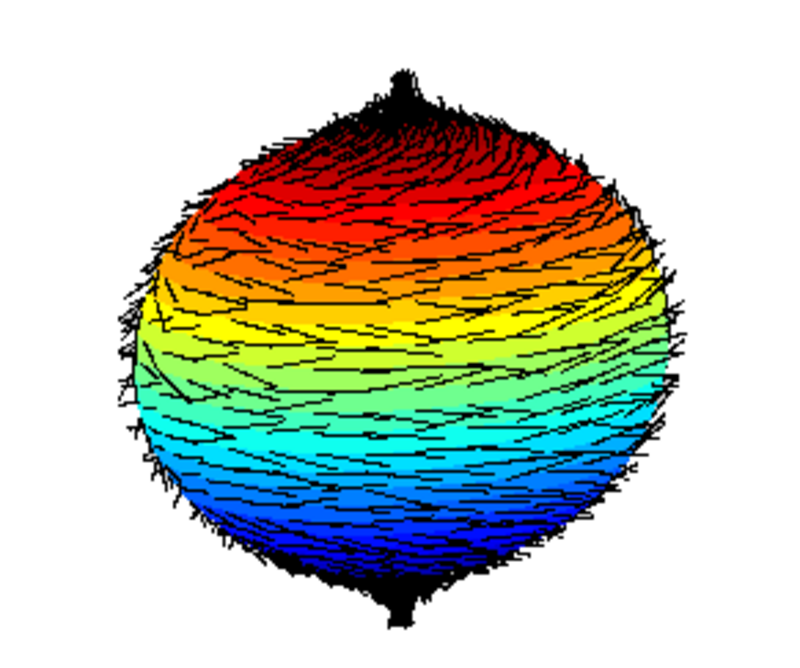
Imagine a ball covered in hair, like a fuzzy tennis ball. The hairy ball theorem says you cannot smoothly comb down all the hair on this ball without creating a tuft, like a cowlick on your head, somewhere on the surface.
In mathematical terms, it is about continuous tangent vector fields on spheres. A tangent vector field assigns a direction (a vector) to each point on a surface like a sphere. Think of it as combing the hair at each point on the sphere in a consistent direction. No matter how you comb the hair on a fuzzy ball like a coconut or a tennis ball, there will always be a spot where the hair stands up.
Henri Poincaré first proved this for the two-sphere (the ordinary sphere) in 1885. Later, Luitzen Egbertus Jan Brouwer extended it to higher even dimensions. Next time you see a hairy ball, remember that even math has rules for combing.
The Dichotomy Paradox
Zeno’s paradoxes are a set of philosophical problems that question how motion is possible. The dichotomy paradox is one of them.
In the paradox of the cheetah and the snail, a cheetah is in a race with an espresso-charged snail. Suppose the cheetah is sprinting at 10 m/s, the snail is zooming at 1 m/s thanks to the espresso shot, and the snail starts 9 m ahead of the cheetah. On the face of it, the cheetah should catch the snail after 1 second, at a distance of 10 m from where it starts and 1 m from where the snail starts.
But before the cheetah can catch the snail, it must reach the point where the snail started. In the time it takes to do this, the snail slithers a little further forward. So next the cheetah must reach this new point, but in the time it takes to achieve this, the snail inches forward a tiny bit further, and so on to ∞. Every time the cheetah reaches the place where the snail was, the snail has had enough time to get a little bit further, and so the cheetah has another run to make. Zeno concludes that the cheetah has an infinite number of catch-ups to do before it can catch the snail, and so the cheetah never catches the snail.
The Birthday Problem
The birthday problem in probability theory asks: what is the chance that in a group of n randomly chosen people, at least two of them share the same birthday?
The birthday paradox refers to the surprising fact that you only need 23 people for there to be a better than 50% chance that two of them share a birthday. This is a veridical paradox, meaning it seems wrong at first but is actually true.
At first it seems unlikely that 23 people would be enough for a 50% chance of shared birthdays, but it makes more sense when you consider the number of birthday comparisons. With 23 people, there are (23 × 22) / 2 = 253 pairs of people to compare, which is much more than half the number of days in a year (365).
This concept has real-world uses, particularly in cryptography. A birthday attack uses the birthday paradox principle to find two different inputs that produce the same hash value more efficiently, exploiting the likelihood of collisions in hash functions. The problem is often credited to mathematician Harold Davenport around 1927, though he did not publish it because he assumed someone else must have discovered it earlier. The first published version was by Richard von Mises in 1939.
The National Security Agency (NSA) has used the principles behind the birthday paradox to understand and design secure hash functions. In the 1980s and 1990s, cryptographers realized that the birthday paradox could be used to mount efficient birthday attacks on hash functions. A hash function takes an input and produces a fixed-size string of characters which appears random. For a secure hash function, it should be computationally infeasible to find two different inputs that produce the same hash output (a collision). However, due to the birthday paradox, if you have a large number of different inputs, the chances of finding a collision increase dramatically. This understanding led to the development of more robust cryptographic standards and practices, ensuring that hash functions are secure against such probabilistic attacks.
Gabriel’s Horn
Gabriel’s horn, also known as Torricelli’s trumpet, is a fascinating geometric shape that has an infinite surface area but a finite volume. This paradoxical figure was named after the Archangel Gabriel, who is said to blow a horn to announce Judgment Day in Christian tradition. The shape was first studied in the 17th century by Evangelista Torricelli, an Italian physicist and mathematician.
It is a super long trumpet that stretches out to ∞. If you tried to paint the outside of this trumpet, you would need an infinite amount of paint because it has an endless surface area, so you could never paint it. But here is the magic part: if you wanted to fill the inside of the trumpet with honey (or whatever you prefer), you would only need a finite amount. Even though it is infinitely long, you can fill it up with a limited amount. It is a special trumpet that is impossible to cover on the outside but possible to fill on the inside.
The Elevator Paradox
The elevator paradox is an interesting phenomenon observed by two physicists, Marvin Stern and George Gamow, who worked in a tall building. Gamow noticed that the first elevator to stop at his floor near the bottom was usually going down. Meanwhile, Stern, who worked near the top floor, observed that the first elevator to stop at his floor was usually going up. This seems to suggest that elevators are more likely to be going in one direction depending on which floor you are on, which is a bit confusing at first.
Imagine a building with 30 floors and one slow elevator. The elevator stops at every floor as it goes up and down. If you are on the first floor and walk up to the elevator at a random time, most of the time the elevator will be on its way down. This is because the elevator spends a lot of time traveling down through all the floors after reaching the top. If you are on the 29th floor, the elevator will usually be coming up, so it will more often be going up when it first stops at your floor.
Say the elevator takes 1 minute to travel between each floor. If you stand by the elevator doors on the first floor, it takes the elevator 30 minutes to go up to the top floor and 30 minutes to come back down. That is 60 minutes for a full round trip. During this time, the elevator is only going up past the first floor for the first 2 minutes of each hour (from 0 to 2 minutes). The rest of the time (58 minutes) it is coming down past the first floor. So if you walk up to the elevator at a random time, there is only a small chance (2 out of 60) it is going up and a big chance (58 out of 60) it is going down. The same idea applies if you are near the top floor, but in reverse.
The elevator paradox is about how elevators seem to be more likely to be going in one direction depending on which floor you are on, making it seem like it is always going in the opposite direction of where you want to go.
The St. Petersburg Paradox
In 1713, mathematician Nicholas Bernoulli put forth a question about the notion of expected value that came to be known as the St. Petersburg Paradox. Consider a game where you flip a coin. If it lands heads on the first flip, you win $1. If it lands heads on the second flip, you win $2, and so on, doubling your winnings each time. On heads, it pays out double the prior round and the game ends. On tails, the coin is tossed again.
How much would you pay to play this game?
Based on expected value theory, a rational person should be willing to pay any price for a ticket in this game. After all, there is a small probability that the coin will land on tails so many times in a row that the payout is ∞, and anything times ∞ is ∞. In reality, however, people are rarely willing to pay more than $10. This is the St. Petersburg Paradox: why are people only willing to pay $10 for a game which has an infinite expected value?
Bernoulli came up with a psychological and behavioral explanation. He proposed that the desirability or utility associated with a financial gain depends not only on the gain itself but also on the wealth of the person making the gain. This makes intuitive sense. To a person who has no money, $500 could make a big impact on their life. To a person who has $1 million, an extra $500 does not really change anything for them. Instead of computing the expected value of the winnings, Bernoulli proposed computing the expected value of the gain in utility. He concluded that individuals were willing to pay only $10 rather than an infinite sum because the marginal utility of money diminishes as wealth increases.
Hilbert’s Hotel
Imagine a hotel with an infinite number of rooms, each numbered from 1 and upwards without any limit. This means there is always a room for every number you can think of, forever. Now let’s say all the rooms are already occupied, but suddenly more guests arrive, each expecting their own room. Normally, in a regular hotel with a finite number of rooms, once all rooms are taken there is no space for new guests. But here is the fascinating part: in this infinite hotel, even if an endless number of new guests show up, there is a way for everyone to get their own room.
If just one extra guest arrives, the hotel can make room by moving everyone to the next room. The person in room 1 moves to room 2, the person in room 2 moves to room 3, and so on. This clears up room 1 for the new guest.
If more guests arrive, say k guests, the hotel can still manage. They just repeat the process, but instead of moving everyone one room over, they move each person k rooms over. This way everyone still has their own room and there is space for the new guests.
What is even more mind-boggling is that the hotel can handle an infinite number of new guests. They do this by moving the person in room 1 to room 2, the person in room 2 to room 4, the person in room 3 to room 6, and so on. This cleverly leaves all the odd-numbered rooms empty, and those are countably infinite, meaning there is an endless amount of them. So there is plenty of room for the new arrivals.
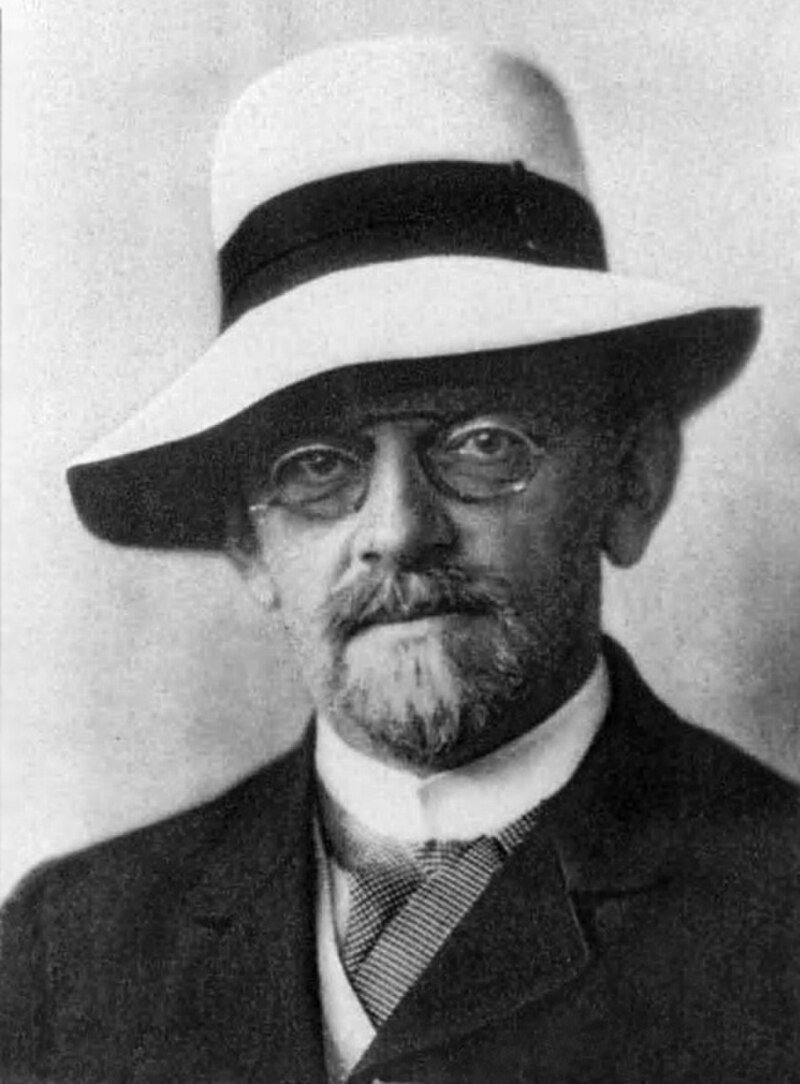
In essence, this infinite hotel can always find a way to accommodate new guests, no matter how many show up, simply by shuffling everyone around in a clever way. The idea was introduced by David Hilbert in a 1925 lecture and was popularized through George Gamow’s 1947 book One Two Three… Infinity.
Russell’s Paradox
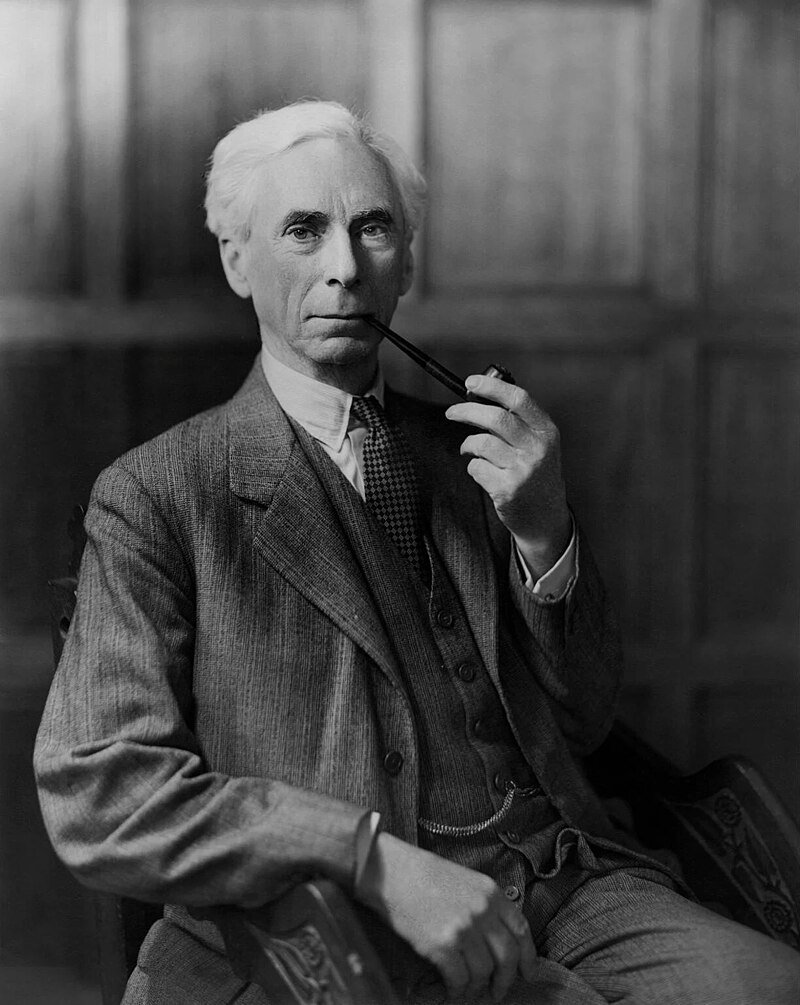
Russell’s Paradox is a tricky problem in math that was discovered by Bertrand Russell, an English mathematician and philosopher, in 1901. He found a big problem in a system created by another math expert named Gottlob Frege. Frege came up with a rule called the comprehension principle. This rule basically said that if you have a condition, like “all red things,” you can make a set containing all the things that meet that condition, like all the red apples. It sounds pretty simple, right?
But here is where things get complex. Russell realized that if you apply this rule to all conditions, it leads to some strange situations. Imagine a set of all sets that do not contain themselves. Sounds okay at first, but then we ask: does this set contain itself? If it does, then it should not, because it is supposed to contain only sets that do not contain themselves. But if it does not contain itself, then it should, because it fits the condition of sets that do not contain themselves. Baffling, right?
This is Russell’s Paradox. It shows that if you try to make a set of all sets, you run into problems. It is like trying to define a word using the word itself in the definition. Things get all tangled up.
To fix this, mathematicians had to put limits on Frege’s rule. They came up with new rules like the Zermelo-Fraenkel system, which says you cannot make sets bigger than ones you already have. This way you avoid those weird situations like trying to make a set of all sets.
The Banach-Tarski Paradox
The Banach-Tarski Paradox is a mind-bending concept in geometry. It basically says you can take a solid ball, chop it into a few pieces, then rearrange them into two identical solid balls without stretching, bending, or adding anything. Sounds crazy, right?
What is even weirder is that these pieces are not normal solids. They are made up of infinitely many points scattered around. So when you put them back together, you are not dealing with traditional volumes. This idea challenges our basic geometric intuition. Normally, when you move things around without changing their shape, you expect the volume to stay the same. But here that is not the case. Even though the pieces themselves do not have volumes you can measure, putting them together creates something with a volume.
The proof of this paradox relies heavily on certain principles in set theory, especially the axiom of choice, which lets you construct some unusual sets that do not behave like normal ones. Surprisingly, it has been shown that you can move these pieces around smoothly without them crashing into each other.
Now, if we switch gears and look at this paradox through a different mathematical lens called locales instead of traditional spaces, it does not break the rules anymore. In this abstract setup, you can have spaces without points, but they are still not empty. When you consider the intersections of pieces, they have a kind of hidden mass that can be measured, making everything fit together nicely.
In the end, it is a mind-bending result that shows how counterintuitive ∞ and set theory can be.
Leave a Reply