
Intro
Dividing mathematics into distinct categories isn’t a simple task. Some fields are vast, while others are narrow, and in many cases, it’s hard to say where one subject ends and another begins. Still, we’ve done our best to make sense of it all.
Arithmetic
Arithmetic is the foundation of all mathematics. It studies numbers and the essential operations such as addition, subtraction, multiplication, and division. It underpins more advanced disciplines and is applied in everything from everyday tasks to scientific modeling. In its simplest form, arithmetic begins with the natural numbers or their extended version with zero. To these are added the integers, the rationals , and, on a broader level, the real numbers .
These sets form the hierarchy that underpins calculus and further analysis. The fundamental operations can be formally described as:
- Addition:
- Subtraction: Inverse operation of addition,
- Multiplication:
- Division: Inverse operation of multiplication,
- Exponentiation:
- Root extraction:inverse operation of exponentiation.
- Logarithms:
Algebra
Algebra uses symbols to represent numbers, relationships, and structures, enabling the generalization of patterns and the universal solving of problems. Unlike arithmetic, it is not limited to specific values; instead, it introduces unknowns such as x or y, which can assume different values depending on the context.
Its foundations include operations with algebraic expressions, addition and subtraction of monomials and polynomials, notable products, factorization, algebraic fractions, powers, roots, and logarithms. It also covers equations and inequalities of different degrees, systems of linear equations, functions, and their graphical representation.
At more advanced levels, linear algebra studies vectors, vector spaces, matrices, determinants, complex numbers, and arithmetic and geometric progressions. Abstract algebra expands the scope toward structures such as groups, rings, and fields, which are fundamental in number theory, algebraic geometry, and cryptography.
Geometry
studies shapes, their properties, and the relationships between points, lines, surfaces, and solids, spanning from two-dimensional space to three-dimensional space and, in advanced applications, spaces of higher dimensions. Its foundations begin with primitive elements such as the point (dimensionless), the line (one dimension), the plane (two dimensions), and the solid (three dimensions), from which figures like triangles, polygons, circles, and geometric solids are constructed.
It includes branches such as Euclidean geometry, focused on flat space, and non-Euclidean geometry, which describes curved spaces essential to general relativity. Analytic geometry combines algebra and coordinates to solve spatial problems, covering everything from the study of lines, circles, and conics to surfaces, polar coordinates, parametric equations, and curves in space.
Trigonometry
Trigonometry studies the relationships between angles and sides of triangles, as well as their applications in space. Its foundation lies in the trigonometric functions: sine, cosine, tangent, and their reciprocals, which describe specific ratios in right triangles and are extended through the unit circle to any angle. For example: sign theta equals opposite over hypotenuse.
It expresses the ratio between the side opposite an angle and the hypotenuse.
In addition to solving right triangles, it addresses oblique triangles through laws such as the law of sines and the law of cosines. It includes fundamental trigonometric identities such as sine squared theta plus cosine squared theta equals 1, sum, difference, and product formulas, as well as inverse functions to determine angles from known ratios.
Its scope extends to the study of spherical triangles, essential in geodesy, astronomy, and navigation. Thanks to the periodic nature of its functions, trigonometry models repetitive phenomena such as sound waves, electrical signals, light, tides, or mechanical vibrations.
Calculus
Calculus, formalized by Newton and Leibniz in the 17th century, is based on earlier ideas from Archimedes, Fermat, and Wallis.
Calculus studies continuous change and accumulation. It is structured into two fundamental areas: differential calculus, which analyzes rates of change and instantaneous variations, and integral calculus, which studies infinite sums applied to the calculation of areas, volumes, and accumulations. Added to these is vector calculus, which extends the concepts to the study of multivariable functions and vector fields, incorporating tools such as partial derivatives, directional derivatives, double and triple integrals, curvilinear coordinates, and the analysis of quadric surfaces, all essential in physics, engineering, and three-dimensional geometry.
Mathematical analysis provides the formal rigor that underpins these concepts, ensuring they rest on solid foundations. It precisely introduces the notion of a limit, a cornerstone for defining continuity and differentiability, and extends the study to the convergence of infinite series, such as
In differential calculus, the key concept is the derivative dy over dx, which indicates how one quantity changes with respect to another. It allows for determining the slopes of curves, optimizing processes, and modeling dynamic phenomena. For example, if function s of t represents the position of an object, its derivative v of t equals s prime of t, is the velocity. This field includes topics such as limits, differentiation rules, graph analysis, optimization problems, numerical methods, and differential equations.
Integral calculus introduces the definite integral, which measures accumulations and areas under curves. It includes techniques such as integration by parts, partial fractions, or trigonometric substitutions, as well as applications for determining arc lengths, volumes of revolution, or centers of mass.
The fundamental theorem of calculus links both branches, showing that differentiation and integration are inverse processes. Its applications range from predicting planetary motion and designing structures to analyzing financial data, modeling biological growth, simulating fluids, and systems engineering. Even in everyday tasks such as estimating consumption, costs, or optimal times, calculus turns data into precise decisions.”
Differential equations
Differential equations are mathematical tools that describe how the variables of a system change based on their rates of variation, allowing for the modeling of phenomena that evolve over time or space. Instead of establishing direct relationships between quantities, they express links between derivatives, focusing on the dynamic behavior of real systems.
They are classified into ordinary differential equations (ODEs), with a single independent variable, and partial differential equations (PDEs), which involve several. Among ordinary differential equations (ODEs) are first-order cases, higher-order equations such as Cauchy–Euler and Bernoulli equations, as well as linear and nonlinear systems.
A simple example is the derivative of y with respect to x equals k times y, whose solution is y equals C times e raised to the k x, where C denotes a real constant and e denotes Euler’s number. This describes exponential growth or decay, applicable in demography, radioactivity, or economics. Partial differential equations (PDEs) include models such as the heat equation, which describes thermal diffusion, or the wave equation, relevant in acoustics and electromagnetism.
Set theory
Set theory is the fundamental language of mathematics, as it describes and organizes collections of objects called sets. A set is usually denoted with braces, for example, [0, 2, 4, 6, …]Its elements can be numbers, points, objects, functions, or even other sets.
The basic operations include:
- Union: Elements that are in A, in B, or in both
- Intersection: Common elements
- Difference: Elements that are in A but not in B
- Complement: Groups the elements outside a given set, with respect to a defined universe
Concepts such as subsets, disjoint sets, and the empty set theta are also studied.
At more advanced levels, set theory addresses equipotence and cardinality, which allow the comparison of the sizes of infinities, as well as the role of ordinals in organizing well-ordered collections. Concepts such as the axiom of choice, cardinal and ordinal numbers, and the properties of infinite sets underpin deep branches of modern mathematics.
Topology
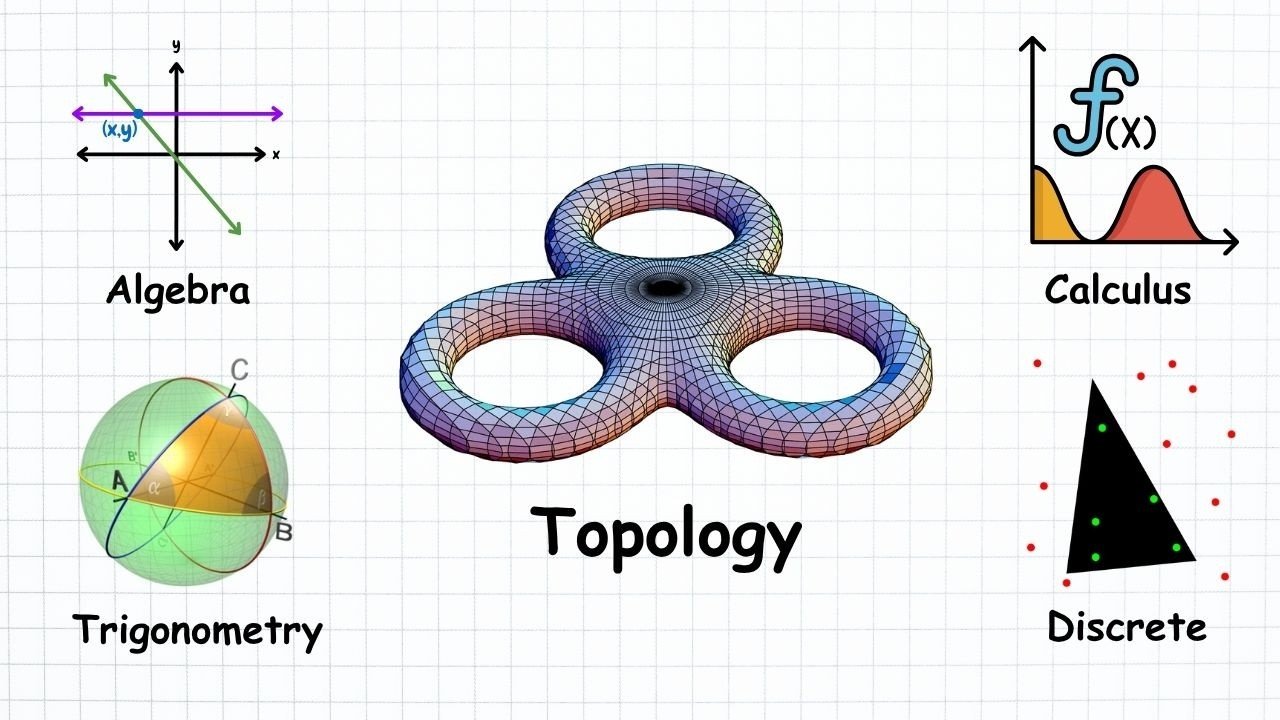
Topology studies the properties of spaces and figures that remain invariant under continuous deformations such as stretching, twisting, or bending, as long as there are no cuts or new attachments. Thus, a circle and an ellipse are topologically equivalent, whereas a circle and a figure with a hole are not.
At its core lies the concept of a topological space, which generalizes the notion of “closeness” without strictly depending on metric distances. From this arise notions such as compactness, connectivity, complete metric spaces, bases and subspaces, as well as topological products and quotients. It also addresses separation axioms, metrization theorems, and properties of special spaces such as Baire spaces or locally Euclidean manifolds.
Algebraic topology uses tools to identify and compare spaces according to their deeper shapes and connections, even when they are deformed without breaking. Differential topology studies surfaces and smooth spaces where concepts such as curvature apply, which are fundamental in physics and relativity. Geometric topology analyzes how to fit and represent objects and surfaces, even in dimensions beyond what we can visualize.
Discrete mathematics
Discrete mathematics studies structures whose values are separate and not continuous. Unlike mathematical analysis, which focuses on smooth variations, it deals with countable elements, whether finite or countably infinite, that can be modeled and manipulated exactly.
Among its pillars is mathematical logic, which formalizes reasoning and underpins the construction of proofs and algorithms. Graph theory describes systems through nodes and edges, with applications in transportation networks, telecommunications, and data analysis.
Discrete mathematics also encompasses discrete relations and functions, counting methods, the pigeonhole principle, recurrence relations for modeling iterative processes, and the study of automata and formal languages, which are essential in computation theory. Boolean logic and Boolean algebras underpin circuit design and the simplification of logical processes.
Discrete mathematics is the hidden language behind search engines, networks, logistical planning, and artificial intelligence systems, translating real-world problems into structures that computers can process.
Probability and statistics
Probability and statistics are key tools for understanding and managing uncertainty. Probability studies random phenomena and tells us how likely an event is to occur. For example, when rolling a die, the probability of getting an even number is the same as that of getting an odd number. From this idea arise notions such as the sample space, event independence, and Bayes’ theorem, which allows us to update our predictions with new information.
Statistics, in turn, deals with collecting and analyzing data to describe what is happening and anticipate what might occur. The descriptive part summarizes information with measures such as the mean or standard deviation, while the inferential part uses samples to estimate characteristics of an entire population and test hypotheses.
Financial mathematics
Financial mathematics applies mathematical tools to model, analyze, and solve problems related to investments, loans, amortizations, annuities, and asset valuation. Its purpose is to quantify the value of money over time and optimize economic decision-making.
Among its fundamentals are present value and future value
which relate current money to its equivalent at another point in time through interest rates, as in the compound interest formula:
Which calculates the accumulated amount after periods at a rate
.
As already noted, this field encompasses the study of simple and compound interest, commercial and rational discount, deposit and loan operations, as well as the capitalization and discounting of rents and annuities, including special cases such as perpetuities. It also develops methods for calculating the number of installments or the implicit rate in periodic payments and analyzes amortization systems that determine how debts are settled.
Mathematical logic
Mathematical logic studies the principles of formal reasoning, providing the rules to distinguish valid arguments from invalid ones and avoiding ambiguities through a precise symbolic language. It rests on two main pillars: propositional logic, which analyzes propositions and their combinations using logical connectives such as and, or, and not, and predicate logic, which introduces quantifiers such as for all, and there exists, essential for formulating and proving theorems.
This field ranges from systems that define logical rules and ways of reasoning to the study of how to decide whether a problem has a solution, and the most difficult problems to verify, known as NP-complete, passing through truth theories such as Tarski’s and the analysis of the validity and completeness of logical systems. It also connects with automata theory and Turing machines, which are mathematical models that simulate the functioning of a computer and allow the analysis of which problems can be solved through algorithms—fundamental for understanding the limits of computation and algorithmic complexity.
Leave a Reply