
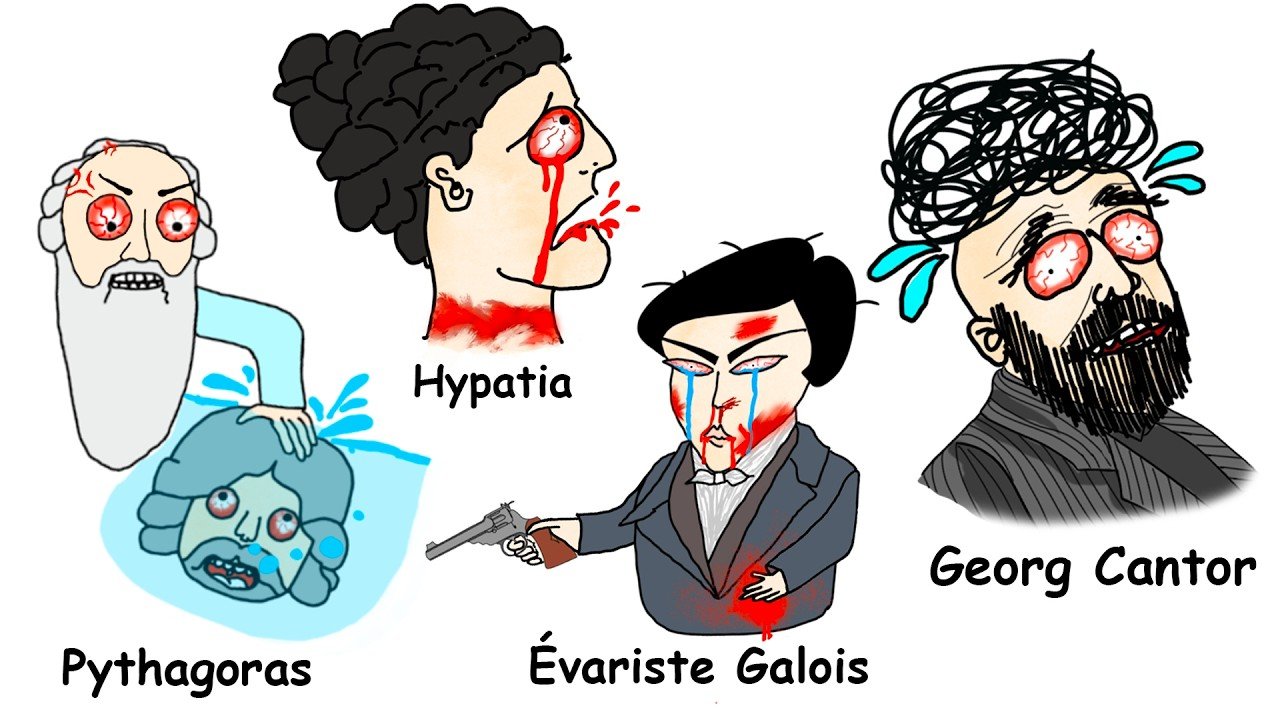
Math has its dark side and today we uncover some of the biggest scandals in mathematical history, including the burning of the Library of Alexandria, the tragic story of Alan Turing, and the Air Force Cheating Scandal. Watch Next:
https://www.youtube.com/watch?v=MY8kou989Ls
Playlists:
Timestamps:
0:00 Hypatia
0:50 Nobel Affair
1:30 Burning of the Library of Alexandria
2:15 MIT Card Counters
3:18 Air Force Cheating Scandal
4:17 Andre Bloch
5:02 P vs.
The Murder of Hypatia
Hypatia was a Greek female mathematician, astronomer, and philosopher who lived during a very turbulent era in Alexandria’s history. Reasonably detailed knowledge exists about her life and work. Her philosophy was Neoplatonist and was thus seen as pagan at a time of bitter religious conflict among Christians, Jews, and pagans. With the accession of Cyril to the bishopric of Alexandria, Hypatia became the victim of a particularly brutal murder at the hands of a gang of Christian zealots.
This made Hypatia a powerful feminist symbol and a figure of affirmation for intellectual endeavor in the face of ignorant prejudice. Her intellectual accomplishments alone were quite sufficient to merit the preservation and respect of her name, but sadly the manner of her death added even greater emphasis.
The Nobel Affair
There is no Nobel Prize for mathematicians. According to popular legend, Alfred Nobel’s wife had an affair with a mathematician who would have been a prime candidate for the prize. Enraged by this betrayal, Nobel supposedly excluded mathematics from his prestigious awards to prevent the mathematician from ever winning.
However, the twist in this story is that Nobel was never married, making the affair impossible. Despite the myth being debunked, its persistence continues to cast a mysterious shadow over the Nobel Prize’s history, making it a fascinating piece of mathematical lore.
The Burning of the Library of Alexandria
The Library of Alexandria, including the famous Great Library, faced multiple instances of destruction over centuries. The first significant damage occurred in 48 BC during Julius Caesar’s siege, when a fire set to the Egyptian fleet spread to the library, destroying numerous scrolls. In 391 AD, Theophilus, the patriarch of Alexandria, ordered the demolition of pagan temples, possibly affecting library collections. The final blow likely came in 642 AD when Arab forces captured Alexandria, leading to the loss of any remaining works. Each event contributed to the irreversible loss of vast amounts of knowledge, marking the decline of Alexandria as a major center of learning and scholarship.
The MIT Card Counters in Las Vegas
The MIT Blackjack Team, composed of students from MIT and Harvard, used sophisticated card-counting techniques to beat blackjack in casinos worldwide starting in 1979. Formed by J.P. Massar and later joined by Bill Kaplan, the team operated as a formal business with rigorous training and management procedures. By the 1990s, they were making regular trips to Las Vegas and winning big. According to casino security investigators, they took over $400,000 in one weekend.
The team developed a mathematical model and trained computers using data from games played to determine favorable situations. Their strategy included card counting, shuffle tracking, and ace tracking. New members underwent extensive training before participating. The team disbanded as casinos started kicking suspected players out, making it difficult for the team leaders to manage such a large group.
The Air Force Cheating Scandal
The US Air Force’s nuclear weapons corps faced a significant scandal when Secretary Deborah Lee James disclosed that nearly 20% of its intercontinental missile launch officers were involved in cheating on a proficiency test that included mathematics, computation, and coordination. Of the 500-member force, 92 individuals were found to have shared test answers or known about the cheating.
The revelation highlighted systemic issues within the nuclear force, which James described as causing undue stress and fear. The scandal emerged during an investigation into possible drug use among members of the corps, revealing broader challenges in maintaining integrity and discipline even in highly specialized fields. As a result of the scandal, the Air Force general who commanded the nuclear missile forces was fired. The Air Force responded by changing its grading system to pass/fail, aiming to reduce the pressure for perfection that could contribute to cheating.
André Bloch’s Murders
André Bloch is remembered in the mathematical community for Bloch’s theorem, the Bloch constant, and Bloch space. Despite his contributions, Bloch is infamous for committing a triple homicide in 1917, killing his brother Georges, his aunt, and his uncle while on leave from military service during World War I.
Bloch was institutionalized in the asylum at Charenton-Saint-Maurice, where he continued his mathematical career, corresponding with notable mathematicians. He justified the murders by stating that there were mentally ill people in his family and that “the destruction of the whole branch had to follow as a matter of course.” Bloch was transferred to Sainte-Anne Hospital in Paris in 1948 and died of leukemia later that year.
P versus NP
P versus NP is one of the most profound unsolved questions in computer science and mathematics. It asks if every problem for which a solution can be quickly verified (in polynomial time, NP) can also be solved quickly (in polynomial time, P). If P equals NP, it would revolutionize fields like cryptography, optimization, and algorithm design by allowing complex tasks, such as factoring large numbers or solving the traveling salesman problem, to be solved as efficiently as they are verified. Conversely, if P does not equal NP, it implies certain problems are inherently hard to solve, setting fundamental limits on efficient computation.
In August 2010, HP researcher Vinay Deolalikar claimed proof that P does not equal NP, sparking global interest, but many experts found flaws in his argument. Despite ongoing efforts to refine his proof, the question remains unsolved, with no definitive answer in sight and the $1 million prize for its resolution still unclaimed.
Alan Turing
Alan Turing was a pioneering mathematician and computer scientist who faced a scandalous prosecution in 1952 for engaging in homosexual acts, despite his pivotal role in wartime codebreaking. Turing’s admission to a relationship with another man led to a conviction for gross indecency. To avoid imprisonment, he underwent hormonal treatment, resulting in severe physical and emotional consequences. His security clearance was revoked, and in 1954, he took his own life.
In 2013, Turing received a posthumous royal pardon and apology from the British government, highlighting his profound legacy as a computing and AI pioneer and sparking ongoing discussions on justice and LGBTQ+ rights.
Newton and Leibniz’s Calculus Wars
One of the most bitter and prolonged disputes in the history of mathematics was the conflict between Newton and Leibniz, each claiming priority and accusing the other of plagiarism. Neither was willing to share the glory of making the greatest mathematical advancement in calculus, involving differentiation and integration principles, since ancient Greek days.
In partisan fashion, the British championed Newton while the Germans insisted Leibniz invented calculus. A Royal Society report, unsurprisingly favoring Newton, was overseen and largely written by Newton himself. This scandalous controversy not only damaged their reputations but also caused a rift in the mathematical community, inhibiting mathematical development in Britain for a century.
The Drowning of Hippasus
One of the most notorious examples of cover-up in mathematics involves the alleged murder of Hippasus of Metapontum. Pythagoras, in love with numbers and triangles, had quite a fierce reaction when confronted with the concept of irrational numbers by his student Hippasus. An irrational number, such as √2, defies representation as a simple fraction due to its infinite, non-repeating decimal expansion.
However, Pythagoras believed in the absoluteness of numbers and could not accept the existence of irrational numbers. He could not disprove their existence through logic, but his beliefs would not allow it. According to legend, Pythagoras and his followers, unable to reconcile this discovery with their belief in the purity of numbers, threw Hippasus overboard from a ship and drowned him.
Galois’s Duel and Death
The most famous duel in the history of mathematics, if not all of science, took place on the 30th of May, 1832. It ended with Évariste Galois, a French mathematician, being shot in the abdomen. He died the very next day at the age of 20.
Known for his significant contributions to mathematics, Galois developed what is now called Galois theory, which addresses the solvability of polynomial equations. Galois was also deeply involved in radical politics opposing the monarchy after Charles X’s coup in 1830. The reasons for the duel are ambiguous. Some suggest it was due to a personal dispute, possibly involving an unhappy love affair. Others believe Galois, frustrated by his lack of recognition in mathematics and disillusioned by his political struggles, staged the duel as a form of suicide, with stories describing him spending the night before the duel documenting his theories.
The Eudaemons
In the late 1970s, University of California physics students Doyne Farmer and Norman Packard formed a group called the Eudaemons. Driven by curiosity rather than wealth, they sought to beat roulette by scientific means. During the summer holidays, they bought a roulette wheel and used a camera and oscilloscope to study the wheel’s movement, eventually succeeding in creating a formula.
They built a small computer hidden in a boot with a solenoid mechanism signaled by vibration. After two years of refinement, they tested the device in Las Vegas in 1978, winning $10,000 despite technical issues such as burning holes in their skin. Despite their aversion to professional fraud, they proved that roulette could be beaten by calculating the ball’s trajectory.
Cardano versus Tartaglia
Niccolò Fontana Tartaglia, a self-taught mathematician, discovered a method for solving cubic equations and shared his findings with Gerolamo Cardano under the promise of secrecy. However, Cardano later published these solutions in his 1545 book Ars Magna, crediting Tartaglia, Scipione del Ferro, and Ludovico Ferrari, but igniting a fierce dispute over intellectual property.
This betrayal led to a bitter feud, with Tartaglia feeling his trust had been violated and his work stolen. Tartaglia agreed to debate Ferrari, but Ferrari had been studying cubic and quartic equations and had a more thorough understanding. Tartaglia left town that same night, leaving the contest unresolved, which effectively left the victory of the debate to Ferrari.
Cantor Driven to a Nervous Breakdown
Until the late 19th century, infinity was considered unattainable by mathematicians. Georg Cantor was the first to fully address this abstract concept by developing set theory, which led him to the surprising conclusion that infinities come in different sizes, and each infinite cardinal number is succeeded by an even greater one, continuing indefinitely.
The main detractor of Cantor was Leopold Kronecker, who constantly opposed his ideas and prevented him from getting a position at the University of Berlin. Kronecker argued that mathematics should be based on whole numbers and systematically rejected Cantor’s incipient new branch of mathematics. Kronecker’s attacks provoked nervous breakdowns that Cantor suffered periodically throughout his life. Cantor spent the end of his days in a psychiatric hospital in Halle, where he died. However, his set theory ended up becoming the common language used across the various branches of modern mathematics.
Newton versus Hooke
The conflict between Isaac Newton and Robert Hooke began in 1672 when Newton submitted his first paper on light to the Royal Society, where Hooke held significant influence. Newton’s discovery of the light spectrum and his particle theory of light contradicted Hooke’s wave theory, prompting Hooke to attack Newton and even threaten to have him removed from the Society. Hooke publicly accused Newton of plagiarism, leading Newton to withdraw from publishing.
In addition to their disagreements over optics, Hooke also proposed ideas about gravity which influenced Newton’s later work on the subject. Newton, in his Principia, gave little credit to Hooke for his contributions, particularly to the concept of gravity. Newton delayed the publication of the final book of the Principia until after Hooke died. In 1703, Newton became president of the Royal Society, and some argue he removed Hooke’s only portrait, ensuring his legacy was diminished.
L’Hôpital’s Rule
Plagiarism abounds in the sciences as well as the arts. In the late 17th century, a nobleman, the Marquis de L’Hôpital, was very fascinated by mathematics, particularly calculus. However, he lacked the skill to understand calculus well enough. But money can fix everything.
L’Hôpital knew about a bright mathematician, Johann Bernoulli, who had worked with Gottfried Leibniz in the development of calculus. So he hired Bernoulli as his mathematical consultant, helping him with any difficulties related to calculus while discussing new ideas with him before public disclosure. In return, L’Hôpital paid Bernoulli annually. Due to bad financial conditions, it was a good opportunity for Bernoulli to earn money while doing what he loved.
As a result of this agreement, L’Hôpital took credit for Bernoulli’s work, including the famous book on calculus, Analyse des Infiniment Petits, while cleverly adding a statement in the book: “I have made free use of their discoveries, so that I frankly return to them whatever they pleased to claim as their own.” One of the most important ideas from the book became known as L’Hôpital’s rule, a technique for evaluating limits when the limit yields the indeterminate form 0/0. L’Hôpital received all the recognition for the hard work of Bernoulli, who stayed unnoticed in the shadows.
This article was generated from the video transcript of “Every Dark Scandal in Math”.
Watch the full video above for visual explanations and diagrams.
Leave a Reply