
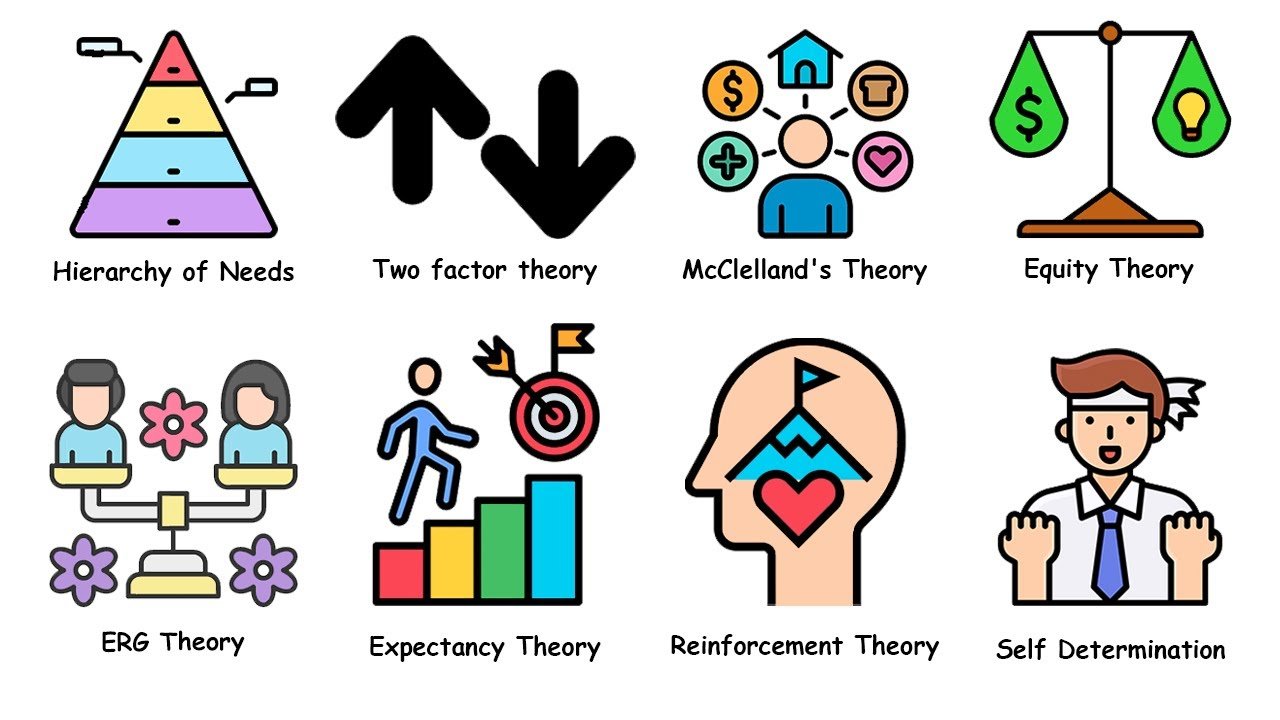
Some of the Most Popular Motivation Theories
From Maslow’s hierarchy of needs to Herzberg’s two-factor theory, these theories help explain what drives us to achieve our goals and how we can improve our motivation in different areas of life, including work and personal development.
Maslow’s Hierarchy of Needs
Maslow’s hierarchy of needs is like a pyramid where each level represents different things we need. At the bottom are the most basic needs like food and shelter, because without these it is hard to survive. Once we have those, we move up to safety. After that comes the need for love and belongingness, like having friends and family. At the top is self-actualization, which is about reaching our full potential. Maslow says we need to take care of the lower needs before we can focus on the higher ones, like climbing up a ladder step by step.
Herzberg’s Two-Factor Theory
This theory says that there are two kinds of things that affect how happy and motivated people are at work. The first set are the basics, like how much you get paid and whether your workplace is comfortable. These things do not necessarily make you happy, but if they are bad, they can make you really unhappy. The second set are the things that actually make you feel good about your job, like being praised for your work or feeling like you are achieving something. According to Herzberg, it is important for employers to focus on both kinds of factors to keep their employees happy and motivated.
McClelland’s Theory of Needs
McClelland’s theory of needs says that people have three main desires: achieving things, connecting with others, and being in control. Depending on who you are, you might care more about one of these desires than the others. For example, some people really want to succeed at things they do, while others care more about having good relationships, and some want to be in charge. It is all about what drives you and makes you feel fulfilled in life.
Expectancy Theory
Expectancy theory says that people are more likely to do something if they believe two things. First, that their efforts will lead to a good result. And second, that the result is something they really care about. So if you think you will succeed at something and it matters to you, you are more likely to try hard to make it happen.
Goal-Setting Theory
Developed by Edwin Locke and Gary Latham, this theory emphasizes the importance of setting specific and challenging goals for motivation. Imagine you are planning a road trip. Goal-setting theory is like having a road map for your life. You decide where you want to go, and those are your goals. These goals act as destinations on your journey.
When you have clear goals, it is like putting big signposts on the road. You know exactly where you are headed, and these goals give you a sense of purpose and direction. They motivate you to take action. So set specific and challenging goals, like learning 50 new words in a month or climbing a steep hill. When you see progress toward your goals, it feels great. It is like checking off places on your road trip map. Plus, knowing what you are aiming for keeps you focused and energized. So next time you are setting goals, think of them as exciting destinations on your life’s journey.
Self-Determination Theory
Self-determination theory, from Deci and Ryan, says that people have three basic needs built into them: feeling like they have control over their lives (autonomy), feeling capable and effective at what they do (competence), and feeling connected to others (relatedness). When these needs are met, it makes us want to do things just because we enjoy them, not because we are forced or rewarded. In simple terms, when we feel in control, capable, and connected, we are naturally motivated.
Equity Theory
Equity theory, by J. Stacy Adams, is like a fairness meter for how we feel about our rewards compared to the effort we put in and compared to others. Basically, it is about whether we think we are getting what we deserve. If we feel like we are being treated fairly, we are motivated to keep working. But if we see someone else getting more for less work, we might feel upset and less motivated. It is all about that sense of fairness and what we get for what we give.
Reinforcement Theory
Reinforcement theory, linked to B.F. Skinner, says that what we do is influenced by what happens after we do it. If something good follows our action, like a reward, we are more likely to do it again (positive reinforcement). If something bad stops or goes away because of our action, we are also more likely to do it again (negative reinforcement). But if something bad happens because of our action, we might stop doing it (punishment). Or if nothing happens at all, we might lose interest (extinction). It is basically about how our actions are shaped by what happens next.
ERG Theory
ERG theory, by Clayton Alderfer, simplifies Maslow’s idea into three main needs: existence (basic needs like food and shelter), relatedness (connection with others), and growth (personal development). Unlike Maslow’s ladder where you climb one step at a time, Alderfer says you can chase after these needs all at once. So you might be trying to satisfy your hunger while also seeking friendships and wanting to learn new things, all at the same time. It is like juggling different priorities in life instead of following a strict order.
Cognitive Evaluation Theory
Cognitive evaluation theory, from Richard Ryan and Edward Deci, explores how rewards and feedback from the outside influence how much we want to do something internally. If we feel like someone is making us do it, we might not enjoy it as much. But if we feel like we are choosing to do it ourselves, we are more likely to be excited about it. It is all about feeling like we are in control of what we do and how that makes us feel about doing it.
This article was generated from the video transcript of “Every Motivation Theory Explained in 4 minutes”.
Watch the full video above for visual explanations and diagrams.
Leave a Reply