
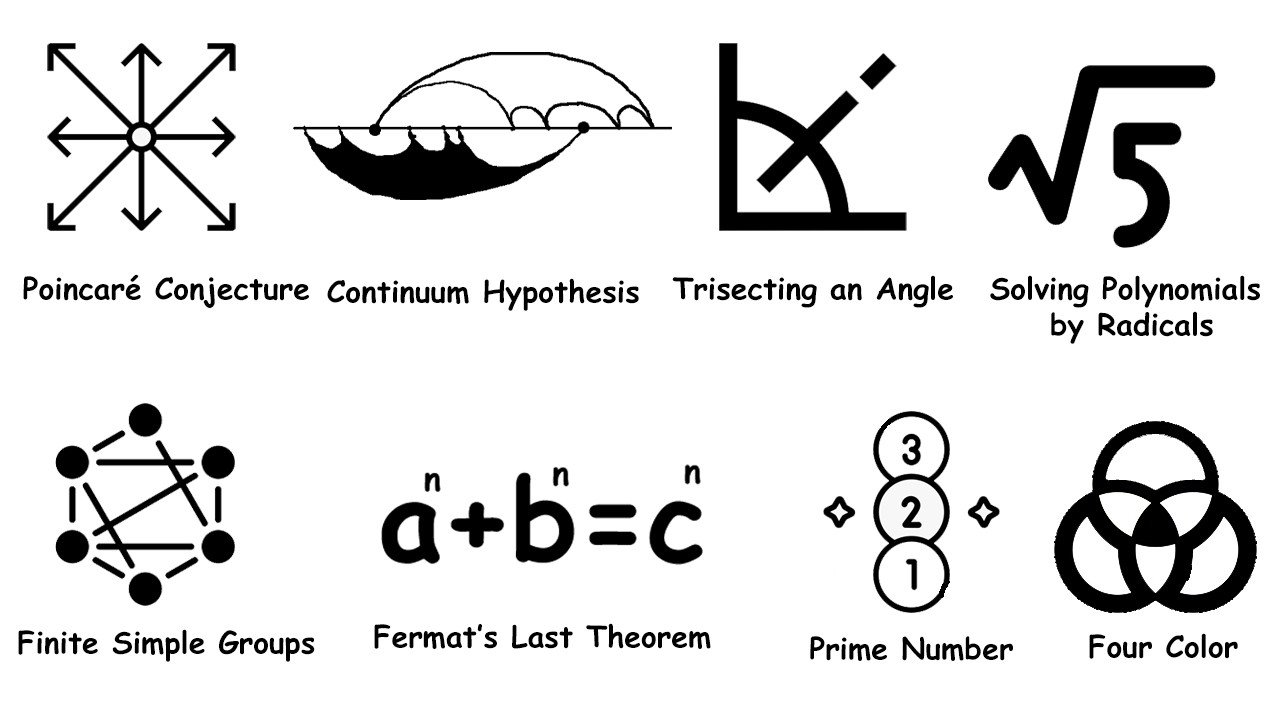
The Poincaré Conjecture
In 2000, the Clay Mathematics Institute, a nonprofit organization, offered a $1 million prize for solving each of seven important unsolved problems in mathematics. The Poincaré conjecture, posed by Henri Poincaré around 1900, was one of these problems.
Henri Poincaré was a famous French mathematician who lived around a hundred years ago. He studied a special kind of math called topology. Topology is all about shapes and how they can be changed. For example, you can stretch or twist a shape, but you can’t cut it or glue it together. Topologists want to find ways to tell different shapes apart, even if they look different but can be changed into each other.
When it comes to 3D shapes like a ball or a donut, it’s not too hard to figure out what they are. In a way, a ball is the simplest 3D shape of all. Poincaré wondered if the same thing is true for 4D shapes. He thought that maybe there is one 4D shape that is the simplest, just like how a ball is the simplest 3D shape. This idea ended up becoming known as the Poincaré conjecture.
About 100 years after Poincaré came up with his idea, a Russian mathematician named Grigori Perelman found a way to prove it. In 2003, Perelman posted his proof on a website called arXiv, which is where scientists share their work. Perelman’s proof was really important and groundbreaking, but it also had a few small problems that needed to be fixed. Perelman’s proof also used a lot of the work done by another mathematician, an American named Richard Hamilton.
Even though Perelman’s proof wasn’t perfect, it was still a huge deal. He had finally solved the Poincaré conjecture, which had been a mystery for a very long time. He proved it using the Ricci flow method developed by Richard Hamilton, who laid the foundations for using Ricci flow to attack the Poincaré conjecture. The Ricci flow is a set of partial differential equations that deform the manifold in a certain way. It usually deforms manifolds into round structures but can sometimes encounter singularities. To handle singularities, Perelman introduced Ricci flow with surgery, in which he manually removes the singular points and replaces them with smooth structures. Perelman’s proof showed that every simply connected closed three-dimensional manifold is homeomorphic to the three-sphere, proving the Poincaré conjecture.
After Perelman posted his proof, the math community spent a few years making sure his work was correct. Once they confirmed it was right, Perelman was offered some big prizes. The Clay Mathematics Institute said that they would give him $1 million since they had offered that much money to anyone who could solve the Poincaré conjecture. Perelman was also offered the Fields Medal, which is like the Nobel Prize for math. But Perelman didn’t want the prizes. He said he did his work because he loves math, not to win money or awards. Perelman also thought that Richard Hamilton should get some of the credit too, as Hamilton had done important work that helped Perelman solve the problem.
Trisecting an Angle
In ancient Greece, mathematicians were interested in constructing geometric shapes and lines using only a compass and a straight edge, which is pretty much a ruler without any markings. One thing they could do easily was to bisect, or cut in half, an angle. There’s a simple four-step process to do this using just a compass and a straight edge.
However, the ancient Greeks could not figure out how to trisect, or cut an angle into three equal parts. Despite many attempts over 15 centuries, no one could find a way to do this using only a compass and a straight edge.
It turns out that trisecting an angle is actually impossible to do with just those tools. This was proven in the 1800s by two French mathematicians. Évariste Galois developed a whole theory that explained the conditions under which geometric constructions are possible. Pierre Wantzel published the first proof that angle trisection is impossible a few years before most of Galois’s work became widely known. Their insights show that the inability to trisect an angle is related to the properties of certain mathematical equations. This closed off one of the oldest unsolved problems in mathematics.
The Classification of Finite Simple Groups
Algebra is a branch of math that has many real-world applications, from solving Rubik’s Cubes to analyzing fictional scenarios like body swapping on Futurama. One important concept in algebra is algebraic groups. These are sets of numbers or objects that follow certain basic rules, like having an identity element that works like adding zero. Groups can be finite, having a limited number of elements, or infinite.
Figuring out all the possible groups of a particular size n can get very complicated depending on the value of n. For small values of n like 2 or 3, there’s only one way the group can look. But when n reaches 4, there are two possibilities. Mathematicians wanted to make a complete list of all possible groups for any given size. This turned out to be an immense challenge that took decades to finish.
In 1972, a mathematician by the name of Daniel Gorenstein laid out a 16-step plan for proving the enormous theorem, the classification of all finite simple groups. This monumental mathematical project would take decades to complete. In 1981, Gorenstein declared the first version of the proof finished, but issues were later found with an 800-page section. This required further work to resolve. Recognizing the sprawling, disorganized nature of the full proof, which spanned over 15,000 pages, Gorenstein persuaded others like Richard Lyons to help revise and streamline it into a more accessible second-generation proof of around 3,000 to 4,000 pages. Gorenstein did not live to see the final piece of the revised proof put in place, as he passed away in 1992. But of course he remained very actively involved in the project until the very end, having three conversations about it the day before his death.
By the 1990s the proof was widely accepted. Since then there have been efforts to simplify and streamline this monumental mathematical achievement, and that work is still ongoing to this very day.
The Four Color Theorem
This one is as easy to state as it is hard to prove. Let’s say you want to color a map with different states using only four colors, following one rule: no two states that share a border can be the same color. It turns out that this is always possible, no matter how complicated the map is. This fact is called the four color theorem.
Proving this theorem was very difficult. In the 1800s, mathematicians showed you could do it with five colors, but getting it down to four colors took until 1976. Two mathematicians, Kenneth Appel and Wolfgang Haken, figured out a way to break the proof into a large number of specific cases, around 2,000. With the help of computers, they checked each one of these cases one by one. This was a new kind of proof that relied partly on computer calculations. Some mathematicians were unsure about it at first since part of the proof was done by a machine. But eventually most people accepted Appel and Haken’s proof. Using computers to help with proofs became more common after their work, and they were pioneers in this approach.
The Continuum Hypothesis
In the late 1800s, a mathematician named Georg Cantor made an amazing discovery about infinity. He showed that there are different sizes, or cardinalities, of infinity. Cantor proved that the set of real numbers is larger than the set of natural numbers. The size of the natural numbers (1, 2, 3, etc.) is a smallest infinite size. But is the size of the real numbers the next larger size of infinity? This question is known as the continuum hypothesis, also known as CH.
If CH is true, then the real numbers are the second infinite size, and there is nothing in between the natural numbers and the real numbers. If CH is false, then there are other infinite sizes in between the natural numbers and the real numbers.
So what’s the answer? It turns out that CH is neither true nor false. Mathematicians proved that CH is independent: it can be both true and false without causing any logical contradictions. This was shown in two parts. Kurt Gödel proved in 1938 that CH is consistent with the basic rules of math. Decades later, Paul Cohen proved that the opposite of CH is also consistent. This means CH is like the axiom of choice. It’s a statement that could be either true or false, and math works either way. It is a weird situation, but it is an important discovery in the world of infinity and set theory.
Fermat’s Last Theorem
Pierre de Fermat was a French mathematician who lived in the 1600s. He was a lawyer by profession but he loved math as a hobby. Fermat shared many of his mathematical ideas through casual letters to other mathematicians. He often made claims without proving them, leaving it to others to prove them later, sometimes even centuries later.
One of his most famous claims is called Fermat’s Last Theorem. It is simple to state. There are many sets of three whole numbers x, y, z that satisfy the equation x² + y² = z². These sets are called Pythagorean triples, like 3, 4, 5 and 5, 12, 13. Fermat claimed that there are no sets of three whole numbers x, y, z that satisfy the equation x³ + y³ = z³, or indeed xⁿ + yⁿ = zⁿ for any integer n greater than 2. And this is Fermat’s Last Theorem.
Fermat wrote his Last Theorem in the margin of a book along with a note saying he had a proof but it was too big to fit in the margin. For centuries, mathematicians wondered if Fermat really had a valid proof. In 1995, 330 years after Fermat’s death, British mathematician Sir Andrew Wiles finally proved Fermat’s Last Theorem. He proved it by showing it was a consequence of the Taniyama-Shimura conjecture. Wiles worked in secret for seven years, combining new techniques from algebraic geometry and number theory to try to prove the Taniyama-Shimura conjecture. After fixing a flaw in his original proof, he published the corrected proof in 1995. Since the Taniyama-Shimura conjecture implied Fermat’s Last Theorem, Wiles had finally solved a 300-year-old mathematical mystery.
The techniques he used, such as the theory of elliptic curves, were completely unknown in Fermat’s time, leading many to believe that Fermat did not actually have a proof of his Last Theorem. As a reward, Queen Elizabeth II knighted Wiles, and he received a special award instead of the Fields Medal because he was slightly too old to receive the Fields Medal.
Gödel’s Incompleteness Theorems
Gödel’s work in mathematical logic was totally next level. His incompleteness theorems show that there are always some true statements that cannot be proven within a given mathematical system.
The first incompleteness theorem says that in any mathematical system with a certain level of complexity, there will always be true statements that cannot be proven using the rules and axioms of that system. To understand this, consider the statement: “This statement cannot be proven true.” If the statement is false, then it can be proven true, which is a contradiction. The only logical possibility is that the statement is true but cannot be proven within the system.
Gödel’s second incompleteness theorem is equally mind-bending. It says that a mathematical system cannot prove its own consistency. That is, it can’t show that it will never produce any logical contradictions. Imagine two people, Amanda and Bob, each with their own set of mathematical axioms. If Amanda can use her axioms to prove that Bob’s system is free of contradictions, then Bob cannot use his own axioms to prove that Amanda’s system is inconsistent. This shows inherent limitations of any formal mathematical system.
These theorems reveal deep truths about the nature of mathematics and logic. They demonstrate that there will always be unprovable truths, and that mathematical systems have built-in limitations when it comes to proving their own reliability.
The Prime Number Theorem
Prime numbers are whole numbers greater than one that can only be divided evenly by one and themselves. One of the basic facts about prime numbers is that there are infinitely many of them. The prime number theorem goes a step further, describing how the prime numbers are distributed along the number line.
It states that the number of prime numbers less than or equal to a given number n is approximately equal to n divided by the natural logarithm of n. In other words, as n gets larger, the number of primes less than or equal to n is close to n/ln(n), where ln is the natural logarithm of n.
This theorem was independently proven in 1896 by two mathematicians, Jacques Hadamard and Charles de la Vallée Poussin. Their proofs built on earlier ideas about prime numbers. The prime number theorem is very useful in practice. It helps computer programs that work with prime numbers, and it is fundamental to methods for testing whether a number is prime, which is crucial for cryptography and security. While the theorem has been restated and simplified over the years, its importance in mathematics and computer science has only grown since it was first proven over 120 years ago.
Solving Polynomials by Radicals
You may remember learning the quadratic formula in high school math. This formula gives a solution to any quadratic equation of the form ax² + bx + c = 0. The formula is x = (−b ± √(b² − 4ac)) / 2a. This is a nice compact formula that allows you to find the solutions to any quadratic equation.
Mathematicians wondered if they could find similar compact formulas for solving higher-degree polynomial equations, like cubic equations or quartic equations. They were able to find such formulas for cubic and quartic equations, but the formulas got increasingly complex as the degree increased.
Then in the 1800s, a young French mathematician named Évariste Galois made a groundbreaking discovery. He proved that for polynomial equations of degree 5 or higher, it is impossible to find a general formula to solve them like the quadratic formula. Galois developed an entire mathematical theory, now called Galois theory, that explains the conditions under which a polynomial equation can be solved by radicals, that is, solved using a compact formula. He showed that this is possible for polynomials up to degree 4 but not for higher degrees. Galois’s work was not fully appreciated until after his early death at age 20. However, his ideas laid the foundation for a deep understanding of the limitations in solving higher-degree polynomial equations.
— Sources —
https://en.wikipedia.org/wiki/Poincar%C3%A9_conjecture
https://en.wikipedia.org/wiki/Angle_trisection
https://en.wikipedia.org/wiki/Classification_of_finite_simple_groups
https://en.wikipedia.org/wiki/Four_color_theorem
https://plato.stanford.edu/entries/continuum-hypothesis/
https://en.wikipedia.org/wiki/Continuum_hypothesis
https://en.wikipedia.org/wiki/Fermat%27s_Last_Theorem
https://plato.stanford.edu/Entries/goedel-incompleteness/
https://en.wikipedia.org/wiki/G%C3%B6del%27s_incompleteness_theorems
https://en.wikipedia.org/wiki/Prime_number_theorem
http://www.scienzamedia.uniroma2.it/~eal/Wiles-Fermat.pdf
https://mathigon.org/world/Axioms_and_Proof
Leave a Reply