
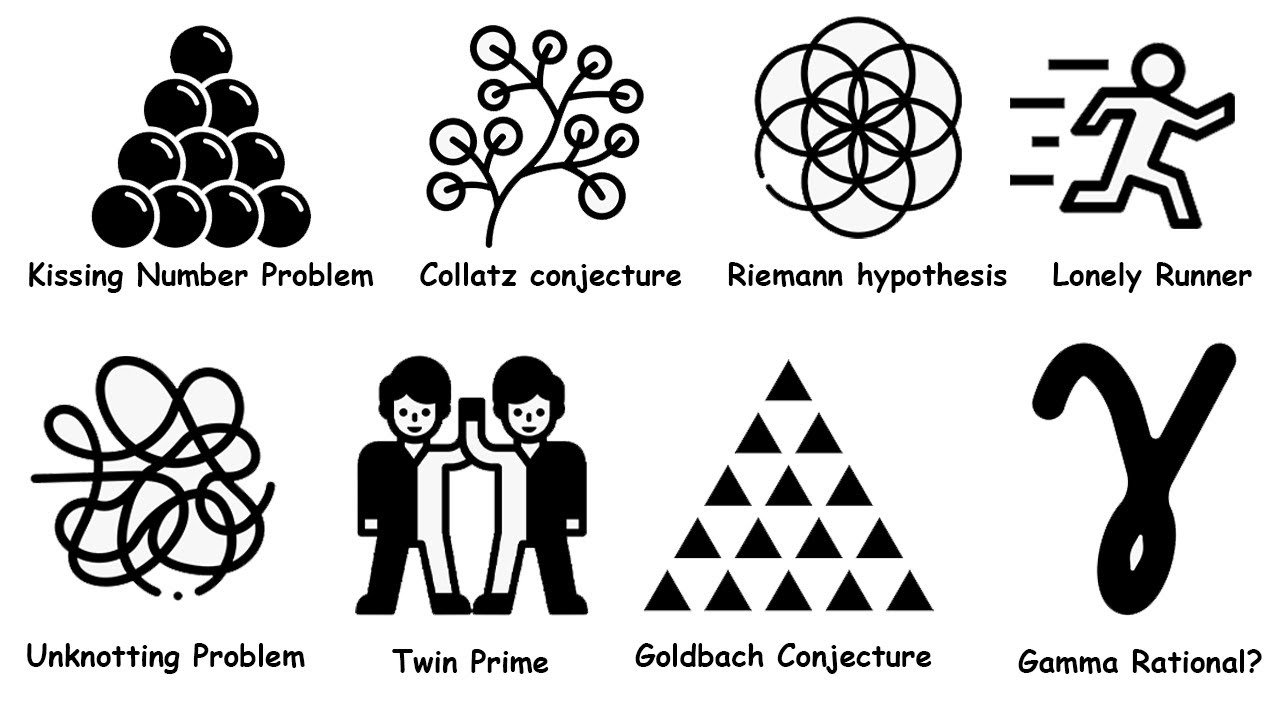
The Kissing Number Problem
A broad category of problems in math are called the sphere packing problems. They range from pure math to practical stuff like figuring out how to stack many spheres in a given space, like fruit at the grocery store. Some of these problems have solutions, but others, like the kissing number problem, are still tricky.
When a bunch of spheres are packed in some region, each sphere has a kissing number, which is the number of other spheres it’s touching. If you’re touching five neighboring spheres, then your kissing number is five. Nothing tricky. A packed bunch of spheres will have an average kissing number, which helps mathematically describe the situation. But a basic question about the kissing number stands unanswered.
A one-dimensional thing is a line and a two-dimensional thing is a plane. For these low numbers, mathematicians have proven the maximum possible kissing number for spheres of that many dimensions. It’s two when you’re on a 1D line, one sphere to your left and the other to your right. There’s proof of an exact number for three dimensions, although that took until the 1950s. Beyond three dimensions, the kissing problem is mostly unsolved. Mathematicians have slowly whittled the possibilities to fairly narrow ranges for up to 24 dimensions, with a few exactly known. For larger numbers, or a general form, the problem is wide open. There are several hurdles to a full solution, including computational limitations, so expect incremental progress on this problem for years to come.
The Goldbach Conjecture
One of the greatest unsolved mysteries in math is also very easy to write. Goldbach’s conjecture is: every even number greater than two is the sum of two primes. You can check this in your head for small numbers. 18 is 13 + 5, and 42 is 23 + 19. Computers have checked the conjecture for numbers up to enormous magnitude, but we need proof for all natural numbers.
Goldbach’s conjecture precipitated from letters in 1742 between German mathematician Christian Goldbach and legendary Swiss mathematician Leonhard Euler, considered one of the greatest in math history. As Euler put it, “I regard it as a completely certain theorem, although I cannot prove it.”
Euler may have sensed what makes this problem counterintuitively hard to solve. When you look at larger numbers, they have more ways of being written as sums of primes, not fewer. 3 + 5 is the only way to break 8 into two primes, but 42 can be broken into 5 + 37, 11 + 31, 13 + 29, and 19 + 23. So it feels like Goldbach’s conjecture is an understatement for very large numbers. Still, a proof of the conjecture for all numbers eludes mathematicians to this day. It stands as one of the oldest open questions in all of math.
The Collatz Conjecture
In September 2019, news broke regarding progress on this 82-year-old question thanks to genius mathematician Terence Tao. And while the story of Tao’s breakthrough is promising, the problem isn’t fully solved yet.
The Collatz conjecture is all about a function f(n) which takes even numbers and cuts them in half, while odd numbers get tripled and then added to one. Take any natural number, apply f, then apply f again and again, and you eventually land on one. For every number we’ve ever checked, this holds true. The conjecture is that this is true for all natural numbers, the positive integers from 1 through ∞.
Tao’s recent work is a near solution to the Collatz conjecture in some subtle ways, but he most likely can’t adapt his methods to yield a complete solution to the problem, as Tao subsequently explained. So we might be working on it for decades longer.
The conjecture lives in the math discipline known as dynamical systems, or the study of situations that change over time in semi-predictable ways. It looks like a simple, innocuous question, but that’s what makes it special. Why is such a basic question so hard to answer? It serves as a benchmark for our understanding. Once we solve it, we can proceed to much more complicated matters. The study of dynamical systems could become richer than anyone today could imagine, but we’ll need to solve the Collatz conjecture for the subject to flourish.
The Twin Prime Conjecture
Together with Goldbach, the twin prime conjecture is the most famous in number theory, or the study of natural numbers and their properties, frequently involving prime numbers. Since you’ve known these numbers since grade school, stating the conjectures is easy.
When two primes have a difference of two, they’re called twin primes. So 11 and 13 are twin primes, as are 599 and 601. Now it’s a day-one number theory fact that there are infinitely many prime numbers. So are there infinitely many twin primes? The twin prime conjecture says yes.
Let’s go a bit deeper. The first in a pair of twin primes is, with one exception, always one less than a multiple of six, and so the second twin prime is always one more than a multiple of six. You can understand why if you’re ready to follow a bit of number theory. All primes after two are odd. Even numbers are always zero, two, or four more than a multiple of six, while odd numbers are always one, three, or five more than a multiple of six. Well, one of those three possibilities for odd numbers causes an issue. If a number is three more than a multiple of six, then it has a factor of three. Having a factor of three means a number isn’t prime, with the sole exception of three itself. And that’s why every third odd number can’t be prime.
Now imagine the headaches of everyone who has tried to solve this problem in the last 170 years. We’ve made some promising progress in the last decade. Mathematicians have managed to tackle closer and closer versions of the twin prime conjecture. Their idea: trouble proving there are infinitely many primes with a difference of two? How about proving there are infinitely many primes with a difference of 70 million? That was cleverly proven in 2013 by Yitang Zhang at the University of New Hampshire. In the years since, mathematicians have been improving that number in Zhang’s proof from millions down to hundreds. Taking it down all the way to two will be the solution to the twin prime conjecture. The closest we’ve come, given some subtle technical assumptions, is 6. Time will tell if the last step from 6 to 2 is right around the corner, or if that last part will challenge mathematicians for decades longer.
The Unknotting Problem
The simplest version of the unknotting problem has been solved, so there’s already some success with this story. Solving the full version of the problem will be an even bigger triumph.
You probably haven’t heard of the math subject knot theory. It’s taught in virtually no high schools and few colleges. The idea is to try and apply formal math ideas like proofs to knots, like what you tie your shoes with. For example, you might know how to tie a square knot and a granny knot. They have the same steps except that one twist is reversed from the square knot to the granny knot. But can you prove that those knots are different? Well, knot theorists can.
Knot theorists’ Holy Grail problem was an algorithm to identify if some tangled mess is truly knotted or if it can be disentangled to nothing. The good news is that this has been accomplished. Several computer algorithms for this have been written in the last 20 years, and some of them even animate the process.
But the unknotting problem remains computational. In technical terms, it’s known that the unknotting problem is in NP, while we don’t know if it’s in P. That roughly means we know our algorithms are capable of unknotting knots of any complexity, but that as they get more complicated, it starts to take an impossibly long time. For now, if someone comes up with an algorithm that can unknot any knot in what’s called polynomial time, that will put the unknotting problem fully to rest. On the flip side, someone could prove that isn’t possible and that the unknotting problem’s computational intensity is unavoidably profound. Eventually, we’ll find out.
The Enigma of π + e
Given everything we know about two of math’s most famous constants, π and e, it’s a bit surprising how lost we are when they’re added together. This mystery is all about algebraic real numbers.
The definition: a real number is algebraic if it’s the root of some polynomial with integer coefficients. For example, x² − 6 is a polynomial with integer coefficients since 1 and −6 are integers. The roots of x² − 6 = 0 are x = √6 and x = −√6, so that means √6 and −√6 are algebraic numbers. All rational numbers and roots of rational numbers are algebraic, so it might feel like most real numbers are algebraic. Turns out it’s actually the opposite. The antonym to algebraic is transcendental, and it turns out almost all real numbers are transcendental, for certain mathematical meanings of “almost all.”
So who’s algebraic and who’s transcendental? The real number π goes back to ancient math, while the number e has been around since the 17th century. You’ve probably heard of both, and you’d think we know the answer to every basic question to be asked about them. We do know that both π and e are transcendental. But somehow it’s unknown whether π + e is algebraic or transcendental. Similarly, we don’t know about π × e, π/e, and other simple combinations of them. So there are incredibly basic questions about numbers we’ve known for millennia that still remain mysterious.
The Birch and Swinnerton-Dyer Conjecture
The Birch and Swinnerton-Dyer conjecture is another of the six unsolved Millennium Prize problems, and it’s the only other one we can remotely describe in plain English.
This conjecture involves the math topic known as elliptic curves. In a nutshell, an elliptic curve is a special kind of function. They take the unthreatening-looking form y² = x³ + ax + b. It turns out functions like this have certain properties that cast insight into math topics like algebra and number theory. British mathematicians Bryan Birch and Peter Swinnerton-Dyer developed their conjecture in the 1960s. Its exact statement is very technical and has evolved over the years. One of the mathematicians who has worked on refining and understanding this conjecture is Andrew Wiles, who’s famous for proving Fermat’s Last Theorem.
The Riemann Hypothesis
Today’s mathematicians would probably agree that the Riemann hypothesis is the most significant open problem in all of math. It’s one of the seven Millennium Prize problems, with a $1 million reward for its solution. It has implications deep into various branches of math, but it’s also simple enough that we can explain the basic idea here.
There is a function called the Riemann zeta function. For each s, this function gives an infinite sum which takes some basic calculus to approach for even the simplest values of s. For example, if s = 2, then ζ(s) is a well-known series which strangely adds up to exactly π²/6. When s is a complex number, one that looks like a + bi using the imaginary number i, finding ζ(s) gets tricky. So tricky, in fact, that it’s become the ultimate math question.
Specifically, the Riemann hypothesis is about when ζ(s) = 0. The official statement: every non-trivial zero of the Riemann zeta function has real part 1/2. On the plane of complex numbers, this means the function has a certain behavior along a special vertical line. The hypothesis is that the behavior continues along that line infinitely.
The hypothesis and the zeta function come from German mathematician Bernhard Riemann, who described them in 1859. Riemann developed them while studying prime numbers and their distribution. Our understanding of prime numbers has flourished in the 160-plus years since, and Riemann would never have imagined the power of supercomputers. But lacking a solution to the Riemann hypothesis is a major setback. If the Riemann hypothesis were solved tomorrow, it would unlock an avalanche of further progress. It would be huge news throughout the subjects of number theory and analysis. Until then, the Riemann hypothesis remains one of the largest dams to the river of math research.
The Lonely Runner Conjecture
Assume there are some kids running around a circular track. Each kid runs at a different speed. Now, if a kid gets far enough away from all the other kids, we say that kid is lonely. The lonely runner conjecture says that every kid running will become lonely at some point.
If there’s only one kid running, it’s easy because they’re always lonely since no one else is there. With two kids it’s also simple. We just watch how fast they run. By pretending one kid is standing still, we can see when the other kid gets lonely. For 3, 4, 5, 6, and 7 kids, smart people have already figured out that each kid will become lonely at some point. But for more than seven kids, we’re still not sure. There have been some guesses and ideas, like looking at really big groups of kids running at different speeds, but the problem hasn’t been completely solved yet.
Is γ Rational?
This is another easy-to-write problem but hard to solve. All you need to recall is the definition of rational numbers. Rational numbers can be written in the form p/q where p and q are integers. So 42 and 1/3 are rational, while π and √2 are not. It’s a very basic property, so you’d think we can easily tell when a number is rational or not.
Meet the Euler-Mascheroni constant. It’s a real number, approximately 0.5772, with a closed form that’s not terribly ugly. The sleek way of putting words to those symbols: γ is the limit of the difference of the harmonic series and the natural log. So it’s a combination of two very well-understood mathematical objects. It has other neat closed forms and appears in hundreds of formulas. But somehow we don’t even know if γ is rational. People have calculated it to half a trillion digits, yet nobody can prove if it’s rational or not. The popular prediction is that γ is irrational. Along with our previous example of π + e, we have another question of a simple property for a well-known number, and we can’t even answer it.
Leave a Reply