
Notable Conjectures and Unsolved Problems in Mathematics
Casas-Alvero Conjecture
If an integer k can be expressed as the product of two integers m and n, then m and n are called factors of k. A common factor of two integers is a factor shared by two integers. For instance, 4 and 6 have a common factor of 2. Similarly, if a polynomial f can be expressed as the product of two polynomials g and h, then g and h are called factors of f. The polynomials x² + x and 2x + 2 have a common factor of (x + 1), since they can respectively be expressed as x(x + 1) and 2(x + 1), where x, 2, and (x + 1) are each polynomials on their own.
Now consider the single-variable polynomial function f(x) = x³ + 3x² + 3x + 1. This can actually be expressed as the third power of a polynomial of degree 1: f(x) = (x + 1)³. A polynomial of degree 1 is called a linear polynomial. Some might call this a line instead, but this is just a difference in terminology.
Let’s take the derivative of our function. This can be factored into 3(x + 1)², showing that it shares a common factor of (x + 1) with f(x). Now take the second derivative of the original function. This factors into 6(x + 1), again sharing a common factor with f(x). Alternatively, you could have simply left the original function expressed as f(x) = (x + 1)³ and taken derivatives using the power and chain rules, which would have easily yielded the same result.
Now the original function was of degree 3, and we’ve taken derivatives up to the second order, which is one less than three. Therefore, we can stop here. As we have seen, both of the derivatives share a common factor with the original function, and the original function can be expressed as a power of a linear polynomial.
The Casas-Alvero conjecture, proposed by Spanish mathematician Eduardo Casas-Alvero in 2001, is the hypothesis that whenever a polynomial f of degree d shares a common factor with all of its derivatives up to order d − 1, then f must be a power of a linear polynomial. The polynomials do not necessarily have to represent real numbers. They can represent the elements of any field of characteristic zero, of which the real numbers are an example.
Riemann Hypothesis
Take the sum 1/1s + 1/2s + 1/3s and so on toward infinity, where s is a complex number. An infinite sum like this is called a series. If the real part of s (the a in a + bi) is greater than one, then this series converges, meaning that adding more and more terms makes it approach a specific finite value. We define the series to be equal to that value.
This series is how the Riemann zeta function, named after German mathematician Bernhard Riemann, is defined for complex numbers with real part greater than one. On the rest of the complex plane, the Riemann zeta function is defined by filling in the gaps in a way where the function always has a derivative at every point where it’s defined. The complex derivative is defined similarly to the real derivative, just with everything being complex numbers. This method of extending a function is called analytic continuation using the portion we already have. There is exactly one way to do this, so we are locked into one specific definition for the function, even if the definition is very implicit. This defines the function for every complex number except s = 1.
Despite the relatively simple definition of this function, much remains unknown about it. In particular, one conjecture (a math term for “guess”) concerns the function’s zeros: the inputs where the function outputs a value of zero. Every negative even integer falls into this category, being called a trivial zero. Besides that, we know all other zeros have real parts between zero and one, occupying a region of the complex plane called the critical strip. The complex numbers with real part 1/2 compose a line called the critical line.
Riemann conjectured that all non-trivial zeros of the zeta function have real part one-half, lying on the critical line. Indeed, this is true of every non-trivial zero we’ve found so far. This conjecture is known as the Riemann hypothesis, and proving or disproving it would have big implications in many areas of math, but no one has managed. It is the sixth of the Millennium Prize Problems, a set of problems with million-dollar prizes attached.
Navier–Stokes Existence and Smoothness
Consider the equation f′(x) = f(x). This states that the function f is its own derivative. An equation relating a function and its derivatives like this is called a differential equation. A differential equation can be solved. Instead of solving for a specific value, we are solving for the function f. Here, the solution is f(x) = cex for some constant c, as that captures every possible defined-everywhere function which is its own derivative. Since the equation uses a single-variable function, it is called an ordinary differential equation, or ODE.
In contrast, multivariable calculus sees the use of multivariable functions like f(x, y) = x² + xy + y. You plug in two numbers x and y, and the expression on the right gives you a number in return. This concept gives rise to the partial derivative: a derivative with respect to one variable that treats the other variables as constants. An equation relating the partial derivatives of a multivariable function is called a partial differential equation, or PDE.
The Navier–Stokes equations are PDEs that characterize how viscous fluids move. They are named after Claude-Louis Navier and George Gabriel Stokes—the former a French engineer, the latter an Irish mathematician. Both were physicists.
The Navier–Stokes existence and smoothness problem, which is the fourth Millennium Prize Problem, asks the following: Suppose you have an initial velocity field in 3D space determining which way and how fast the particles in a fluid flow at the starting time. You need to prove that you can provide a vector velocity and a scalar pressure field, both smooth and defined everywhere, that solve the Navier–Stokes equations—or you need to provide an example of a case where this is impossible.
The Navier–Stokes equations are a promising lead in terms of the concept of turbulence. Anyone who’s taken enough plane rides is probably familiar with turbulence. It’s when a fluid (as in a liquid or gas) rapidly undergoes chaotic changes. But it is one of physics’ biggest unsolved problems. Physicists believe that if we can understand the Navier–Stokes equations better, we will be able to understand turbulence better as a result.
Jacobian Conjecture
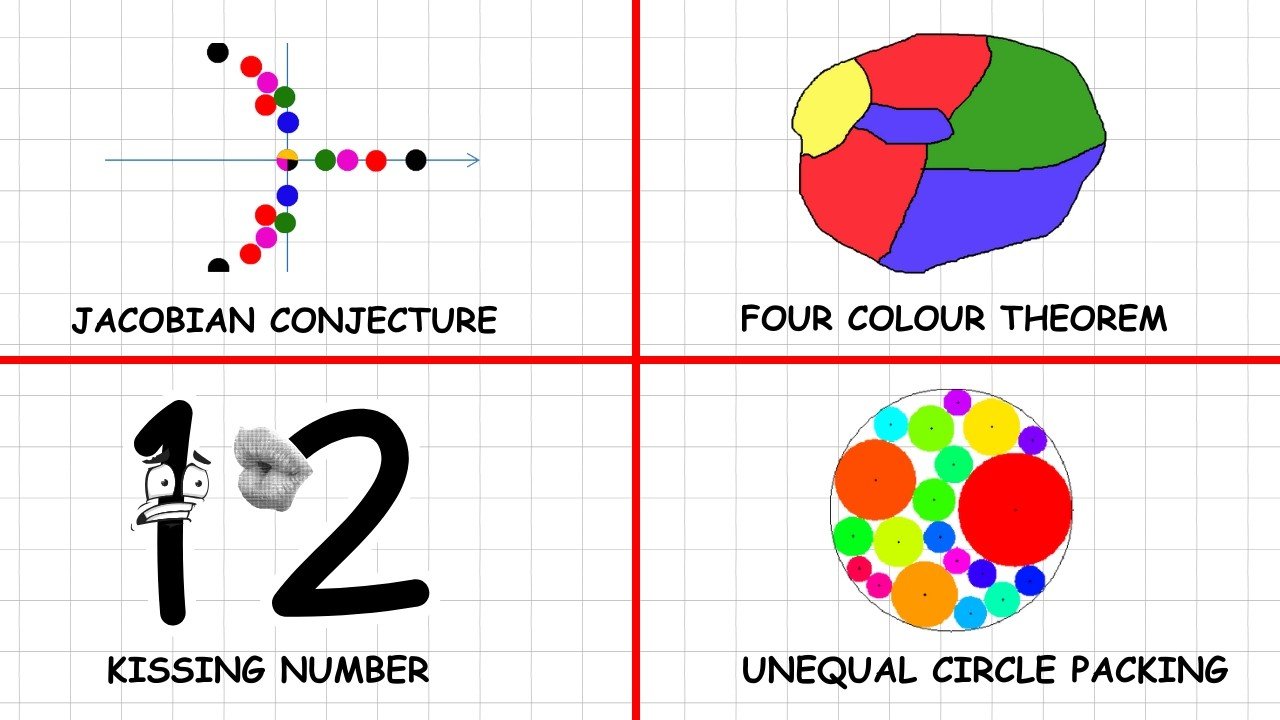
In multivariable calculus, a function can take in a vector and give you a vector in response. For instance, you can have the function f(x, y) = (2y, 3x). Evaluating this function on the vector (1, 2), you get f(1, 2) = (2 × 2, 3 × 1) = (4, 3). So the vector (1, 2) gets mapped to (4, 3). Here the first part of the output, f₁ = 2y, is called the function’s first component, and the second part, f₂ = 3x, is called the second component.
When you have a function like this, you can construct its Jacobian matrix. This is a matrix full of each of the partial derivatives of each of the components of f. Since our input and output have the same number of dimensions, the matrix we get is a square matrix. This means that we can take its determinant, called the Jacobian determinant, denoted Jf. The Jacobian matrix and determinant are named after German mathematician Carl Gustav Jacob Jacobi. They allow us to apply linear algebra concepts to transformations of space that look locally linear in a small neighborhood of each point.
The other concept needed is that of a field, which is a set equipped with the normal arithmetic operations with similar behavior as in the real numbers. A field has an additive identity and a multiplicative identity. Adding the additive identity doesn’t change an element, nor does multiplying by the multiplicative identity. These are zero and one in the real numbers, respectively. If the additive identity can’t be obtained by adding together a positive number of copies of the multiplicative identity, the field is said to have characteristic zero. You can’t add a positive number of ones to get zero, so the real numbers have characteristic zero.
Now let k be a field of characteristic zero, and let f be a function from kn to itself for fixed integer n greater than 1. For example, k could be the real numbers and n could be 2. Then f would map from ℝ² to itself, where ℝ² is the usual 2D vector space. If Jf is some constant nonzero value, then f has an inverse function g with polynomial components.
To use our earlier example: we found that the Jacobian determinant of our function was −6, which is indeed a constant and also not zero. Can we find an inverse g that maps the output back to the input? Solving yields a definition of g where both 1/3 y and 1/2 x are indeed polynomials, so g does have polynomial components. If you can either prove or disprove that this will always happen, you will have solved the Jacobian conjecture.
Erdős–Oler Conjecture
A unit circle is a circle whose radius (the distance from the center to the edge) is one. An equilateral triangle is a triangle where all the side lengths are the same. Suppose you have a certain number n of unit circles, where n is at least one, and you want to pack them into an equilateral triangle with no overlap. For each n, what is the smallest possible triangle side length s? This is an example of a packing problem.
Of course, packing problems are notorious for producing a lot of unsolved examples, but we can work out some specific cases. For instance, starting with n = 1, the side length of our triangle is 2√3, about 3.464. Then n = 2 gives a side length of 2 + 2√3, about 5.464. Interestingly enough, n = 3 actually gives the same side length of 2 + 2√3. Solutions are known all the way up to n = 12.
And for all triangular numbers: a triangular number is a number obtained by taking the sum 1 + 2 + 3 and so on up to n, where n is a non-negative integer. If n equals 0, then the result is equivalent to adding together no numbers (known as the empty sum), which is zero. The first few triangular numbers are 0, 1, 3, 6, and 10. If you have a triangular number of objects, then they can be packed together into the shape of an equilateral triangle. This method can be used to obtain a circle packing in an equilateral triangle for all triangular numbers n.
The Erdős–Oler conjecture, named after Hungarian mathematician Paul Erdős and Canadian mathematician Norman Oler, states as follows: if you have a triangular number n of unit circles, then the optimal bounding triangle for n and n − 1 is the same. In other words, given an optimal packing of n circles in an equilateral triangle, you can always remove a circle and still have the packing be optimal. This conjecture seems to make intuitive sense, but it has not been proven.
Gauss Circle Problem
A point in space can be described by a coordinate list. For instance, in two dimensions, we can use the coordinate pair (x, y). Now, suppose that all of the coordinates you have are integers. If you plot all possible points you can reach under this restriction in a given Euclidean space, then the result is called a lattice, composed of lattice points. In 2D, using a Cartesian coordinate system, you can draw a lattice by just filling in all the points where the integer-valued grid lines intersect.
Now imagine you have a circle of radius r centered at the origin in 2D. This circle will enclose a certain number of lattice points depending on its radius. The Gauss circle problem asks how many lattice points are enclosed for a given radius. This problem is named after German mathematician, astronomer, geodesist, and physicist Carl Friedrich Gauss, who was the first person to make progress on a solution to it.
For a given radius r, let’s call the number of enclosed lattice points N(r). This number can be approximated by the area enclosed by the circle, which is given by A = πr². For instance, a radius of 5 yields an enclosed area of about 78.54, whereas the number of enclosed lattice points is 81. In other words, N(5) = 81. This approximation gets better and better for larger values of r.
We can express this approximation by adding an error term. An error term is an expression added on in order to account for the difference between an approximation and the true value. Here, the equation is N(r) = πr² + E(r). Therefore, the problem now takes the form of finding an upper bound for E(r), where progress continues to this day. Similar problems can be asked of shapes other than circles, such as conic sections or spheres in three-dimensional space.
Kissing Number Problem
Suppose you have a unit circle and you want to have a bunch of other unit circles touch it without any overlap between the interiors. How many can you fit? This number is known as the kissing number. The problem is a special case of a problem known as the kissing number problem, which remains unsolved in general. However, in the two-dimensional case, the answer is six.
We can also consider the problem in higher and lower dimensions. The generalization of a circle is the set of points in a given space that is a certain distance (the radius) away from a given center point. In one-dimensional space, this is simply a pair of points, each of them a distance of one from a point in the middle. The kissing number in one dimension is two. Meanwhile, in three dimensions, we have spheres of radius 1, known as unit spheres. The kissing number in dimension 3 is 12.
For a while, it was unknown whether this was the case. English polymath Isaac Newton and Scottish mathematician and astronomer David Gregory famously disagreed on the subject in the late 1600s. Newton thought the answer was 12, whereas Gregory thought it was 13. Indeed, it may appear as if a 13th sphere can fit, given that there appears to be a lot of extra space in the configuration for 12 kissing spheres. A convincing proof would not arrive until 1953, over 200 years after Newton’s death, but Newton was finally crowned the winner of the debate.
After three dimensions, we can keep going into higher dimensions. The kissing number in four dimensions is 24. However, the unsolved dimensions begin with dimension 5. A lower bound of 40 and an upper bound of 44 are known, but no exact solution is apparent. Dimensions 6 and 7 are also unsolved, but dimension 8 has a solution of 240. The next known solution comes in dimension 24 with a whopping 196,560. No solutions are known beyond this point.
Unequal Circle Packing
Previously, we examined the case of packing circles of only one given size. Technically, if the interior region is included, it is called a disk. However, problems exist in the form of packings of non-congruent disks as well. If a packing system permits disks of two different sizes, then it is known as a binary system. The question then becomes: what is the optimal packing density in a binary system?
Let’s start with the ratio between the radius of the smaller disk and the radius of the larger disk. Certain values of this ratio allow for a compact packing, wherein if two disks are touching, then they also mutually touch two other disks. In all, there are nine such ratios allowing for a compact packing. All nine of these allow for a denser packing than the standard uniform packing, which involves just a single disk size. Additionally, some non-compact packings involve a higher packing density as well. However, for packing densities in binary systems with size ratios of less than about 0.742, only upper bounds are known, not exact solutions.
Sendov’s Conjecture
Suppose you take the graph of a polynomial function in the real numbers. The roots of a polynomial are the points where the polynomial’s value becomes zero. For instance, if you have f(x) = x³ − 3x, its roots are x = 0 and x = ±√3. Meanwhile, a point where the function flattens out is known as a critical point. For instance, if you have f(x) = x³ − 3x, the function flattens out at x = 1 and x = −1. From a calculus perspective, this is because the derivative of the function at that point, representing the function’s rate of change, is zero. Since the function’s value can be thought of as stationary there, such a point is called a stationary point.
We can extend this idea to complex numbers, though it’s harder to use graphs to visualize it. The derivative of a complex function is defined similarly. For complex numbers z where this becomes zero, we call those critical points. A unit disk is the region enclosed by a unit circle. The unit disk is called closed if it includes its bounding circle, and open otherwise. In the complex plane, the closed unit disk centered at the origin is the set of complex numbers z satisfying |z| ≤ 1, where the absolute value of a complex number is its distance from zero.
Now imagine a polynomial function in the complex numbers of degree n ≥ 2. Suppose that all of its roots are contained within the unit disk centered at the origin. Sendov’s conjecture, named after Bulgarian mathematician, diplomat, and politician Blagovest Sendov, states that all of the roots must be a distance of no more than one from a critical point of the function.
A few things are known about this conjecture. For instance, the Gauss–Lucas theorem guarantees that if the function’s roots are inside the unit disk, then the critical points must also be. As for proofs of the conjecture itself, mathematicians Brown and Xiang published a 1999 proof for n < 9, whereas Terence Tao published a proof for sufficiently large n in 2020, essentially meaning that starting at a certain positive integer, the conjecture is true for all values of n greater than or equal to it, whatever that integer happens to be.
Tripod Packing
Let’s start with a cube existing at some fixed location in 3D space. Interestingly enough, this problem can be easier to comprehend if you think of the cubes as Minecraft blocks, which you can do if you prefer. If you join a bunch of congruent cubes face to face, the resulting structure is known as a polycube. A polycube can also be infinite if it extends forever in at least one direction.
Now, let’s build a special type of polycube. Start with one cube called the apex. Now build a long straight string of cubes from the right of the apex. Do the same thing from the top of the apex and from the front of the apex. Imagine these strings of cubes extending forever off to infinity. This polycube is called a tripod, named for its resemblance to a camera tripod. For our purposes, the legs of each tripod will always face the directions considered positive: rightward, forward, and upward.
Now suppose we have a 3×3×3 cubic region of space, like a Rubik’s Cube. We want to pack this region with the apexes of tripods. The rule is that no two tripods can cross through each other, and we have to fit as many apexes as we can. How many can we fit? This is an instance of the tripod packing problem, one of the many packing problems in geometry. Assuming you don’t want to try building this in Minecraft yourself and just want the answer: it’s five apexes.
If we consider larger cubes of side length n, the answer is known up to n = 14, where 55 tripod apexes can be packed into a 14×14×14 cube. However, the problem remains unsolved for larger cubic regions. In particular, we do not know of an algorithm that can let us know the answer for every given side length. However, lower and upper bounds have been produced using big-omega notation.
Thomson Problem
Let’s say you’re stranded on a perfectly spherical planet with two other people, but all of you really hate each other. So you agree to get as far apart on the surface of the planet as possible. You want to have an optimal arrangement: the higher the minimum distance between any two given people, the better. So, what is the best arrangement for the three of you to take?
This is a special case of the Thomson problem, named after Dutch botanist Pieter Merkus Lambertus Thomson. In fact, it’s one of the few mathematical problems not actually named after a mathematician. It was posed in 1930 based on the pores found on grains of pollen. Of course, you can also consider this problem involving any number of points on the sphere you want, which we will call n. The problem is solved for all n from 3 through 14, as well as n = 24. Guesses for other solutions and solutions in higher dimensions have been proposed. The general case remains unsolved.
The problem can also be reframed in terms of a packing problem: what is the optimal packing of a given number of circles on a sphere? Alternatively, it can be viewed from the perspective of electrons arranged on a sphere, where the goal is to minimize the Coulomb force between the electrons—that being the force between particles at rest due to electric charge. Besides those previously mentioned, one practical application comes in the form of spherical codes, whose surfaces are arranged as approximate solutions to the problem.
Levi–Hadwiger Conjecture
A dilation is a type of transformation determined by a center of dilation and a ratio or scale factor. When a shape is dilated, each point on the shape has its distance from the center of dilation scaled by the scale factor, while either preserving or reversing the relative direction. This can be thought of in terms of vectors (which are basically arrows with direction and magnitude). If the position of each point within the shape is represented by a vector from the center of dilation to that point, then the dilation has the effect of scaling each vector by the scale factor.
Now consider a square with the inside filled in. This is an example of a convex shape. If you choose any two points on the shape and connect them with a line segment, then that line segment will also be entirely contained within that shape. Imagine creating several scaled copies of the square using various dilations. For each dilation, you may use any center of dilation you want. As for the scale factor, it must be strictly between 0 and 1, so that the dilation results in a smaller shape. The goal is to use these dilated squares to completely cover the original square, making as few copies as possible. How many do you need? Well, the answer turns out to be four. If you try the same thing except with a triangle, then the answer is three instead.
Now we can ask this question about any convex shape in any dimensional Euclidean space (2D, 3D, etc.). A conjecture was made about this problem: in n-dimensional Euclidean space, you will never need any more than 2n copies. For instance, in 3D space, the conjecture states that the maximum number of required copies is 2³, or 8.
This is called the Levi–Hadwiger conjecture, named after German mathematician Friedrich Wilhelm Levi and Swiss mathematician Hugo Hadwiger. The 2D case of the Levi–Hadwiger conjecture was proven by Levi in 1955, and in 1957, the general case was included in a list of unsolved problems by Hadwiger. The problem remains open for all higher dimensions today, even the three-dimensional case.
Heesch Problem
It is possible to completely surround a square with a layer consisting of eight identical copies of itself with no overlaps and no gaps. This layer is known as a corona. This corona can itself be surrounded by a second corona of 16 squares, which can also be surrounded, and so on and so forth. On the other hand, a circle cannot be surrounded by even a single corona composed of copies of itself, as there will always be gaps left over.
The Heesch number, named after German geometer Heinrich Heesch, measures the number of possible coronas that can be formed for a given shape. For instance, the equilateral triangle, square, and regular hexagon can all be used to fill up an entire 2D Euclidean space. In other words, they tessellate the plane. Thus, they can each form infinitely many coronas, so they are said to have an infinite Heesch number. On the other hand, the circle’s Heesch number is zero.
Now, Heesch’s problem is as follows: what is the set of numbers that can be Heesch numbers? We haven’t ruled out a single positive integer from being a Heesch number. Conversely, many positive integers have been confirmed to be Heesch numbers through concrete examples.
The first known shape with a finite Heesch number was discovered in 1928 by German mathematician Karl Reinhardt, resembling a teardrop shape with a Heesch number of one. The next such shape would be discovered 40 years later by Heesch himself, consisting of a square, an equilateral triangle, and a 30-60-90 triangle all glued together. Further progress would be made throughout the 20th and 21st centuries. The highest known Heesch number of six was achieved in 2020 using a polygon discovered by Serbian professor Bojan Bašić.
Kalai’s 3d Conjecture
A polygon is a 2D shape bounded by line segments. A polyhedron is a 3D shape bounded by polygons. This concept can be generalized to any number of dimensions. Such a generalization is known as a polytope.
Now suppose you have a shape centered at the origin. This shape is centrally symmetric if you can flip any point on the shape across the origin and still remain on the shape. Such a transformation of a point is called a point reflection. In terms of vectors, if each point on the centrally symmetric shape is represented by a vector from the origin to that point, then the negative of each vector should also represent a point on the shape. Indeed, a point reflection is just a dilation with a scale factor of −1. This can also be thought of as rotating by a half turn (180°, or π radians).
Let’s say we have a centrally symmetric polytope. For instance, let’s choose a line segment—a one-dimensional polytope. There are two vertices and one line segment. Adding these numbers together, we get 2 + 1 = 3, which is equal to 3¹. In 2D, a square is a centrally symmetric polytope (a polygon). In this case, there are four vertices, four edges, and one polygon. Adding these together, we get 4 + 4 + 1 = 9, which is 3². A regular hexagon is also centrally symmetric, with six vertices, six edges, and one polygon, totaling 13, which is greater than 3².
In 3D, a cube is a centrally symmetric polyhedron. There are eight vertices, 12 edges, six faces, and one polyhedron: 8 + 12 + 6 + 1 = 27, which is 3³. Notice that in each case, the process involves counting up all the components of the polytope and adding them together. These components are called k-faces, where k is the dimension of the component.
Note that for the d-dimensional centrally symmetric polytope, the sum of the numbers of k-faces (excluding the empty set) always seems to be greater than or equal to 3d. Kalai’s 3d conjecture, named after Israeli mathematician and computer scientist Gil Kalai, is simply the conjecture that this will always be true. Despite its relative simplicity, this conjecture remains an open problem in polytope theory.
This article was generated from the video transcript of “Every unsolved problem in mathematics”.
Watch the full video above for visual explanations and diagrams.
Leave a Reply