
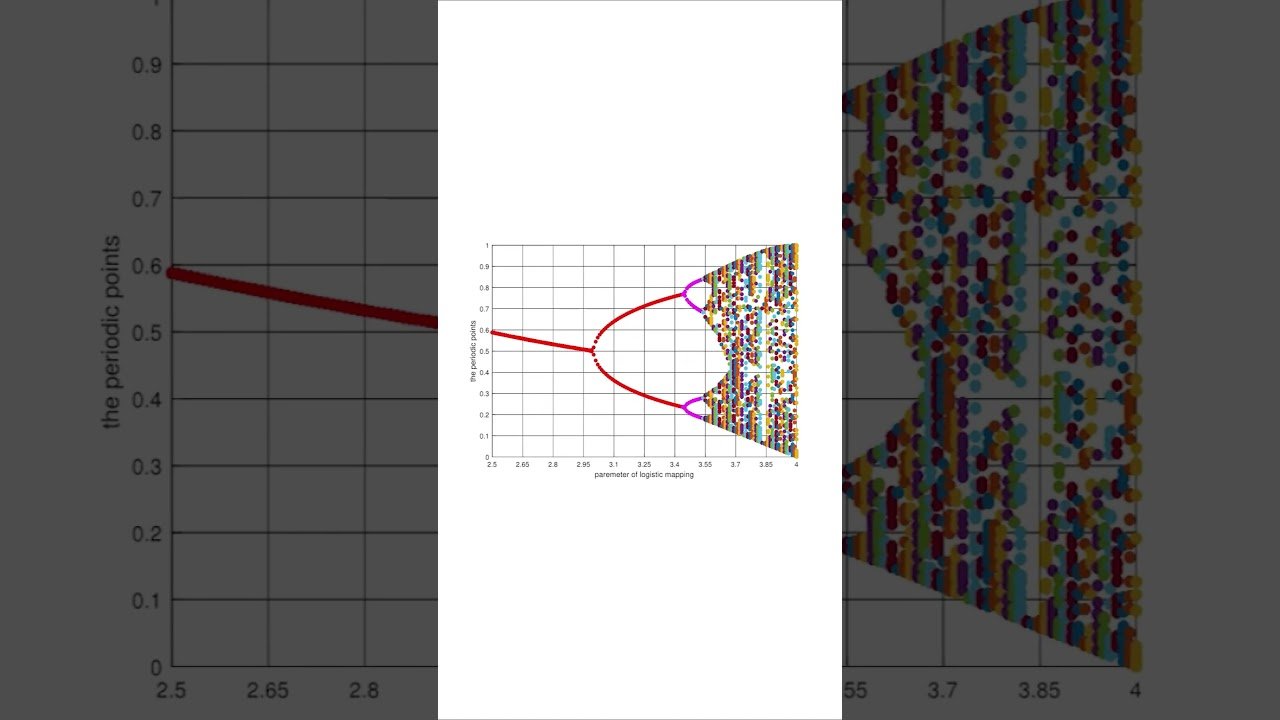
The First Feigenbaum Constant
Overview
The first Feigenbaum constant, usually denoted δ, is a universal number that appears in the study of chaos theory. Its approximate value is:
δ ≈ 4.669201609
It describes how quickly period-doubling bifurcations occur as a system transitions from orderly behavior to chaos.
Discovery
The first Feigenbaum constant, denoted by the Greek letter δ (delta), is a number that has an approximate value of 4.669. This constant was discovered by the mathematician Mitchell Feigenbaum in the late 1970s.
Significance
The first Feigenbaum constant is a fundamental quantity that describes the universal behavior of certain types of nonlinear systems, such as the logistic map, as they transition from stable, periodic behavior to chaotic, unpredictable behavior. It helps us understand the universal patterns and behaviors that emerge in complex nonlinear systems. It is a key concept in the study of chaos theory, which examines how small changes in initial conditions can lead to dramatically different outcomes over time.
This article was generated from the video transcript of “First Feigenbaum Constant (δ) Explained (Chaos Theory)”.
Watch the full video above for visual explanations and diagrams.
Leave a Reply