
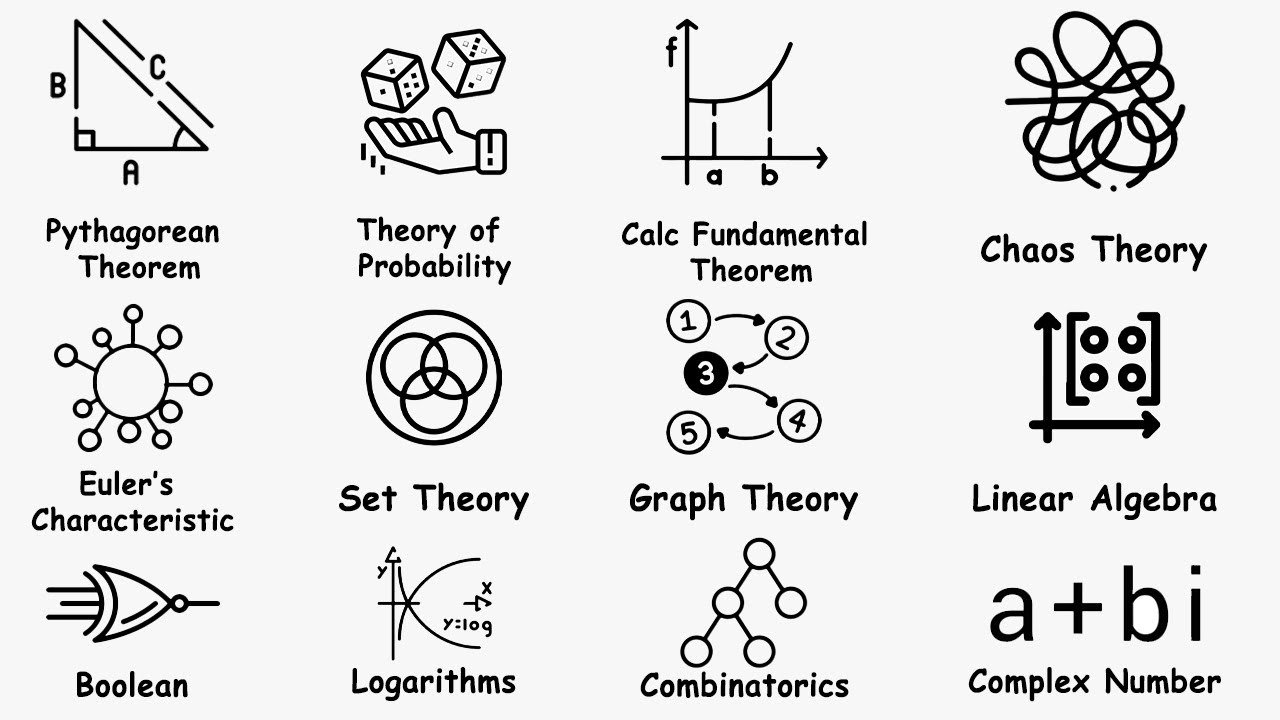
Fundamental Mathematical Concepts and Theories.
Part 1: https://www.youtube.com/watch?v=21iE2XQ9gAU
Part 2 https://www.youtube.com/watch?v=kesaUCEoPbA
Pythagorean Theorem
This theorem is about right-angled triangles, which have one angle that is exactly 90°. It states that if you take the lengths of the two shorter sides of the triangle (called the legs) and square them (multiply each by itself), then add those two numbers together, you get the same result as if you took the length of the longest side (the hypotenuse) and squared it. Imagine a right-angled triangle: if one side is 3 units long and the other side is 4 units long, you can find the length of the longest side by using the formula 3² + 4² = 5², so the longest side is 5 units.
Theory of Probability
Probability is the study of how likely events are to happen. It measures the chance of an event occurring, ranging from zero (impossible) to one (certain). For instance, flipping a fair coin has a 50% chance of landing on heads. If you have a bag with one red ball and one blue ball, the probability of picking the red ball is 1 out of 2, or 50%. Probability helps us predict how often something will happen, like the chances of rolling a six on a die or picking a winning lottery number.
Calculus: Fundamental Theorem
Calculus is a branch of mathematics that studies how things change. The fundamental theorem of calculus links two main concepts: differentiation, which measures how a quantity changes, and integration, which measures the total accumulation of a quantity. Imagine you are driving a car—differentiation helps you figure out your speed at any given moment, while integration helps you figure out how far you’ve traveled over a period of time. The fundamental theorem of calculus shows that these two ideas are connected.
Theory of Relativity
Albert Einstein’s theory of relativity includes special relativity, which deals with objects moving at constant speeds, and general relativity, which deals with gravity. It shows that time and space are connected and that time moves slower for objects moving faster or in stronger gravitational fields. If you travel in a spaceship at a very high speed, time will pass slower for you compared to people on Earth. This is why astronauts age slightly less than people on Earth. Also, gravity isn’t just a force pulling objects—it actually bends space and time around massive objects like stars and planets.
Game Theory
Game theory studies situations where individuals (players) make decisions that affect each other. It helps predict what choices players will make by analyzing their strategies and possible outcomes. One famous concept is the Nash equilibrium, where no player can benefit by changing their strategy if others keep theirs unchanged. Imagine you and a friend are deciding whether to watch a movie or go out to eat—game theory helps predict what you both might decide based on your preferences and how you think the other person will decide. It’s used in economics, politics, and even biology to understand decision-making.
Chaos Theory
Chaos theory studies how small changes in the initial conditions of a system can lead to vastly different outcomes. This is known as the butterfly effect, where a tiny change—like a butterfly flapping its wings—can eventually cause a significant event like a tornado. Think about predicting the weather: a tiny change in temperature or wind speed can make weather forecasts very difficult. Chaos theory helps us understand these unpredictable systems and why they behave so erratically.
Number Theory: Prime Numbers
Number theory is a branch of mathematics focused on the properties and relationships of numbers, especially whole numbers. Prime numbers are a key part of this. They are numbers greater than one that have no positive divisors other than one and themselves. For example, 2, 3, 5, and 7 are prime numbers because they can’t be divided evenly by any other numbers.
Topology: Euler Characteristic
Topology is a branch of mathematics that studies the properties of shapes and spaces that are preserved under continuous deformations. Euler’s characteristic is a number that describes a topological space’s shape or structure. For a polyhedron, it’s calculated as V − E + F, where V is the number of vertices, E is the number of edges, and F is the number of faces. It helps in understanding the fundamental nature of the shape.
Bayes’ Theorem
Bayes’ theorem is a way to find the probability of an event based on prior knowledge of conditions related to the event. In simple terms, it helps us update our predictions or beliefs about the likelihood of an event happening given new evidence. For example, if you know the probability of it raining and the probability of you carrying an umbrella, Bayes’ theorem helps calculate the probability of it raining given that you carried an umbrella.
Fermat’s Last Theorem
Fermat’s Last Theorem states that there are no whole number solutions to the equation xn + yn = zn for n greater than two. This means that you can’t split a cube into two smaller cubes, a fourth power into two fourth powers, and so on using whole numbers. The theorem was a mystery for over 350 years until it was proven in 1994 by Andrew Wiles.
Set Theory
Set theory is the study of sets, which are collections of objects. These objects can be anything: numbers, letters, or even other sets. Set theory helps us understand how collections of objects interact with each other, like how they can overlap or be combined.
Graph Theory
Graph theory studies graphs, which are mathematical structures used to model pairwise relations between objects. A graph is made up of vertices (nodes) connected by edges (lines). Graph theory helps solve problems related to networks, such as finding the shortest route on a map or designing efficient computer networks.
Fourier Transform
The Fourier transform is a mathematical technique that transforms a function of time (a signal) into a function of frequency. This means it takes a complex signal and breaks it down into its basic building blocks—simple waves with different frequencies. It’s widely used in signal processing, like analyzing sound waves or processing images.
Linear Algebra
Linear algebra is the branch of mathematics concerning linear equations, linear functions, and their representations through matrices and vector spaces. It deals with vectors (quantities with direction and magnitude) and matrices (arrays of numbers) and helps solve systems of linear equations.
Complex Numbers
Complex numbers extend the concept of one-dimensional numbers to two dimensions. Think of complex numbers like pairs of numbers, similar to coordinates on a map. Imagine you have a treasure map that tells you how far you are from a treasure in two directions: north–south and east–west. In this treasure map, you might see something like 3 steps north and 4 steps east. Now let’s translate that into a complex number: the 3 steps north corresponds to the first number (let’s call it a), and the 4 steps east corresponds to the second number (let’s call it b). So our complex number would be 3 + 4i, where i is like a special east–west direction. That’s how complex numbers work—they help us understand locations and directions in two dimensions, just like reading a treasure map.
Fractal Geometry
Fractal geometry studies shapes that are self-similar at different scales, meaning they look similar no matter how much you zoom in or out. Fractals are complex patterns that are found in nature, such as in the branching of trees, the structure of snowflakes, and coastlines.
Boolean Algebra
Boolean algebra is a branch of algebra that deals with true or false values (binary variables). It’s used in computer science and digital logic to perform logical operations. For example, in Boolean algebra, AND, OR, and NOT are basic operations that combine or invert true/false values.
Euclidean Geometry
Euclidean geometry is the study of plane and solid figures based on axioms and theorems formulated by the ancient Greek mathematician Euclid. It deals with properties and relationships of points, lines, surfaces, and shapes in a flat two-dimensional plane or three-dimensional space.
Non-Euclidean Geometry
Non-Euclidean geometry explores geometries that are not based on Euclid’s postulates. The most famous types are hyperbolic and elliptic geometry. These geometries differ from Euclidean geometry in how they handle parallel lines and the sum of angles in a triangle, leading to different concepts of space.
Logarithms and Exponentials
Logarithms are the inverse operations of exponentials. Imagine you have a magic machine with two cool tricks. One is called the exponential, and the other is called the logarithm. When you use the exponential trick, you start with a number and make it bigger by multiplying it many times by itself—it’s like saying “double it, double it again,” and so on. The logarithm trick is the opposite: it tells you how many times you need to cut a number into smaller pieces to get back to the original number. These tricks are super useful in things like counting money or understanding how fast things grow. These concepts are used in many areas of math and science, including compound interest calculations and the study of growth rates.
Ring Theory
Ring theory studies structures called rings, which are sets equipped with two operations: addition and multiplication. Rings generalize the arithmetic of whole numbers. Imagine a collection of objects where you can add and multiply them together following some rules—ring theory helps mathematicians understand these structures and how they behave under addition and multiplication.
Combinatorics
Combinatorics is the study of counting, arranging, and combining objects. It deals with questions like: How many ways can you arrange a deck of cards? Or how many different combinations of toppings can you have on a pizza? Think of combinatorics as figuring out the different possibilities when you’re organizing or selecting things. It’s like counting how many different outfits you can make with a certain number of shirts and pants.
Transfinite Numbers
Transfinite numbers are used to describe sizes of infinitely large sets. They extend beyond the concept of counting numbers and represent different levels of infinity. Imagine counting forever without ever reaching an end—transfinite numbers help mathematicians understand and compare different kinds of infinity, like the infinite number of points on a line or the infinite number of real numbers.
Cryptography
Cryptography is the science of securing information and communication. It involves techniques for encoding messages so that only authorized parties can understand them, even if the message is intercepted by others. Cryptography is like creating secret codes to protect information. It’s used in everyday activities like online banking, messaging apps, and securing sensitive data. It ensures that only the intended recipient can read the message, even if it’s transmitted over public channels.
This article was generated from the video transcript of “Greatest Math Theories Explained”.
Watch the full video above for visual explanations and diagrams.
Leave a Reply