
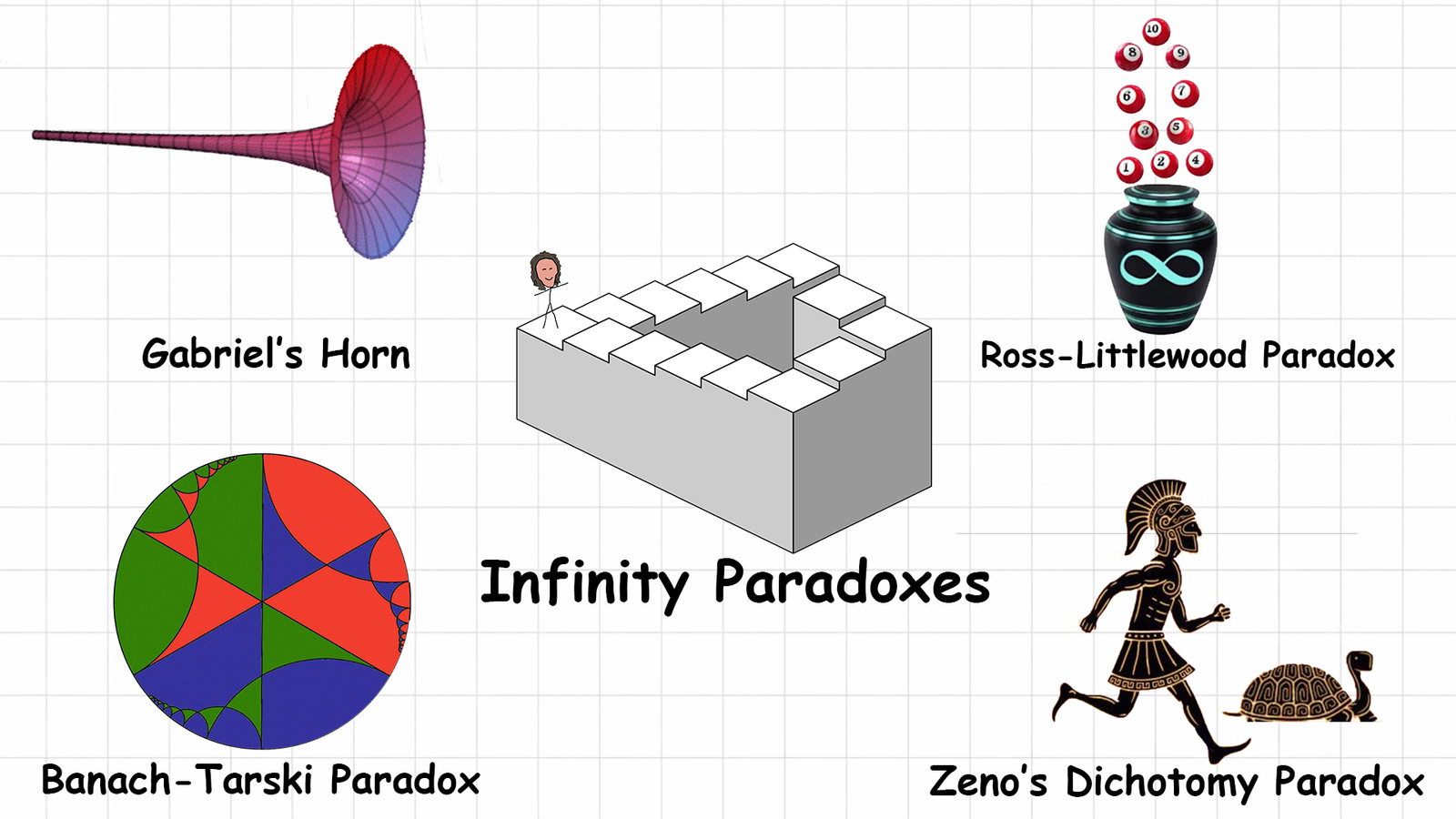
Every Infinity Paradox Explained
(Adding the equations and correctly ordering the sections is in progress)
1. Two Envelopes Paradox
The Two Envelopes Paradox presents a dilemma about mathematical expectation that arises when comparing two unknown quantities. The problem is formulated as follows: there are two envelopes, one contains an amount , and the other contains . One envelope is chosen at random and, after observing its content, the possibility of switching to the other envelope is offered. The question is: is it advisable to switch?
Suppose the selected envelope contains an amount A. It is then argued that the other envelope could contain either or , each with a probability of . Under this assumption, the expected value of the other envelope is:
Since 5A/4 > 5, it would seem that switching is always advantageous. This result creates a logical contradiction: if switching is always the better choice, then one would enter an infinite cycle of switching with no rational justification.
The mistake lies in assuming symmetric probabilities without knowing the prior distribution of the values of . In models where can take any positive value with equal probability, the expected value becomes undefined, and applying mathematical expectation directly becomes misleading. This analysis reveals the subtlety of infinity in probabilistic decision-making.
2. Galileo’s Paradox
Galileo’s Paradox, formulated by Galileo Galilei in the century, challenges our intuition about the size of infinite sets. Consider the set of natural numbers {1, 2, 3, 4,…} and the subset of perfect squares {1, 4, 9, 16,…}. At first glance, it would appear that there are fewer perfect squares than natural numbers, since many integers are not squares.
However, Galileo observed that there is a one-to-one correspondence between these two sets: each natural number corresponds to its square , and vice versa, each square corresponds to its square root , which is also a natural number. Formally, this defines an injective and surjective function:
This implies that the set of perfect squares has the same cardinality as the set of natural numbers, even though it is a proper subset. This conclusion contradicts the finite concept of quantity, where a subset must always be smaller than the entire set.
Galileo concluded that the notions of greater than, less than, and equal do not intuitively apply to infinity, anticipating the concept of cardinality that would be rigorously developed centuries later by Georg Cantor.
3. Burali–Forti Paradox
The Burali–Forti Paradox, discovered by Cesare Burali-Forti in , arises when attempting to define the largest possible ordinal within set theory. In this context, ordinal numbers are an extension of natural numbers used to describe positions in well-ordered sequences, including infinite ordinals such as , the first infinite ordinal.
Let be the set of all ordinals. Since ordinals are well-ordered, it is also possible to define the ordinal of ; that is, the smallest ordinal not contained in . However, by definition, that new ordinal should also belong to , since it is supposed to contain all ordinals. This leads to a logical contradiction: an ordinal that both is and is not a member of itself.
Formally, if is the set of all ordinals, then it must itself be an ordinal. But if it is an ordinal, it must be included in itself, which contradicts the principle that no ordinal is a member of itself.
The paradox reveals that the set of all ordinals cannot exist as a legitimate set within axiomatic set theory, such as Zermelo–Fraenkel. This led to the introduction of the concept of proper classes, collections that are too large to be sets and whose inclusion in other sets is restricted.
4. Russell’s Paradox
Russell’s Paradox, formulated by Bertrand Russell in 1901, is one of the most influential in the history of logic and set theory. It arises from analyzing the set of all sets that do not contain themselves. If this set is defined as , the question is posed: does contain itself?
If , then by definition (R is not an element of R) ; but if , then by definition . This contradiction shows that the naive notion of a set as a “collection of well-defined objects” leads to inconsistencies if the rules for forming sets are not restricted.
The paradox highlights the need for a more rigorous theory to avoid such contradictions. In response, axiomatic set theories such as Zermelo–Fraenkel (ZF) and Zermelo–Fraenkel with the Axiom of Choice (ZFC) were developed. These frameworks prohibit the existence of sets that are “too large,” like , through the use of hierarchies and restrictions on set comprehension. Russell also proposed his own solution with type theory, in which sets are organized into levels, preventing a set from referring to itself either directly or indirectly.
5. Tristram Shandy Paradox
The Tristram Shandy Paradox, proposed by philosopher Jon Barwise, is based on a fictional character from Laurence Sterne’s novel. Tristram Shandy writes his autobiography so slowly that it takes him an entire year to write about a single day of his life. The question is: if he were to live forever, could he ever finish his autobiography?
Intuitively, it seems not, since the delay between lived days and written days accumulates indefinitely. However, from the perspective of set theory and transfinite arithmetic, the situation becomes interesting.
Assume that Tristram lives an infinite number of days and writes forever. Then, on day , he writes about day . A bijective function can be established between the days written and the days lived: each written day corresponds to a lived day. In terms of cardinality, both sets; the days lived and the days he writes about, have the same cardinality: , the cardinality of countable infinity.
The paradox illustrates how, in infinite contexts, relationships that would be impossible in finite contexts can logically hold without contradiction, challenging our intuition about the passage of time and the completion of tasks.
6. The Harmonic Series Paradox
The paradox of the harmonic series arises from analyzing an infinite sum of positive terms that, despite decreasing, does not have a finite limit. The harmonic series is defined as:
Intuitively, one might think this sum converges, since the individual terms tend to zero. However, it can be shown that the series diverges; that is, its sum grows without bound.
One way to demonstrate this divergence is through grouping:
Each group contains at least as many terms as a power of 2, and within each group, every term is greater than or equal to the inverse of the largest index. Thus, each group contributes at least to the total sum. Therefore, the series grows indefinitely.
The paradox lies in the fact that, although the terms tend to zero, the accumulation of infinitely many small terms can produce an infinite sum. This demonstrates that the convergence of an infinite series does not depend solely on the local behavior of its terms, but rather on its overall structure.
7. Grandi’s Series
Grandi’s series is an infinite alternating series defined as:
At first glance, this series does not seem to have a well-defined sum, since its partial sums alternate between 1 and 0. That is, the partial sums are:
Formally, the series does not converge in the classical sense, as the limit of the partial sums does not exist. However, throughout history, regularization methods have been proposed, such as Cesàro summation, which attempt to assign a value to certain divergent series.
With Cesàro summation, the average of the partial sums is considered. For this series, that average tends toward , which suggests that the series can be “summed” to that value under this method. This interpretation, while useful in specific physical or mathematical contexts, does not imply that the series converges in the traditional sense.
Grandi’s series illustrates how infinity and alternation can produce counterintuitive results, and how different methods of analysis can yield different conclusions about the same mathematical object.
8. Vitali Sets
Vitali sets are a classical example of non-measurable objects in the context of Lebesgue measure theory. They were introduced by Giuseppe Vitali in 1905 as a construction that challenges our intuition about length and measurement within the set of real numbers.
Consider the interval in . Define an equivalence relation if (x minus y is an element of the rationals). This relation partitions into disjoint classes, where each class contains numbers that differ by a rational number. Using the Axiom of Choice, one selects a representative from each equivalence class. The set of all such representatives is called a Vitali set.
This set has extraordinary properties: it cannot be measured using the Lebesgue measure. Suppose, for contradiction, that this set were measurable with measure . If we consider all rational translations of this set within , they would form a collection of disjoint subsets, each with the same measure . Since there are infinitely many rationals in , the total sum of these measures would be infinite, which contradicts the fact that the interval has finite measure.
The paradox does not stem from a logical contradiction, but rather from a violation of geometric intuition: a set has been constructed, legitimately from the axioms, that has no well-defined measure. This situation challenges our basic assumptions about space, length, and the measurability of sets. It shows that even within a rigorous mathematical framework, certain objects defy the rules we take for granted. This is only possible due to the use of the Axiom of Choice, a powerful yet controversial tool in mathematics, as it allows the selection of elements from an infinite number of sets without the need for an explicit constructive rule or algorithm.
Vitali sets illustrate the limits of measure theory, the foundational role of axioms, and the deep interplay between infinity, logic, and the structure of the real numbers. They serve as a striking example of how pure set-theoretic constructions can lead to objects that are formally valid, yet profoundly counterintuitive. In doing so, they prompt reflection on the philosophical boundaries between what can be defined, what can be measured, and what it means for a mathematical object to “exist.”
Leave a Reply