
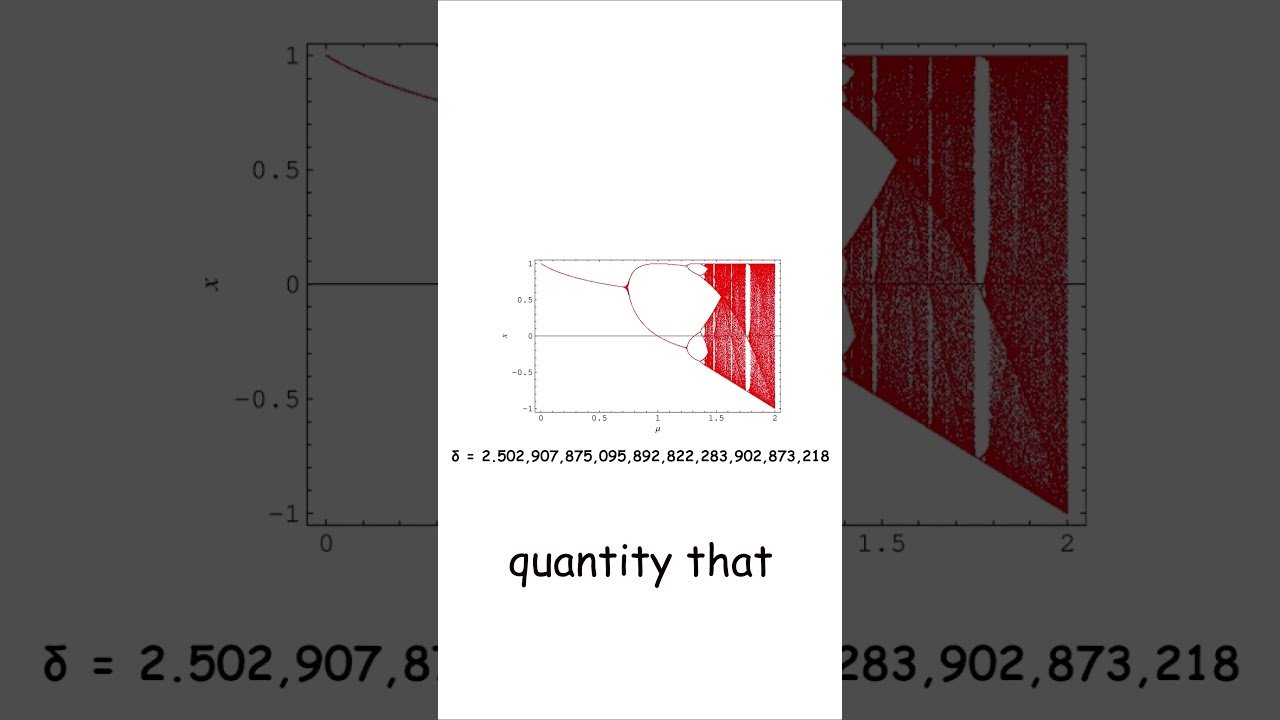
The second Feigenbaum constant, written as α and approximately equal to 2.503, describes how the size of structures in a chaotic system scales as it undergoes period doubling. While the first Feigenbaum constant controls when chaos appears, α controls how the shapes themselves shrink and repeat.
The second Feigenbaum constant has a value of approximately 2.502. This constant describes a ratio between the width of a tine or a branch and the width of one of its two subtines except a tine closest to the fold and the bifurcation diagram of certain nonlinear dynamical systems.
Like the first Feigenbaum constant, the second constant is a universal quantity that describes the behavior of a wide class of nonlinear systems as they transition to chaos. While the first Feigenbaum constant describes the rate of period doubling, the second constant describes the geometric scaling of the bifurcation intervals.
Together, these two constants provide a quantitative description of the universal route to chaos observed in many nonlinear dynamical systems.
This article was generated from the video transcript of “Second Feigenbaum Constant (α) Explained (Chaos Theory)”.
Watch the full video above for visual explanations and diagrams.
Leave a Reply