
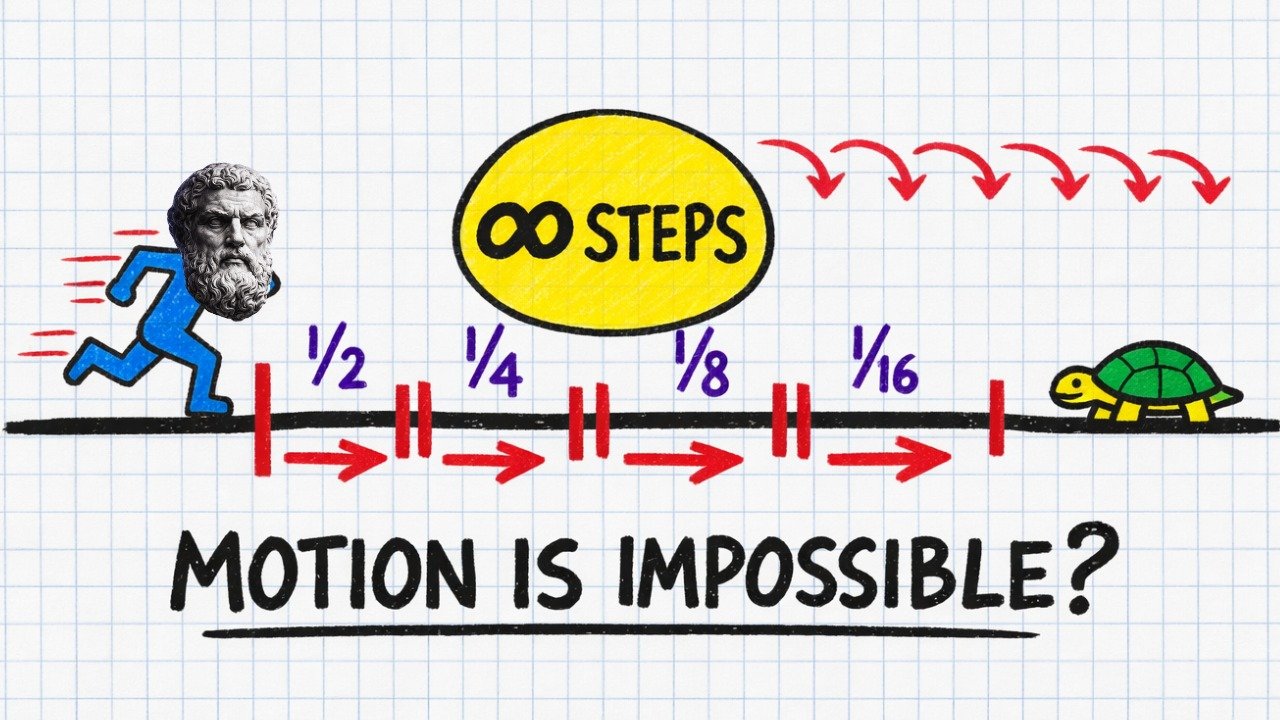
Imagine you are about to clap your hands. But think about what has to happen first. Your right hand has to travel half the distance to your left. Then half of what remains. Then half again. And again. And again.
This is an infinite number of steps. And infinity is not just “a lot.” Here, infinity means there is no last step. So how did your hands ever meet? This is called the Dichotomy Paradox.
The Paradox
This problem has intrigued mathematicians and philosophers for 2,500 years. It comes from a Greek philosopher named Zeno, and his most famous version involves a race.
Achilles, the fastest warrior in Greece, races a tortoise. The tortoise, being slow, gets a 100-meter head start. The race begins and Achilles sprints to where the tortoise started. But in that time, the tortoise has moved forward 10 meters. So Achilles sprints to that new spot. But now the tortoise has moved again, another meter. Achilles reaches that point, but the tortoise has crept forward once more.
This keeps happening forever. Every time Achilles reaches where the tortoise was, the tortoise has moved to somewhere new. There is always another gap to close. No matter how fast Achilles runs, Zeno claims the logic traps him forever, because before reaching the tortoise, he must first reach infinitely many halfway points. Zeno’s argument implies you can never finish crossing infinitely many intervals, no matter how small they get.
The question is not “does Achilles catch the tortoise?” Obviously he does. In the real world we have all seen fast things overtake slow things. The paradox is that you have one line of reasoning that shows Achilles will never reach the tortoise, and another line of reasoning that shows he eventually will. If both lines of reasoning are correct, you get a contradiction. But it is not obvious where the mistake is, hence being called a paradox.
The question is: how can a process with infinitely many steps ever be completed? There is no final step, as the sequence goes on forever. So what does it even mean to “finish” something that has no end?
Importantly, Zeno was not trying to argue that motion does not exist. He was defending his teacher Parmenides, who believed reality was unchanging.
The Mathematician’s Move
Aristotle was the first to seriously respond to Zeno, arguing that infinity here is potential, not actual. You can keep dividing forever, but you never complete all divisions at once.
To make this concrete, imagine holding your hands 2 meters apart and bringing them together by repeatedly halving the distance. First, you travel 1 meter. Then half a meter. Then a quarter. Then an eighth. A sixteenth. And so on, forever.
1 + 1/2 + 1/4 + 1/8 + 1/16 + 1/32 + …
For nearly two thousand years, people used infinite processes intuitively, but they were not rigorously formalized until the 19th century, when Augustin-Louis Cauchy and Karl Weierstrass developed the modern theory of limits and convergence.
Their major contribution to Zeno’s paradox was to reframe the question: do not ask what you get after infinitely many additions. Ask what value the partial sums approach.
Watch what happens when we add these up, one term at a time:
After 1 term: 1 After 2 terms: 1.5 After 3 terms: 1.75 After 4 terms: 1.875 After 5 terms: 1.9375 After 6 terms: 1.96875
You can see where this is going. These partial sums converge to 2. This reframe allowed mathematicians to say the sum IS 2. Not “approaches 2.” It equals 2, exactly, because that is what we define an infinite sum to mean.
The Algebraic Confirmation
We can confirm this using algebraic sums. We will use the sum from n = 0 to ∞ of (1/2)ⁿ.
S = 1 + 1/2 + 1/4 + 1/8 + 1/16 + …
Let’s call this sum S. Whatever it is, let’s multiply both sides by 1/2:
S/2 = 1/2 + 1/4 + 1/8 + 1/16 + …
Now look at these two expressions. On the right-hand side, almost everything matches up. If we subtract the second line from the first, every term cancels with the one below it. All that is left is:
S − S/2 = 1
Which means S/2 = 1, so S = 2.
Your hands travel exactly 2 meters, even though the journey consists of infinitely many steps.
Where Does Time Fit In?
Do those infinitely many steps not take infinitely long? They would, if each step took the same amount of time. But the times shrink too, following the same series of numbers. If each halving took the same time (say 1 second), then yes, the time would be infinite. But in uniform motion, time halves too: the first half takes t seconds, the next takes t/2, then t/4, and so on. So the total time is also a geometric series summing to a finite value.
So Is the Paradox Solved?
This is where things get complicated.
Mathematicians have built a consistent framework where infinite sums make perfect sense. This framework, based on limits and convergence, has been refined over 200 years. It works and gives correct answers. We can calculate exactly when and where Achilles catches the tortoise.
But the philosophical question underneath, how can a process without a final step be completed, remains genuinely puzzling. The math tells us it happens and tells us the answer. But does it fully explain how it happens? Brilliant minds have wrestled with it for 2,500 years.
It can be argued that calculus does not come any closer to a true solution to Zeno’s paradox. Without the concept of a limit, you cannot get a finite result for the sum of this infinite series. The mathematical definition of this limit is equal to 2, but this is a definition. If you had asked Zeno about whether you could find a match for each n, he would have unequivocally said yes. Zeno could see that the partial sums were getting closer and closer to 2. However, he did not see it reasonable to adopt the concept of a limit, because it is just a definition and avoids the key philosophical point brought up by his argument.
The Physics Question
There is a deeper question that takes us beyond mathematics entirely. Philosophers still debate whether completing infinitely many tasks in finite time is coherent, with ongoing work connecting Zeno to questions about the metaphysics of space and time. Is spacetime continuous or discrete?
Up until now we have been assuming that space and time are continuous, that you can always divide a distance in half, no matter how small it gets. There is always a smaller piece. But can you actually do that? Can space and time be divided infinitely many times?
Some physicists think there might be a smallest possible length, the Planck length, about 1.6 × 10⁻³⁵ meters, below which the concept of “distance” stops making sense. Similarly, Planck time is the time it takes for light to travel in a vacuum the distance of one Planck length: 5.39 × 10⁻⁴⁴ seconds. To work on shorter and shorter time scales requires more and more energy. At high enough energy, the universe fights back and hides the ensuing chaos behind an event horizon, and it is not sensible to talk about it being in the universe anymore. That throws up all sorts of entanglements beyond the scope of this article. For now, let’s assume that there are physical limits to the scale of the universe that we cannot breach.
If that is true, then physically speaking, the division eventually stops. You cannot divide by 2 forever. And Zeno’s infinite process is not actually infinite at all. It just looks infinite because we are using continuous mathematics to model a discrete reality. Zeno’s paradox is only a problem if spacetime is a continuum. The idea of Planck length removes the necessary hypothesis of arbitrarily small distance.
In theories like loop quantum gravity, spacetime might be discrete at the Planck scale, making infinite division physically impossible. But this is highly speculative. No experiment has reached those scales, and most physicists treat spacetime as continuous for practical purposes. The Planck length does not “solve” Zeno mathematically; it just suggests the physical premise of infinite divisibility might be wrong.
So maybe the paradox is trying to tell us something. Maybe our conception that space is infinitely divisible is simply wrong. Maybe at the deepest level, the universe is pixelated. We do not know the answer, but it is fascinating that a 2,500-year-old thought experiment about a tortoise might still have something to teach us about the fundamental nature of reality.
Closing Thoughts
Interestingly, Zeno’s name lives on in quantum physics too, via the Quantum Zeno Effect, where frequent observation can freeze quantum changes. That is inspired by his Arrow paradox, not the Dichotomy Paradox explored here.
Outside of some tricks with language (“this statement is a lie”), you cannot have actual paradoxes. By definition, a real paradox is impossible. However, you can get things that seem paradoxical. Normally, these situations involve reasoning that seems good, based on common assumptions, that leads to a result contradicting what we know to be true.
The resolution to this paradox is the realization that an infinite series can have a finite sum. The first line of reasoning shows that it will take an infinite number of steps for Achilles to reach the tortoise, but since each step gets shorter, it can be done in a finite amount of time, since an infinite sum does not have to be infinite but may equal a constant.
So the next time you clap your hands, remember: you just completed an infinite process. Or did you?
Leave a Reply