
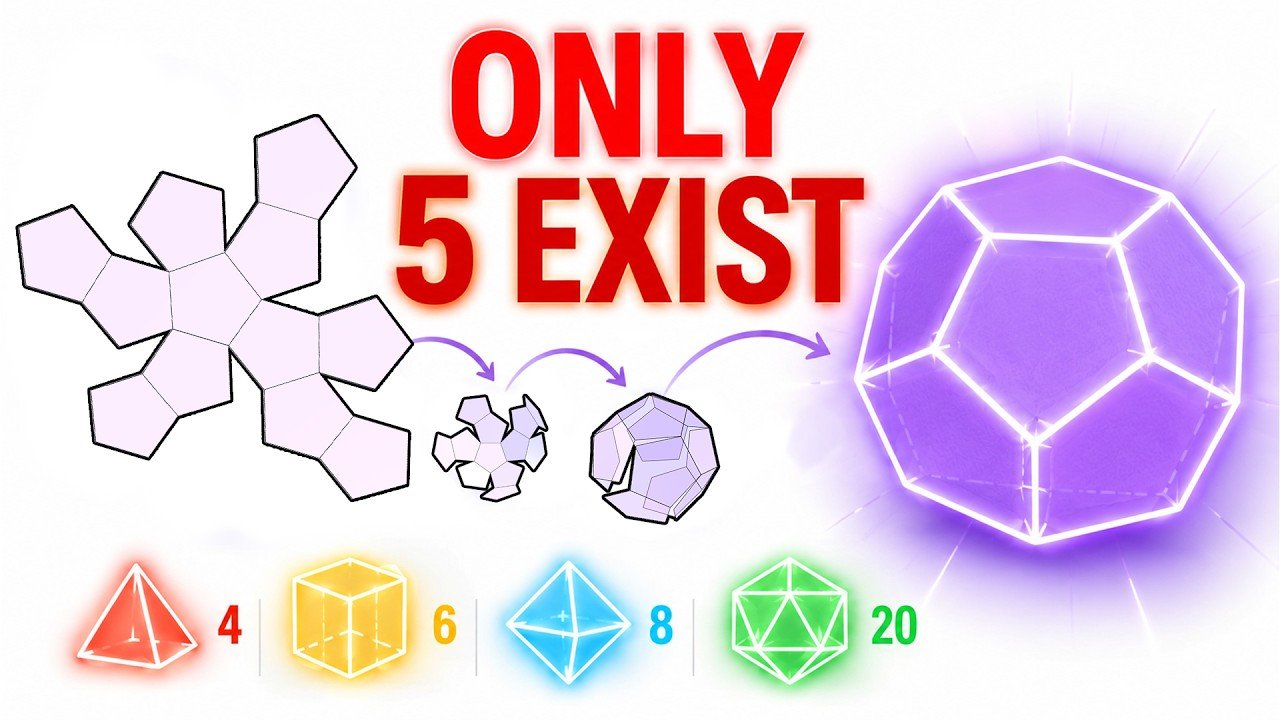
Take a three-dimensional shape in which every face is the same regular polygon, such as an equilateral triangle, square, or regular pentagon, and the same number of faces meet at every corner.
A shape this perfectly symmetrical is called a Platonic solid, named after the ancient Greek philosopher Plato.
Only five Platonic solids exist:
- Tetrahedron
- Cube
- Octahedron
- Dodecahedron
- Icosahedron
This is not merely the number mathematicians have discovered so far. Geometry proves that no sixth Platonic solid can ever exist.
Tetrahedron
Take four identical equilateral triangles and fold them together. They close into a tetrahedron, a pyramid with a triangular base.
The tetrahedron has:
- 4 faces
- 4 vertices
- 6 edges
It is the smallest possible polyhedron and the only Platonic solid that is its own dual.
A dual is formed by exchanging a polyhedron’s faces and vertices. Each face becomes a vertex, and each vertex becomes a face, while the solid’s overall structure is preserved.
Mark the center of each face of a polyhedron and connect those points. With most Platonic solids, this process creates a different solid. With a tetrahedron, however, it creates another tetrahedron.
Aristotle’s 1,800-Year-Old Mistake
Around 350 BC, Aristotle claimed in his work On the Heavens that identical tetrahedra could fill space completely without leaving gaps, just as cubes do.
He was wrong.
When tetrahedra are packed around a shared edge, a thin wedge of empty space remains. The angle between two faces does not divide evenly into a complete 360-degree turn.
Remarkably, Aristotle’s claim went unchallenged for approximately 1,800 years. It was finally corrected in the fifteenth century by the German mathematician Johannes Regiomontanus.
Although tetrahedra cannot fill space by themselves, a combination of tetrahedra and octahedra can. When arranged in a ratio of two tetrahedra for every octahedron, the shapes fill space without gaps.
Alexander Graham Bell constructed structures using this arrangement, which later became known as the octet truss.
Cube
The cube is made from six identical squares. Three squares meet at each corner.
It has:
- 6 faces
- 8 vertices
- 12 edges
Of the five Platonic solids, the cube is the only one that can fill three-dimensional space entirely on its own.
Stack cubes together and they leave no gaps.
Cubes in Nature
The cube’s ability to fill space appears throughout nature. Sodium chloride, pyrite, and many other compounds form cubic crystals because their atoms arrange themselves into repeating cubic lattices.
The cube also possesses a property that sounds impossible.
You can cut a straight tunnel through a cube and pass another cube of exactly the same size through it while leaving the first cube in one piece.
In the seventeenth century, Prince Rupert of the Rhine reportedly won a wager by claiming that this could be done. The English mathematician John Wallis later proved that he was correct.
Nearly a century later, the Dutch mathematician Pieter Nieuwland found the limit. The tunnel can be made wide enough for a cube approximately 6 percent larger than the original to pass through it.
The larger cube can have a side length equal to:
(3 x sqrt(2)) / 4
times the side length of the original cube.
This value is approximately:
1.06066
In other words, the passing cube can be approximately 6.066 percent larger than the cube containing the tunnel.
This phenomenon is known as the Rupert property.
Every Platonic solid has the Rupert property. For a long time, mathematicians suspected that every convex polyhedron might have it as well.
That conjecture was disproven in 2025, when Jakob Steininger and Sergey Yurkevich constructed the Noperthedron, a convex polyhedron that cannot pass through a straight tunnel cut through an identical copy of itself.
The cube also contains the next Platonic solid hidden within it.
Octahedron
Mark the center of each of a cube’s six faces. Connect those six points, and a new solid appears inside it.
This is the octahedron.
It resembles two square pyramids joined base to base and has:
- 8 triangular faces
- 6 vertices
- 12 edges
The cube and octahedron demonstrate what it means for two solids to be duals.
A cube has six faces and eight vertices. The octahedron reverses those numbers, with eight faces and six vertices.
Octahedra in Nature
Nature produces octahedral geometry on its own. Under the right conditions, minerals such as diamond and fluorite grow into sharp octahedral crystals.
Because the cube and octahedron are duals, they also have the same rotational symmetries. Every rotation that leaves a cube appearing unchanged also leaves an octahedron unchanged.
This pattern of duality runs through all five Platonic solids:
- The tetrahedron is its own dual.
- The cube and octahedron are duals.
- The dodecahedron and icosahedron are duals.
Dodecahedron
Take 12 identical regular pentagons, with three meeting at each corner, and they form a dodecahedron.
The dodecahedron has:
- 12 pentagonal faces
- 20 vertices
- 30 edges
Its many faces give it a rounded, almost spherical appearance.
Plato’s Shape of the Heavens
In his dialogue Timaeus, written around 360 BC, Plato associated four of the Platonic solids with the four classical elements:
- Tetrahedron: fire
- Cube: earth
- Octahedron: air
- Icosahedron: water
The dodecahedron was left over.
Rather than discard it, Plato associated it with the heavens. It became the shape through which the cosmos itself was arranged.
Kepler’s Geometric Solar System
In 1596, the German astronomer Johannes Kepler attempted to explain the structure of the solar system using the five Platonic solids.
He imagined the solids nested inside one another, with each planet’s orbit lying on a spherical shell placed between two solids.
The model was incorrect as physics, but it reflected Kepler’s conviction that the spacing of the planets must follow a perfect geometric plan.
Could the Universe Be a Dodecahedron?
The idea that the dodecahedron might describe the heavens survived into modern cosmology.
In 2003, the French astrophysicist Jean-Pierre Luminet and his colleagues published a model in the journal Nature proposing that the entire universe might have a dodecahedral shape.
In this model, each of the dodecahedron’s 12 faces is connected to the opposite face after a slight twist. A traveler leaving through one face would eventually reenter through the corresponding face on the other side.
The model was proposed partly because observations of the cosmic microwave background, the leftover radiation from the Big Bang, appeared to show an unusual shortage of extremely large-scale fluctuations.
A finite dodecahedral universe could potentially explain that shortage.
More than two decades later, the evidence remains inconclusive. The simplest interpretation of measurements from the Planck satellite is that the universe is spatially flat and may extend indefinitely.
However, the dodecahedral model has not been completely ruled out.
The dodecahedron’s dual is the shape Plato associated with water. It is also the Platonic solid that appears most frequently in the living world.
Icosahedron
Mark the center of each of a dodecahedron’s 12 faces and connect those points. The result is an icosahedron.
The icosahedron has:
- 20 triangular faces
- 12 vertices
- 30 edges
It is the exact dual of the dodecahedron, reversing its 12 faces and 20 vertices.
Five equilateral triangles meet at each corner. Of all five Platonic solids, the icosahedron is the most rounded and comes closest to approximating a sphere.
This makes icosahedral geometry especially useful in nature. Many viruses form icosahedral shells because the shape encloses a relatively large volume while using repeated, identical structural units.
Why There Can Only Be Five Platonic Solids
The proof that exactly five Platonic solids exist comes down to one simple geometric rule.
At every vertex, identical regular polygons must meet in a way that creates a three-dimensional corner.
For the faces to fold upward into a solid, their interior angles must add up to less than 360 degrees.
If the angles add up to exactly 360 degrees, they produce a flat pattern.
If the angles add up to more than 360 degrees, the faces overlap.
If the angles add up to less than 360 degrees, the faces can fold into three dimensions.
We can test each regular polygon.
Equilateral Triangles
An equilateral triangle has interior angles of 60 degrees.
Three, four, or five triangles can meet at a vertex:
3 x 60 degrees = 180 degrees
4 x 60 degrees = 240 degrees
5 x 60 degrees = 300 degrees
All three totals are less than 360 degrees.
These arrangements produce:
- Three triangles: tetrahedron
- Four triangles: octahedron
- Five triangles: icosahedron
Six triangles cannot form a Platonic solid because:
6 x 60 degrees = 360 degrees
The triangles lie flat instead.
Squares
A square has interior angles of 90 degrees.
Three squares can meet at a vertex:
3 x 90 degrees = 270 degrees
This creates the cube.
Four squares cannot form a three-dimensional corner because:
4 x 90 degrees = 360 degrees
They form a flat grid.
Regular Pentagons
A regular pentagon has interior angles of 108 degrees.
Three pentagons can meet at a vertex:
3 x 10⁸ degrees = 324 degrees
This creates the dodecahedron.
Four pentagons would exceed the limit:
4 x 10⁸ degrees = 432 degrees
The faces would overlap.
Hexagons and Larger Polygons
A regular hexagon has interior angles of 120 degrees.
Even the minimum arrangement of three hexagons gives:
3 x 120 degrees = 360 degrees
That arrangement tiles a flat plane, as seen in a honeycomb, but it cannot bend into a three-dimensional corner.
Every regular polygon with more than six sides has even larger interior angles, so none can form a Platonic solid.
Geometry Allows Exactly Five
This leaves exactly five possibilities:
- Three solids made from equilateral triangles
- One solid made from squares
- One solid made from regular pentagons
The list is not short by coincidence. It is forced by geometry itself.
Once the angles of the faces become too large to form a three-dimensional corner, the possibilities end.
That is why the five Platonic solids are not merely the only ones we have found.
They are the only ones that can ever exist.
Leave a Reply