
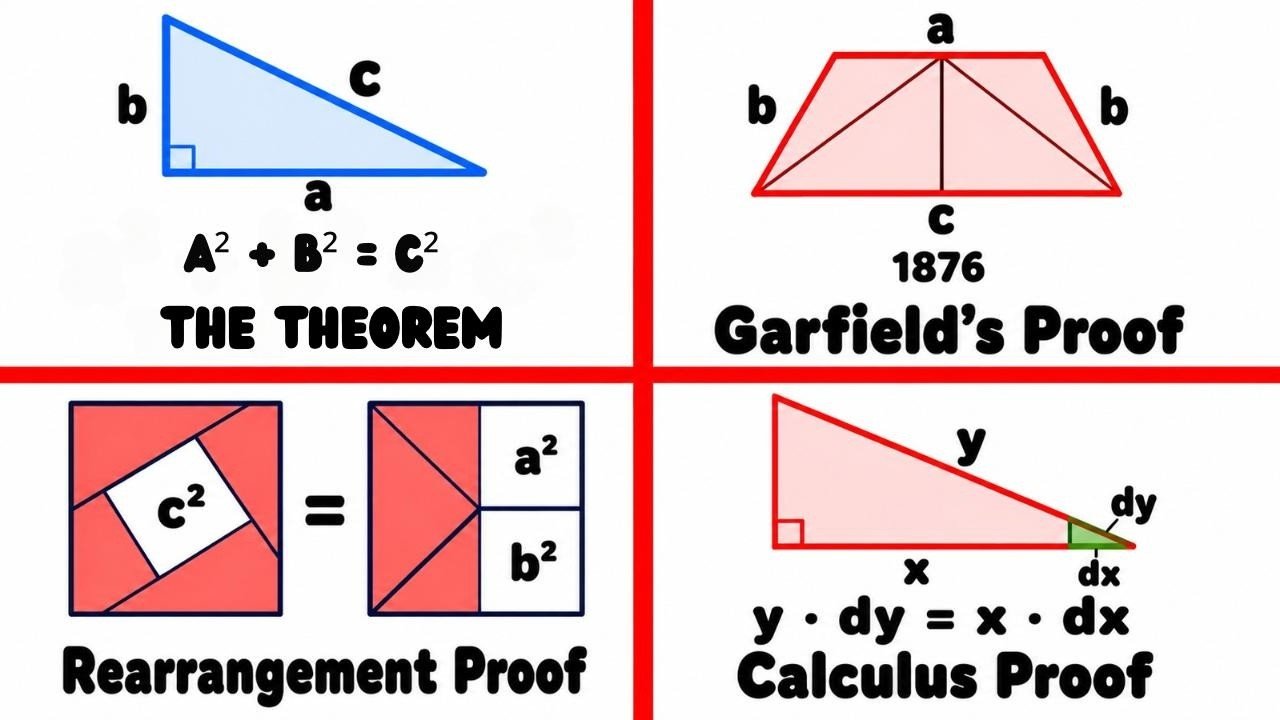
The Pythagorean theorem is one of the oldest and most famous results in mathematics. More than 370 proofs of the theorem are known, and mathematicians have continued finding new ones for over 2,000 years.
Some proofs use nothing more than geometry and rearrangement. Others use algebra, trapezoids, or even calculus.
In this article, we will examine three very different proofs of the Pythagorean theorem:
- The rearrangement proof
- James Garfield’s trapezoid proof
- A calculus proof using differentials
What Is the Pythagorean Theorem?
A right triangle is a triangle containing one right angle.
The two sides adjacent to the right angle are called the legs. The side opposite the right angle is called the hypotenuse.
If the lengths of the legs are known, can we determine the length of the hypotenuse?
The Pythagorean theorem says that for any right triangle:
a^2 + b^2 = c^2
In this equation:
- a and b are the lengths of the legs
- c is the length of the hypotenuse
Before proving the general theorem, it helps to begin with a specific example.
Suppose one leg of a right triangle is 4 units long and the other leg is 3 units long. We will label the unknown hypotenuse c.
Our goal is to determine the value of c.
Understanding Squares and Square Roots
To understand the first proof, we need to think about the area of a square.
The area of a square is found by multiplying its side length by itself.
Area = side length * side length
This can also be written as:
Area = side length^2
Because of this formula, multiplying a number by itself is called squaring the number.
We can also work backward. If we know the area of a square, we can use a square root to find its side length.
For example, imagine a square with an area of 9 square units. Its side length must be 3 units because:
3^2 = 9
Therefore:
sqrt(9) = 3
With this idea in mind, we can begin our first proof.
Proof 1: The Rearrangement Proof
Forming a Square From Four Triangles
Begin with four identical copies of the right triangle whose legs have lengths 3 and 4.
Rotate and translate the triangles until their hypotenuses form the four sides of a smaller square in the center.
Because each hypotenuse has length c, the side length of the central square is also c.
The area of the central square is therefore:
c^2
If we could determine the area of this square, we could take its square root to find the length of the hypotenuse.
The problem is that we do not yet know the value of c.
However, we can find the area indirectly.
Rearranging the Triangles
The four triangles are contained inside a larger square. Some of the area inside the larger square is occupied by the triangles, while the remaining area forms the central square.
The area of this empty space is:
c^2
Now imagine moving the four triangles around inside the larger square without changing their sizes, allowing them to overlap, or moving them outside the boundary.
Rearranging the triangles does not change their total area. It also does not change the area of the larger square.
Therefore, the amount of empty space must remain the same.
After rearranging the triangles, the empty space can be divided into two smaller squares.
One square has a side length of 4, so its area is:
4^2 = 16
The other square has a side length of 3, so its area is:
3^2 = 9
The total empty area is therefore:
4^2 + 3^2
We already know that the empty area is equal to c^2. Therefore:
4^2 + 3^2 = c^2
Now we can solve for c:
16 + 9 = c^2
25 = c^2
c = sqrt(25)
c = 5
The hypotenuse is 5 units long.
Generalizing the Rearrangement Proof
The leg lengths of 3 and 4 were only an example. There is nothing special about those particular numbers.
To make the proof apply to every right triangle, let the two leg lengths be a and b. Let the hypotenuse length be c.
Construct the same arrangement using four identical copies of this triangle.
In the first arrangement, the empty space forms a square whose side length is c. Its area is:
c^2
After rearranging the four triangles, the empty space forms two smaller squares.
The first square has side length a, so its area is:
a^2
The second square has side length b, so its area is:
b^2
The combined area of the two squares is:
a^2 + b^2
Because the amount of empty space did not change during the rearrangement:
a^2 + b^2 = c^2
This proves the Pythagorean theorem.
Proof 2: James Garfield’s Trapezoid Proof
James A. Garfield was a Civil War general and a United States congressman from Ohio. He later became the 20th president of the United States.
He also had a talent for mathematics.
In 1876, Garfield developed a proof of the Pythagorean theorem using the area of a trapezoid.
Constructing Garfield’s Diagram
Begin with a right triangle whose leg lengths are a and b and whose hypotenuse has length c.
Label the vertices of the triangle A, B, and C.
Create a second copy of the triangle. Rotate the copy by a quarter turn and move it so that one of its vertices lines up with a vertex of the original triangle.
Label the remaining two vertices D and E.
Finally, draw the line segment AD to complete the quadrilateral ACED.
The resulting shape contains three triangles:
- The original right triangle
- A rotated copy of the original right triangle
- A larger triangle in the center
The outside quadrilateral is also a trapezoid.
This means we can calculate its area in two different ways.
Calculating the Area Using Three Triangles
The area of a triangle is:
Area = (1/2) * base * height
Each of the two identical right triangles has leg lengths a and b.
The area of one triangle is:
(1/2)ab
Because there are two copies, their combined area is:
2 * (1/2)ab = ab
The central triangle has a base of c and a height of c.
Its area is:
(1/2)c * c
This simplifies to:
(1/2)c^2
The total area of the quadrilateral is therefore:
ab + (1/2)c^2
Calculating the Area as a Trapezoid
The same quadrilateral can also be treated as a trapezoid.
The area of a trapezoid is:
Area = (1/2) * (sum of parallel sides) * height
The two parallel sides have lengths a and b.
Their sum is:
a + b
The height of the trapezoid is also:
a + b
Therefore, the area of the trapezoid is:
(1/2)(a + b)(a + b)
This can also be written as:
(1/2)(a + b)^2
Setting the Two Areas Equal
We have calculated the area of the same shape in two different ways.
Therefore, the two expressions must be equal:
(1/2)(a + b)^2 = ab + (1/2)c^2
Multiply both sides by 2:
(a + b)^2 = 2ab + c^2
Expand the expression on the left:
a^2 + 2ab + b^2 = 2ab + c^2
Subtract 2ab from both sides:
a^2 + b^2 = c^2
The Pythagorean theorem is proven once again.
Garfield’s proof is often noted as the only original mathematical proof developed by a president of the United States.
Proof 3: A Calculus Proof
The final proof uses differential and integral calculus.
Most students encounter the Pythagorean theorem long before they learn calculus. However, this proof provides an interesting exercise in thinking about differentials, similar triangles, and differential equations.
The proof is credited to Michael Hardy, who developed it while he was a student at the University of Toledo.
Defining the Triangle
Begin with a right triangle ABC.
Let one leg have a fixed length of a.
Instead of treating the second leg as a constant, let its length be the variable x.
Because the hypotenuse changes as x changes, let the hypotenuse length be y.
In this context, x and y are not horizontal and vertical coordinates. They are simply variables representing the lengths of two sides of the triangle.
The triangle therefore has:
- One fixed leg of length a
- One variable leg of length x
- A variable hypotenuse of length y
Increasing the Length of One Leg
Imagine extending the side of length x by a very small amount.
Call this small change dx.
The new leg length is:
x + dx
Because the leg becomes slightly longer, the hypotenuse must also become slightly longer.
Call the change in the hypotenuse dy.
The new hypotenuse length is:
y + dy
Mark a point on the new hypotenuse so that the original portion has length y and the small remaining portion has length dy.
Connecting this point to the end of the original leg creates a very small triangle.
Using Similar Triangles
As dx approaches zero, one angle of the small triangle approaches a right angle.
Another angle of the small triangle approaches the corresponding angle in the original right triangle.
Because of these matching angles, the small triangle and the original triangle become approximately similar.
In the limiting case, their corresponding side ratios are equal.
For the small triangle, consider the ratio:
dy/dx
For the original triangle, the corresponding ratio is:
x/y
Therefore:
dy/dx = x/y
This is a differential equation.
Separating the Variables
Multiply both sides by y dx:
y dy = x dx
Now integrate both sides:
integral(y dy) = integral(x dx)
This gives:
(1/2)y^2 = (1/2)x^2 + C
Multiply both sides by 2 and absorb the factor into the constant:
y^2 = x^2 + C
We now need to determine the value of C.
Solving for the Constant
Return to the original triangle and let:
x = 0
When x is zero, the variable leg disappears. The fixed leg and the hypotenuse then have the same length.
Because the fixed leg has length a:
y = a
Substitute x = 0 and y = a into the equation:
a^2 = 0^2 + C
Therefore:
C = a^2
Substitute this value back into the equation:
y^2 = x^2 + a^2
Rearranging the terms gives:
a^2 + x^2 = y^2
Here, a and x are the lengths of the two legs, while y is the length of the hypotenuse.
This is the Pythagorean theorem.
One Theorem, Hundreds of Proofs
The three proofs use very different areas of mathematics.
The rearrangement proof uses geometry and conservation of area.
Garfield’s proof calculates the area of a trapezoid in two different ways.
The calculus proof examines how the hypotenuse changes when one leg of the triangle changes by a tiny amount.
Despite their differences, all three proofs arrive at the same result:
a^2 + b^2 = c^2
The square of the hypotenuse of a right triangle is equal to the sum of the squares of its two legs.
The Pythagorean theorem has been known for thousands of years, but mathematicians continue to find new ways to understand and prove it. Its hundreds of proofs show how a single mathematical truth can connect geometry, algebra, calculus, and many other areas of mathematics.
Leave a Reply