
Thanks for watching! Levels:
0:00 Intro
0:24 Level 1: Natural Numbers
1:14 Level 2: Integers
2:21 Level 3: Rationals
3:38 Level 4: Real Numbers
5:07 Level 5: Complex Numbers
7:16 Level 6: Quaternions
8:41 Level 7: Octonions
9:17 Why There Is No Level 8
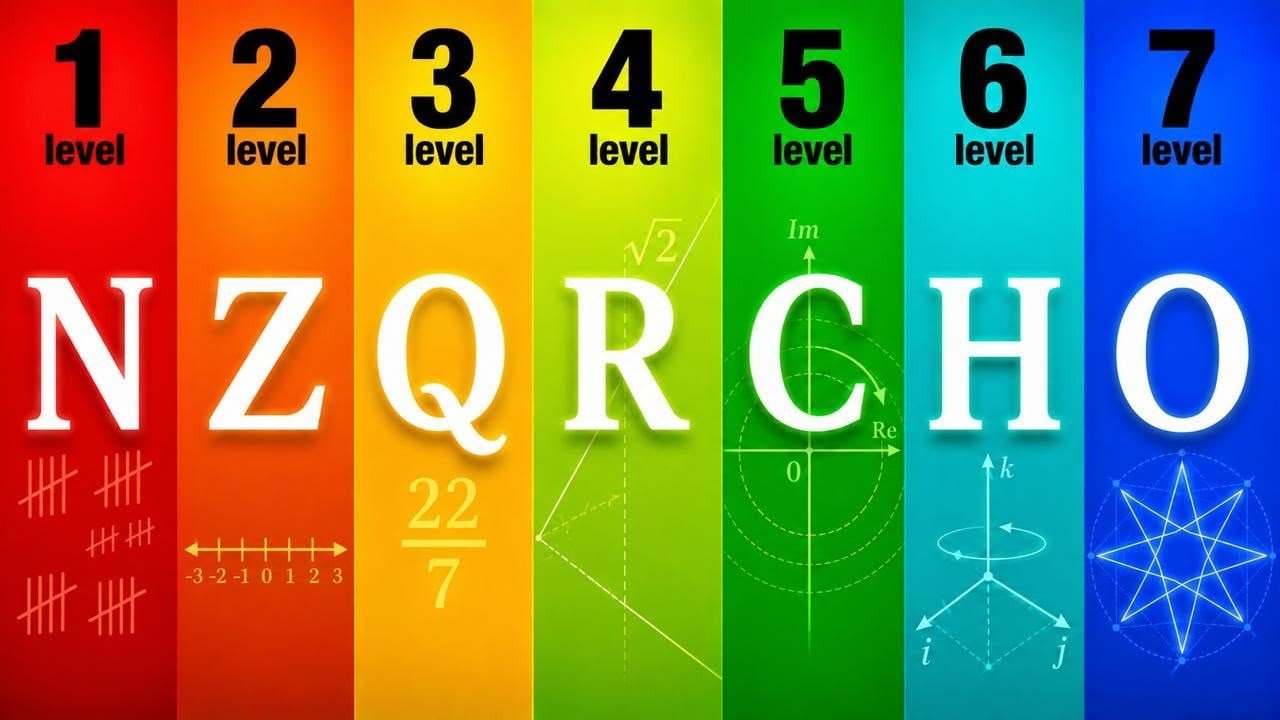
One useful way to organize the major number systems is as a ladder with seven levels:
- Natural numbers, N
- Integers, Z
- Rational numbers, Q
- Real numbers, R
- Complex numbers, C
- Quaternions, H
- Octonions, O
Many of these numbers faced resistance when mathematicians first encountered them.
Negative numbers were once dismissed as false or meaningless. Square roots of negative numbers were called imaginary. Greek legend even tells of a follower of Pythagoras who was thrown overboard at sea after revealing that sqrt(2) could not be written as a fraction.
Each new level expanded what mathematics could express. Subtraction led beyond the natural numbers. Division led beyond the integers. Irrational lengths led beyond the rational numbers. Polynomial equations led beyond the real numbers.
The later systems sacrificed familiar rules in exchange for new capabilities. Quaternions gave up commutative multiplication. Octonions went further and gave up associative multiplication.
At the end, a theorem proves that the process cannot continue while preserving all the same properties.
Natural Numbers
One of the oldest proposed mathematical artifacts is a baboon fibula with 29 notches carved into it.
Known as the Lebombo bone, it was discovered at Border Cave in the Lebombo Mountains, near the border between Eswatini and South Africa. Estimates place it more than 40,000 years in the past.
Some researchers have suggested that the 29 marks may have tracked a lunar or menstrual cycle. That interpretation remains uncertain. What is clear is that humans have been carving repeated marks into objects for tens of thousands of years.
Tallies may have been among the first methods humans used to represent numbers. They allowed people to keep track of things that came in separate, countable amounts.
These counting numbers became the natural numbers.
The set of natural numbers is written as N. In this article, it includes zero:
N = {0, 1, 2, 3, 4, 5, …}
Some mathematical conventions begin the natural numbers at 1 instead. Both definitions are used, so the intended convention should always be stated.
Natural numbers can be added or multiplied without leaving the set.
For example:
3 + 4 = 7
3 * 4 = 12
Both answers are natural numbers.
Subtraction creates a problem:
3 – 5 = -2
The answer is not a natural number.
To make subtraction work more generally, mathematics needed numbers below zero.
Integers
Some of the earliest surviving rules for calculating with negative quantities appear in the Chinese text The Nine Chapters on the Mathematical Art.
The work was compiled over a long period and reached its surviving form during the Han dynasty. It describes calculations using positive and negative quantities, represented with counting rods.
European mathematicians were much slower to accept negative numbers.
René Descartes helped introduce analytic geometry in 1637, placing algebraic relationships onto coordinate axes. Negative values could be interpreted as positions or directions on the opposite side of zero.
Even so, Descartes referred to negative solutions of equations as false roots. Negative numbers remained suspicious to many European mathematicians well into the early modern period.
Eventually, they became ordinary parts of arithmetic.
The integers contain all the natural numbers and all their negatives:
Z = {…, -3, -2, -1, 0, 1, 2, 3, …}
The letter Z is commonly connected to the German word Zahlen, meaning numbers.
The defining feature of the integers is that every integer has an additive inverse.
The additive inverse of 5 is -5 because:
5 + (-5) = 0
The additive inverse of -12 is 12 because:
-12 + 12 = 0
Integers can be added, multiplied, and subtracted without leaving the set.
Division creates the next problem:
3 / 2 = 1.5
The answer is not an integer.
A larger number system was needed to make division possible.
Rational Numbers
The Rhind Mathematical Papyrus is an Egyptian mathematical text dating to approximately 1550 BC.
It was written by a scribe named Ahmose, also spelled Ahmes, and appears to have been based on an older source. The surviving document contains 84 mathematical problems involving multiplication, division, fractions, areas, volumes, and other calculations.
Fractions had been used for thousands of years before negative numbers gained widespread European acceptance.
A rational number is any number that can be written as the ratio of two integers:
p / q
The denominator q cannot equal zero.
The set of rational numbers is written as Q, commonly associated with the word quotient.
Examples include:
1 / 2
-7 / 3
5, because 5 can be written as 5 / 1
0, because 0 can be written as 0 / 1
The restriction against dividing by zero is essential. Allowing division by zero would create contradictions with the ordinary rules of arithmetic.
The rational numbers make division possible whenever the divisor is not zero.
Every nonzero rational number has a multiplicative inverse, also called a reciprocal.
For example, the reciprocal of 3 / 4 is 4 / 3 because:
(3 / 4) * (4 / 3) = 1
Dividing by a nonzero rational number is equivalent to multiplying by its reciprocal.
For example:
5 / (2 / 3) = 5 * (3 / 2) = 15 / 2
For the Pythagorean tradition of ancient Greece, ratios of whole numbers appeared to offer a foundation for understanding quantity, harmony, and geometry.
Then the diagonal of a square refused to fit into that system.
Real Numbers
The Pythagoreans were a philosophical and mathematical community associated with Pythagoras in southern Italy during the sixth century BC.
Later tradition credits a Pythagorean named Hippasus with exposing a disturbing fact.
Consider a square whose sides each have a length of 1.
According to the Pythagorean theorem:
diagonal^2 = 1^2 + 1^2
Therefore:
diagonal^2 = 2
So:
diagonal = sqrt(2)
Suppose sqrt(2) can be written as a fraction p / q, with p and q having no common factor.
Then:
sqrt(2) = p / q
Square both sides:
2 = p^2 / q^2
Multiply both sides by q^2:
p^2 = 2q^2
This means p^2 is even. If p^2 is even, then p must also be even.
We can therefore write:
p = 2k
Substitute 2k for p:
(2k)^2 = 2q^2
Simplify:
4k^2 = 2q^2
Divide by 2:
2k^2 = q^2
This means q^2 is even, so q must also be even.
Both p and q are therefore divisible by 2. This contradicts the original assumption that p / q was already reduced to its lowest terms.
The assumption must be false.
Therefore:
sqrt(2) is not rational.
A number that cannot be written as the ratio of two integers is called an irrational number.
Legend says that Hippasus was thrown overboard at sea for revealing this discovery. The surviving historical evidence does not establish that this event actually occurred, but the story captures how disruptive irrational quantities appeared to the Pythagorean worldview.
The rational and irrational numbers together form the real numbers.
The set is written as R.
The real numbers fill the continuous number line. There are no missing points between rational numbers because irrational numbers occupy the gaps.
This property is called completeness.
Completeness makes the real numbers the foundation of calculus. Limits, continuous motion, derivatives, and integrals depend on having a number line without holes.
The real numbers solved the problem of irrational lengths, but another crisis appeared when mathematicians tried to solve certain equations.
Consider:
x^2 + 1 = 0
Subtract 1 from both sides:
x^2 = -1
No real number has a square equal to -1.
A new number was needed.
Complex Numbers
In 1545, the Italian mathematician Gerolamo Cardano published Ars Magna, one of the most important algebra books of the Renaissance.
The book presented methods for solving cubic and quartic equations. Some cubic equations created a bizarre situation.
The equation could have three ordinary real solutions, yet Cardano’s formula passed through intermediate calculations involving square roots of negative numbers.
Cardano worked with these expressions but regarded them as extremely subtle and practically useless.
In 1637, René Descartes used the term imaginary for roots involving square roots of negative quantities. The label was not originally a compliment, but it remained part of mathematical language.
The key step is to define a new number called i:
i^2 = -1
Equivalently:
i = sqrt(-1)
A complex number has the form:
a + bi
Here, a and b are real numbers.
The value a is the real part. The value b is the coefficient of the imaginary part.
Examples include:
3 + 2i
-5 + 7i
4, which can be written as 4 + 0i
6i, which can be written as 0 + 6i
The set of complex numbers is written as C.
The Complex Plane
Complex numbers can be represented as points on a two dimensional plane.
The horizontal axis represents the real part.
The vertical axis represents the imaginary part.
For example, the complex number:
3 + 2i
is represented by a point 3 units along the real axis and 2 units along the imaginary axis.
Caspar Wessel published an early geometric interpretation of complex numbers in 1799. Jean Robert Argand independently developed a similar representation in 1806. Carl Friedrich Gauss later helped establish and popularize this geometric viewpoint.
The resulting diagram is commonly called the complex plane or an Argand diagram.
The Fundamental Theorem of Algebra
The complex numbers solve the problem of polynomial roots.
The fundamental theorem of algebra states that every nonconstant polynomial with complex coefficients has at least one complex root.
An equivalent version says that a polynomial of degree n has exactly n complex roots when repeated roots are counted according to their multiplicity.
For example:
x^2 + 1 = 0
has the roots:
x = i
and:
x = -i
Because:
i^2 = -1
and:
(-i)^2 = -1
Gauss’s 1799 doctoral dissertation became an important landmark in the history of proving the theorem.
The theorem means that the complex numbers are algebraically closed. Solving polynomial equations does not force mathematicians to create another larger number system.
Complex multiplication also has a geometric meaning.
Multiplying a complex number by i rotates its point in the complex plane by 90 degrees counterclockwise.
For example:
1 * i = i
i * i = -1
-1 * i = -i
-i * i = 1
Repeated multiplication by i moves through four quarter turns around the origin.
This makes complex numbers indispensable in electrical engineering, signal processing, wave mechanics, control systems, and quantum physics.
Complex numbers handle rotations beautifully in two dimensions. Extending the same kind of arithmetic into three dimensional space proved much harder.
The solution required four dimensions.
Quaternions
On October 16, 1843, the Irish mathematician William Rowan Hamilton was walking with his wife along the Royal Canal in Dublin.
Hamilton had spent years trying to construct a three dimensional extension of complex numbers. Every attempt failed.
As he passed Brougham Bridge, now generally called Broom Bridge, the solution came to him.
Three dimensions were not enough. The new system required four components.
According to Hamilton’s account, he carved the defining equation into the stone of the bridge:
i^2 = j^2 = k^2 = i * j * k = -1
These relations define the quaternions.
A quaternion has the form:
a + bi + cj + dk
The values a, b, c, and d are real numbers.
The value a is the real component. The quantities i, j, and k are three distinct imaginary units.
The set of quaternions is written as H in honor of Hamilton.
Quaternions preserve addition, subtraction, multiplication, and division by any nonzero quaternion. They also preserve a useful concept of magnitude or length.
However, they sacrifice a rule that had been standard in ordinary arithmetic.
Multiplication is no longer commutative.
With ordinary real or complex numbers:
a * b = b * a
With quaternions:
i * j = k
but:
j * i = -k
Changing the order changes the answer.
This initially made quaternion arithmetic appear strange and inconvenient.
Vector analysis eventually displaced quaternions in much of physics. More than a century later, three dimensional computer graphics gave them a major practical revival.
Quaternions provide an efficient and stable way to represent rotations in three dimensional space. They are widely used in computer animation, robotics, aerospace systems, spacecraft orientation, games, and virtual reality.
Hamilton’s discovery raised another question.
Could the construction be extended again?
Octonions
Soon after Hamilton discovered quaternions, his friend John Graves began experimenting with a further extension.
Graves developed an eight dimensional system now called the octonions. Arthur Cayley later published work on the same system, which is why octonions are sometimes called Cayley numbers.
An octonion has eight real components:
a0 + a1e1 + a2e2 + a3e3 + a4e4 + a5e5 + a6e6 + a7e7
There is one real component and seven imaginary units.
Each imaginary unit squares to -1:
e1^2 = e2^2 = e3^2 = e4^2 = e5^2 = e6^2 = e7^2 = -1
The set of octonions is written as O.
The octonions preserve division by nonzero elements and a multiplicative notion of magnitude.
However, they sacrifice another familiar rule.
Quaternion multiplication is not commutative, but it remains associative.
For quaternions:
(a * b) * c = a * (b * c)
For octonions, this equation is not always true.
In general:
(a * b) * c does not always equal a * (b * c)
The placement of parentheses can change the result.
Octonions are therefore both noncommutative and nonassociative.
They are far less common in practical engineering than complex numbers or quaternions. However, they appear in advanced areas of mathematics and theoretical physics, including exceptional Lie groups, supersymmetry, particle physics, and some approaches to string theory.
Why the Ladder Stops
The hierarchy does not stop because mathematicians are unable to construct any larger algebraic systems.
Systems larger than the octonions do exist. The next Cayley Dickson construction produces the 16 dimensional sedenions, followed by systems with 32, 64, and more dimensions.
The problem is that these larger systems lose important properties.
In 1898, the German mathematician Adolf Hurwitz proved a result now associated with the classification of normed division algebras.
Under the relevant conditions, there are only four finite dimensional real normed division algebras:
- Real numbers, R, with dimension 1
- Complex numbers, C, with dimension 2
- Quaternions, H, with dimension 4
- Octonions, O, with dimension 8
In these systems, nonzero numbers can be divided, and the magnitude of a product equals the product of the magnitudes:
magnitude(a * b) = magnitude(a) * magnitude(b)
No 16 dimensional extension can preserve all these properties.
The sedenions, for example, contain nonzero elements whose product equals zero. These are called zero divisors.
If:
a is not 0
and:
b is not 0
but:
a * b = 0
then ordinary division cannot work consistently.
This is the precise sense in which the ladder ends at the octonions.
Seven Levels of Numbers
The complete seven stage ladder described here is:
- Natural numbers, N
- Integers, Z
- Rational numbers, Q
- Real numbers, R
- Complex numbers, C
- Quaternions, H
- Octonions, O
Each expansion solves a limitation or introduces a new mathematical capability.
Natural numbers count discrete objects.
Integers make unrestricted subtraction possible.
Rational numbers make division possible whenever the divisor is nonzero.
Real numbers complete the continuous number line and include irrational quantities such as sqrt(2).
Complex numbers provide solutions to every polynomial equation.
Quaternions represent rotations in three dimensional space while preserving division and magnitude.
Octonions extend the pattern one final time while preserving the structure of a normed division algebra.
The progression comes with a cost.
Moving from real numbers to complex numbers introduces a new imaginary direction.
Moving from complex numbers to quaternions sacrifices commutative multiplication.
Moving from quaternions to octonions sacrifices associative multiplication.
Beyond the octonions, division itself breaks.
The seven levels are not simply a collection of increasingly strange inventions. They reveal how far familiar arithmetic can be extended before its defining properties begin to disappear.
Leave a Reply