
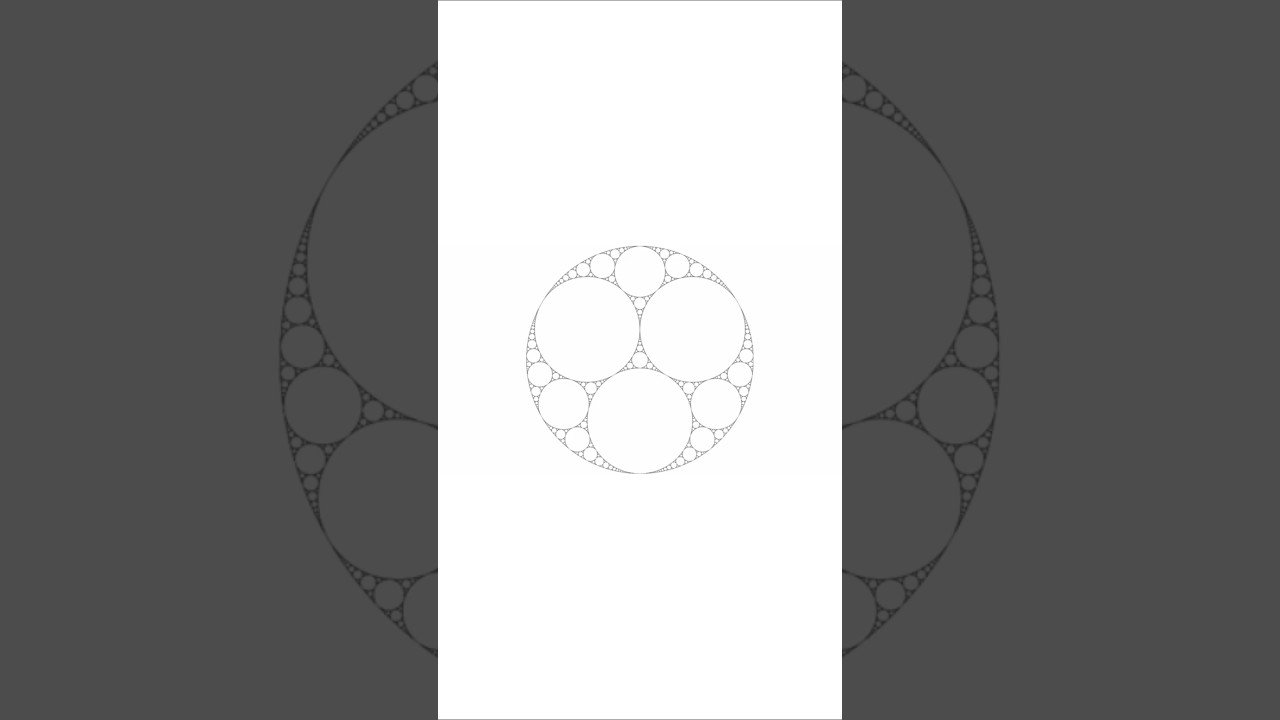
Let’s start by drawing a circle named C₁. Draw a second circle, C₂, that touches C₁ at just one point. Now draw a third circle, C₃, that is tangent to both C₁ and C₂. With these three circles in place, we can always draw exactly two more circles that are tangent to all three.
Let’s keep going. Inside the largest circle, but outside all the circles contained within, there are six gaps that look like curved triangles. We can draw another circle inside each of these gaps, making the new circle tangent to each of its neighboring circles. Once we are done, we have created 18 new triangular gaps, which we can fill with tangent circles as well.
We can keep repeating this process forever. In the limit, we get an infinitely detailed shape: a fractal. This particular fractal is called the Apollonian gasket.
What Makes the Apollonian Gasket Special?
The Apollonian gasket is named after Apollonius of Perga, an ancient Greek mathematician known for his work on conic sections and tangent circles. What makes this fractal remarkable is that it arises from a simple, repeating geometric rule, yet produces a structure of extraordinary complexity. The gasket is self-similar, meaning that if you zoom into any region, you find smaller copies of the same pattern repeating endlessly. It has connections to number theory, hyperbolic geometry, and even physics. The curvatures of the circles in an Apollonian gasket follow surprising integer relationships described by Descartes’ Circle Theorem, which states that if four mutually tangent circles have curvatures k₁, k₂, k₃, and k₄, then (k₁ + k₂ + k₃ + k₄)² = 2(k₁² + k₂² + k₃² + k₄²).
Leave a Reply