Geometric Algebra Explained: Vectors, Bivectors, and the Geometric Product
Geometric algebra opens up a whole new world of possibilities in math and physics. It extends the familiar ideas of linear algebra by introducing new objects and a new way of multiplying vectors together. From simplifying complex calculations to understanding rotations, reflections, and even quantum mechanics, geometric algebra gives you tools that standard linear algebra simply cannot provide. Let us explore the core concepts from the ground up.
Vectors and Scalars
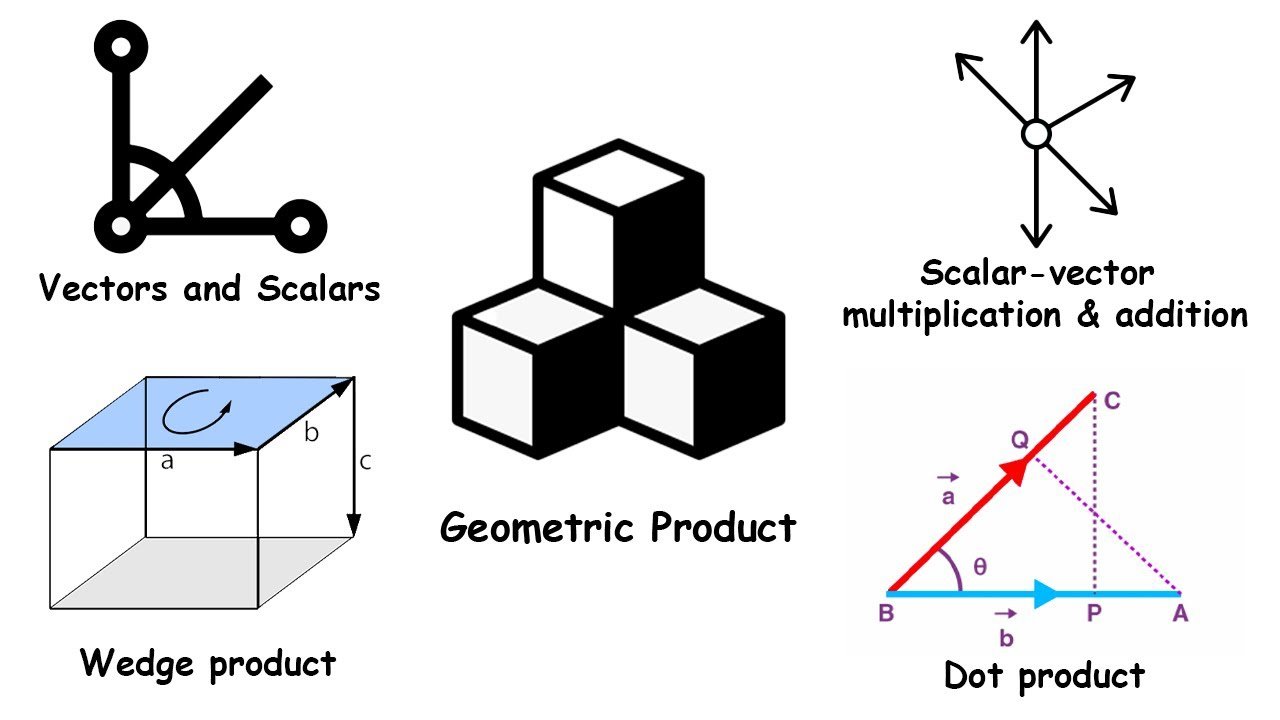
Vectors are one of the main subjects of study in geometric algebra, just as they are in linear algebra. A vector is a geometric object: an arrow with a length and a direction. The starting point of a vector is called its tail and the ending point is its head. The length of a vector is called its magnitude. Direction and magnitude are the only properties that define a vector, meaning that two vectors with the same direction and magnitude are the same vector regardless of where you draw them.
A vector can exist in any number of dimensions, including more than three, even if that is hard to visualize. There is also a special case called the zero vector, which has no direction and a magnitude of zero.
In two dimensions, a vector is represented by a pair of numbers. If you place the tail at the origin, the numbers are simply the coordinates of the head. For instance, the vector (3, 2) points 3 units to the right and 2 units upward.
Vectors model real-world quantities like displacement, which points from a starting position to a current position, and velocity, where the direction tells you which way an object moves and the magnitude tells you how fast. The word scalar is simply a fancy term for a number, named for the role numbers play in scaling vectors.
Scalar Multiplication and Vector Addition
Multiplying a vector by a scalar scales it. Multiplying by 2 doubles its length while keeping the direction the same. Multiplying by 1/2 squishes it to half its length. Multiplying by a negative scalar reverses the direction; multiplying by -3 flips the vector and triples its length. To carry this out, you simply multiply each component by the scalar. The vector (3, 2) scaled by 2 becomes (6, 4).
Adding two vectors produces another vector. To add them geometrically, place the tail of the second vector at the head of the first, then draw the vector from the first tail to the second head. Algebraically, you just add corresponding components. Adding (2, 1) and (3, 4) gives (2 + 3, 1 + 4) = (5, 5). You can think of this as traveling along the first vector and then along the second, with the sum being your total displacement.
Using scalar multiplication and addition together, you can reach any vector in a space by starting from a finite set of vectors called a basis. In n-dimensional space you need exactly n basis vectors. In two dimensions, the standard basis vectors for geometric algebra are e₁ pointing right and e₂ pointing up. The vector (2, 1.5) can be written as 2e₁ + 1.5e₂. In general, any vector v with components a₁ and a₂ is written as v = a₁e₁ + a₂e₂.
The Dot Product
The dot product of two vectors is the sum of the products of their corresponding components. For example, take v = 2e₁ + 5e₂ and w = -2e₁ + e₂. The dot product v · w is computed as (2)(-2) + (5)(1) = -4 + 5 = 1.
There is a geometric interpretation. Project v onto w to get a vector describing how much of v points in the same direction as w. Multiply the magnitude of that projection by the magnitude of w and you get the dot product. You can do this in either order and get the same result, which means the dot product satisfies the commutative property. An equivalent formula uses magnitudes directly:
v · w = |v| |w| cos(θ)
where θ is the angle between the two vectors.
The Wedge Product
The wedge product is the first concept in this discussion that is exclusive to geometric algebra. The wedge product of two vectors v and w, written v ∧ w, produces a new kind of object called a bivector.
A bivector can be thought of as an oriented plane segment, just as a vector can be thought of as an oriented line segment. A bivector has an orientation (clockwise or counterclockwise), an attitude (which plane it lies in), and a magnitude equal to its area. Two bivectors are the same if all three of those match.
To compute v ∧ w geometrically, place the tails of both vectors at the same point and draw the parallelogram they span. The order matters: the first vector determines whether you travel clockwise or counterclockwise around the parallelogram. The specific shape does not matter, only the area and orientation.
The wedge product is closely related to the cross product from linear algebra. Both are useful in the same physical contexts, but the wedge product is far more versatile because it is not restricted to exactly three dimensions the way the cross product is.
Torque is a good example. Suppose you are using a 100 cm wrench to screw a bolt counterclockwise out of the floor. Torque depends on the force vector F and the position vector r pointing from the bolt’s axis of rotation to where you apply force. In standard vector calculus, torque is written as r × F, producing a vector pointing along the axis of rotation. In geometric algebra you write r ∧ F, which produces a bivector that captures all the same properties: it increases with greater force, it increases the farther your hand is from the axis, and it encodes an orientation. Unlike the cross product, the wedge product does not require invoking a third dimension, and it behaves correctly under reflections and other transformations.
The Geometric Product
One of the defining features of geometric algebra is the ability to multiply two vectors together. The geometric product of v and w, written simply as vw, is defined as:
vw = v · w + v ∧ w
This immediately raises a question: the dot product produces a scalar and the wedge product produces a bivector, so how can you add them? It seems algebraically impossible, but geometric algebra simply accepts this the same way complex numbers accept adding a real number and an imaginary number. The result is a mixed object, neither purely scalar nor purely bivector.
To see this in action, take the basis vectors e₁ and e₂. Because they are perpendicular, their dot product is zero. Their wedge product is a bivector called the unit bivector, often written e₁e₂. So the geometric product of e₁ and e₂ is just that unit bivector.
In higher dimensions, you can form trivectors, four-vectors, five-vectors, and so on by taking the wedge product of three or more vectors. Any combination of a scalar, vectors, bivectors, and higher-grade objects is called a multivector, and multivectors are the central objects of study throughout all of geometric algebra.
Leave a Reply