
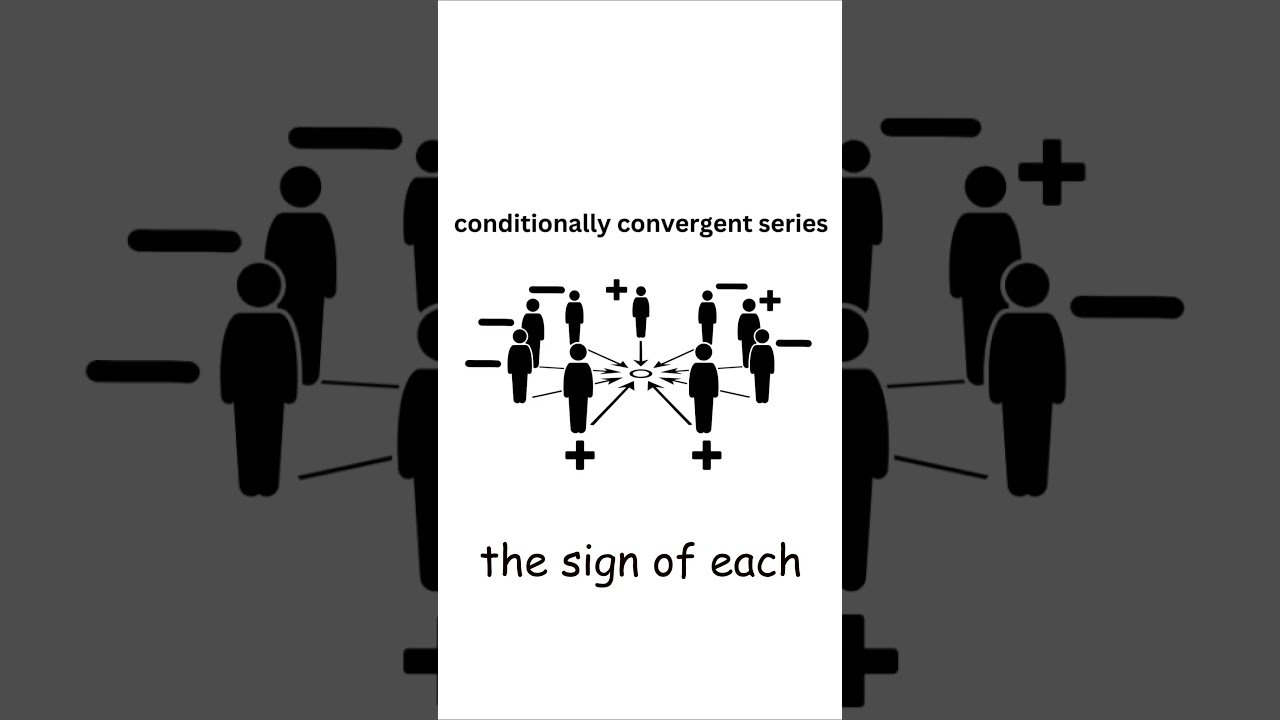
The Riemann Series Theorem
The Riemann series theorem, named for and rigorously proved by German mathematician Bernhard Riemann, involves conditionally convergent series. A conditionally convergent series is one that converges only under the condition that the sign of each term is taken into account. If you were to take the absolute value of every term, the series would diverge.
The Key Idea
To understand the Riemann series theorem, consider grouping all the terms of a conditionally convergent series into two groups: the positive terms and the negative terms. Since the series is conditionally convergent, both the positive terms and the negative terms individually diverge to ∞ and −∞ respectively. The series only converges because the positive and negative terms balance each other out.
Riemann’s remarkable result states that by rearranging the terms of a conditionally convergent series, you can make it converge to any real number you choose, or even make it diverge to ∞ or −∞. The sum is entirely dependent on the order in which the terms are arranged.
Why Does This Matter?
The Riemann series theorem reveals something deeply counterintuitive about infinite sums. In finite arithmetic, the order in which you add numbers does not matter. But once you enter the realm of conditionally convergent series, that familiar rule breaks down completely. This result has important implications in mathematical analysis, as it draws a sharp distinction between conditional and absolute convergence. An absolutely convergent series will always produce the same sum regardless of how its terms are rearranged, making absolute convergence the more robust and reliable property. The theorem serves as a powerful reminder that intuition built from finite experience does not always carry over to the infinite.
Leave a Reply