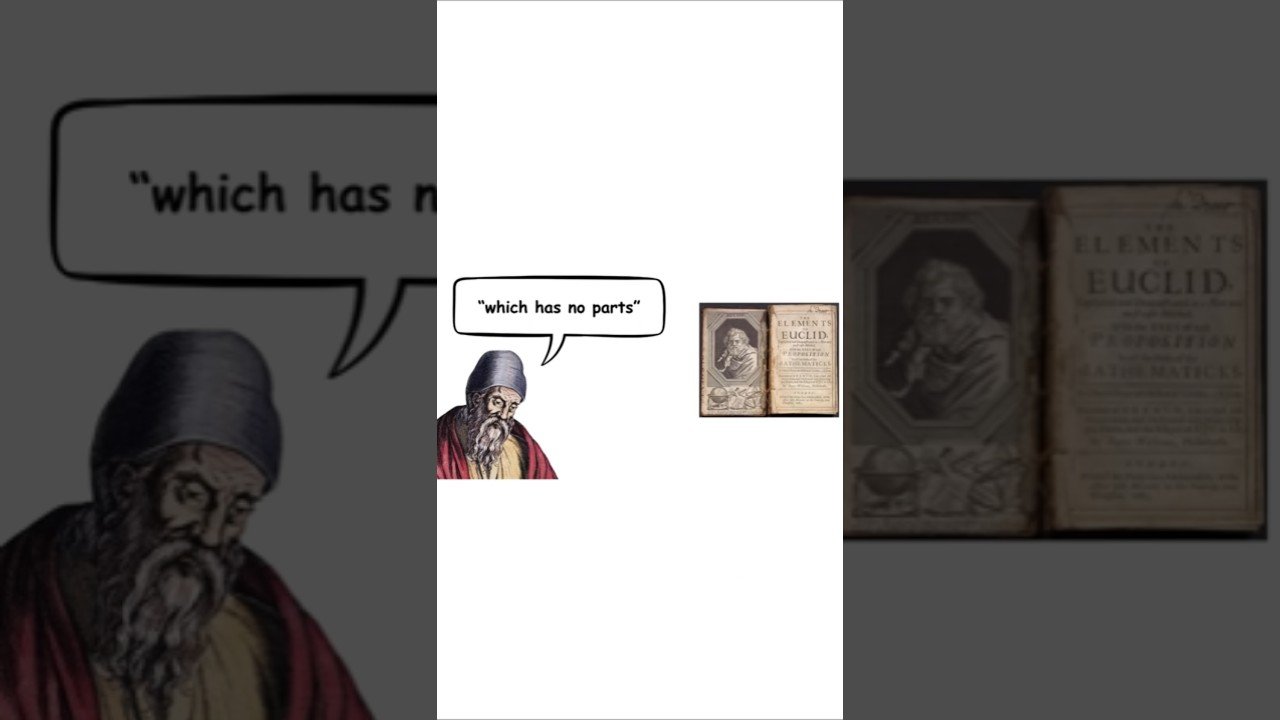
Zero dimension corresponds to the point, defined since antiquity as the entity without length, width, or depth. Euclid described it in his work Elements around 300 BC as “that which has no parts,” establishing the foundation upon which geometry is built.
What Is a Point?
A point has no measurable magnitude but serves the essential function of indicating an exact position in space. In modern notation, a point is represented by an ordered set of coordinates, such as (x) on the line, (x, y) on the plane, or (x, y, z) in three-dimensional space. In all cases, the object itself remains zero-dimensional since it lacks extension.
The notion of the point was not only the beginning of classical geometry but continues to be a central tool in mathematical and scientific formulation today. Every line, surface, and solid in geometry is built from points, yet a point itself contains nothing. It is the smallest possible geometric object, occupying no space at all, and that paradox is exactly what makes it so useful as a foundation.
Leave a Reply