The Möbius Strip: The Surface with Only One Side
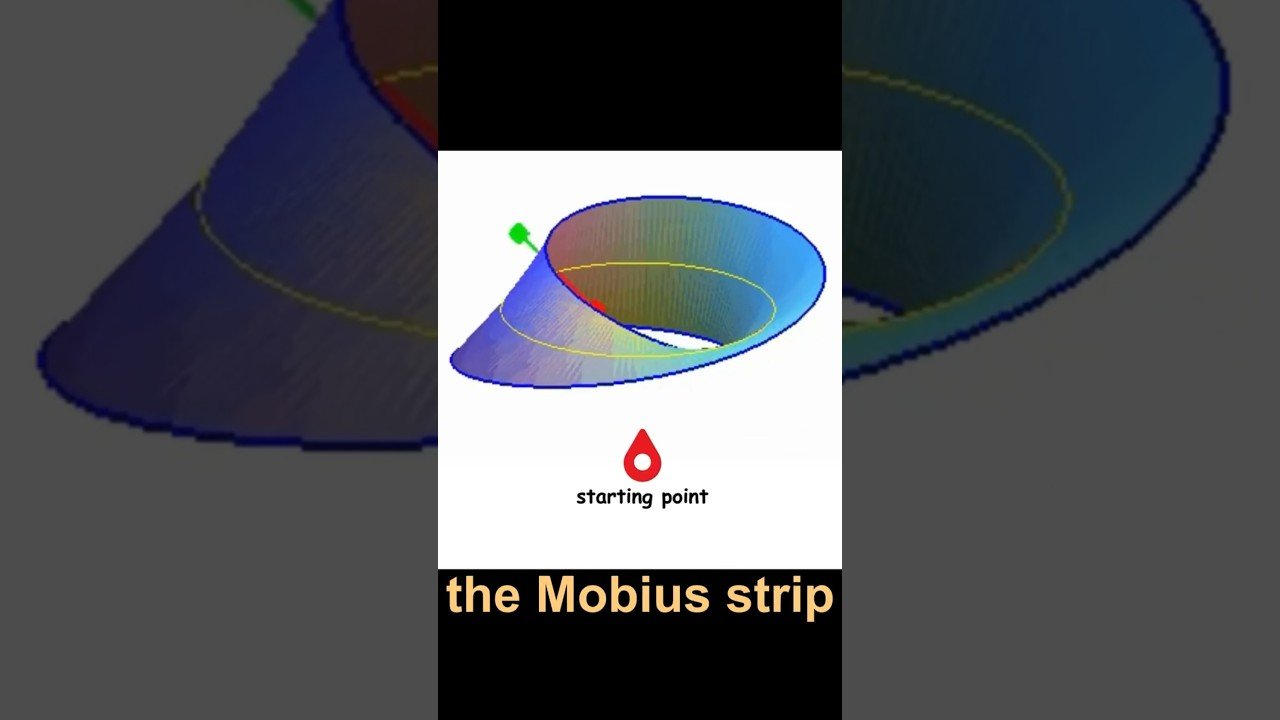
Let’s start with a Möbius strip, named after German mathematician August Ferdinand Möbius. This is an object you could make at home. Just take a paper strip, give one end a half twist, and attach the ends together. The result is a piece of paper with just one side.
What Is a Nonorientable Surface?
The Möbius strip is something called a nonorientable surface, meaning that clockwise and counterclockwise rotation cannot be distinguished within it. If you imagined yourself traveling along the length of the Möbius strip, upon returning to your starting point you would find yourself upside down from your starting orientation.
Of course, this supposes that you are a 3D object traveling on top of the Möbius strip. But if you are actually a 2D object living within the Möbius strip, then traveling along it back to your starting position would cause you to become your mirror image. Rotations that once looked clockwise would now look counterclockwise. So an orientation cannot be consistently defined for this surface.
The Möbius strip also has only one edge. If you trace your finger along the boundary, you will travel the entire edge and return to where you started without ever lifting your finger. Try cutting a Möbius strip down the middle lengthwise and you do not get two separate strips. Instead you get a single, longer strip with a full twist, which is now orientable. These strange properties made the Möbius strip one of the first objects studied in topology, where shapes are classified not by their measurements but by their structural properties.
Leave a Reply