
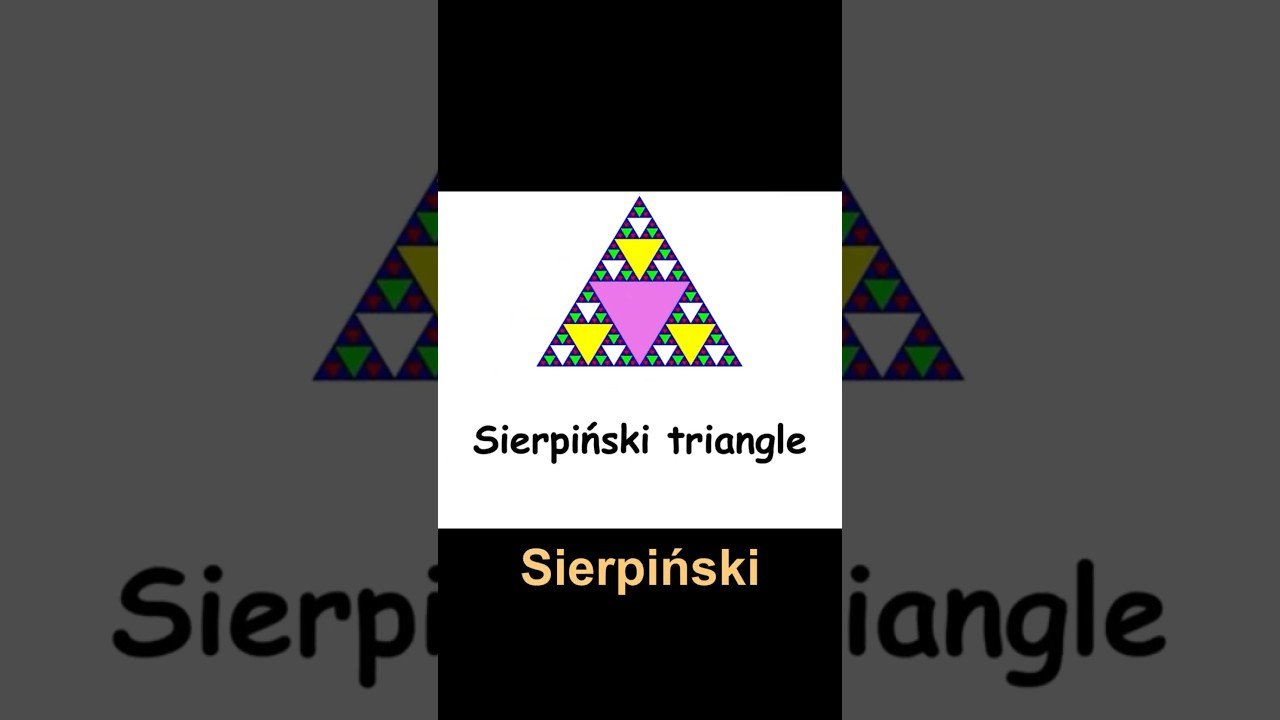
The Sierpiński Triangle: A Fractal Built from Itself
Take three identical equilateral triangles and join them at the vertices so that they form another equilateral triangle in the middle. Then shrink this shape down by a factor of 1/2. Take three identical copies of it and join them in a similar way. If you repeat this process over and over again, the shape you end up approaching is called the Sierpiński triangle, named after Polish mathematician Wacław Sierpiński.
A Fractal with Infinite Detail
The Sierpiński triangle is an example of a fractal, which is essentially a shape that has infinite detail. No matter how far you zoom in, it never smooths out. In particular, the Sierpiński triangle is a self-similar fractal. It is composed of three smaller copies of itself, each of which is composed of three even smaller copies, and so on without end.
What makes this fractal especially interesting is its dimension. The Sierpiński triangle is not quite one-dimensional like a line, and not quite two-dimensional like a filled surface. Its fractal dimension is log(3)/log(2), approximately 1.585. It has more substance than a line but less than a plane. It also has zero area despite being constructed from triangles, since every iteration removes the middle triangle, and in the limit all area is removed while the boundary structure remains infinitely complex.
Leave a Reply