
Why does infinity never behave like a normal number? People think infinity is just a really big number, but infinity is the most broken idea in math, as it does not follow basic rules. Today we’ll cover infinity from ancient India and Greece all the way to the modern mathematics that rigorously define infinity today.
India and Infinity
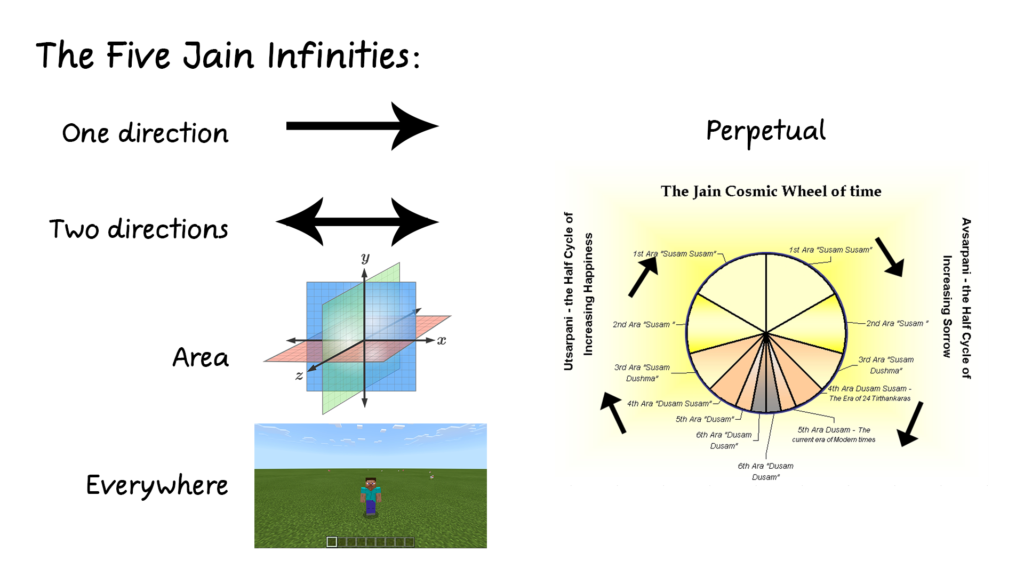
The earliest conceptions of infinity are found in Jain and Vedic texts from Ancient India. Jain mathematicians classified multiple types of infinities, and Vedic cosmology described endless cycles of creation and destruction. These ideas were woven into philosophy, cosmology, spirituality, and logic. Historical conceptions of infinity are often inseparable from concepts of divine nature.
Greek Philosophers and Infinity
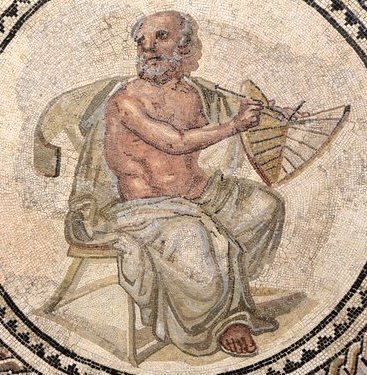
Anaximander (610 BC – 546 BC)
The Greeks first grappled with the problem of infinity through their study of matter. They asked: could matter be divided into smaller and smaller pieces, or would we eventually reach a fundamental particle that could not be divided further?
The Pythagoreans believed the world could be described through whole numbers and ratios, but it was discovered that that the diagonal of a unit square, the square root of 2, cannot be expressed as a ratio of two integers, and is therefore irrational. This showed that lines could not be described as a sequence of tiny points strung together, a problem that would be addressed two thousand years later with the concept of infinitesimals.
The earliest Greek idea of infinity appears about 300 years before Aristotle, with Anaximander, who introduced the concept of apeiron, meaning “the boundless” or “unlimited.” This idea arose from the observation that creation and decay are continuous processes with no clear beginning or end.
Later, Aristotle formalized the discussion by dividing infinity into potential and actual infinity.
Potential infinity describes a process that can continue indefinitely, such as counting the set of real numbers, or endlessly dividing a line segment.
Actual infinity refers to a completed infinite totality, an entire infinite set existing all at once.
Aristotle rejected actual infinity, arguing that a completed infinite magnitude is paradoxical and cannot exist in the physical world. This distinction profoundly shaped Western thought for nearly two thousand years.
Infinity in Calculus
As mathematics evolved, especially with the rise of calculus in the 17th century, the need to grapple with actual infinity became unavoidable.
Mathematicians were working with motion, change, and quantities that could grow without bound or shrink infinitely small. The powerful tool we know as calculus was capable of being applied to anything involving change.
The concept of limits allowed Newton to describe the value a function approaches as its input grows infinitely large or small. Later, Karl Weierstrass formalized this idea, providing a precise definition of the limit of f of x as x approaches infinity.
Isaac Newton and Gottfried Leibniz relied on the concept of potential infinity in developing their calculus frameworks. Both independently developed infinitesimals, quantities smaller than any finite number but greater than zero. This enabled them to define derivatives and integrals rigorously, even though these tiny quantities could not be measured directly.
Calculus allowed mathematicians to reason about continuous motion and area under curves, but it also raised questions about the nature of numbers and the infinite, which would not be fully resolved until the development of rigorous analysis in the 19th century.
Countable Infinity
George Cantor revolutionized mathematics by creating set theory and showing that infinity can be treated as something precise, measurable, and comparable. He introduced the idea that there are different sizes of infinity, forming a hierarchy rather than a single, uniform notion.
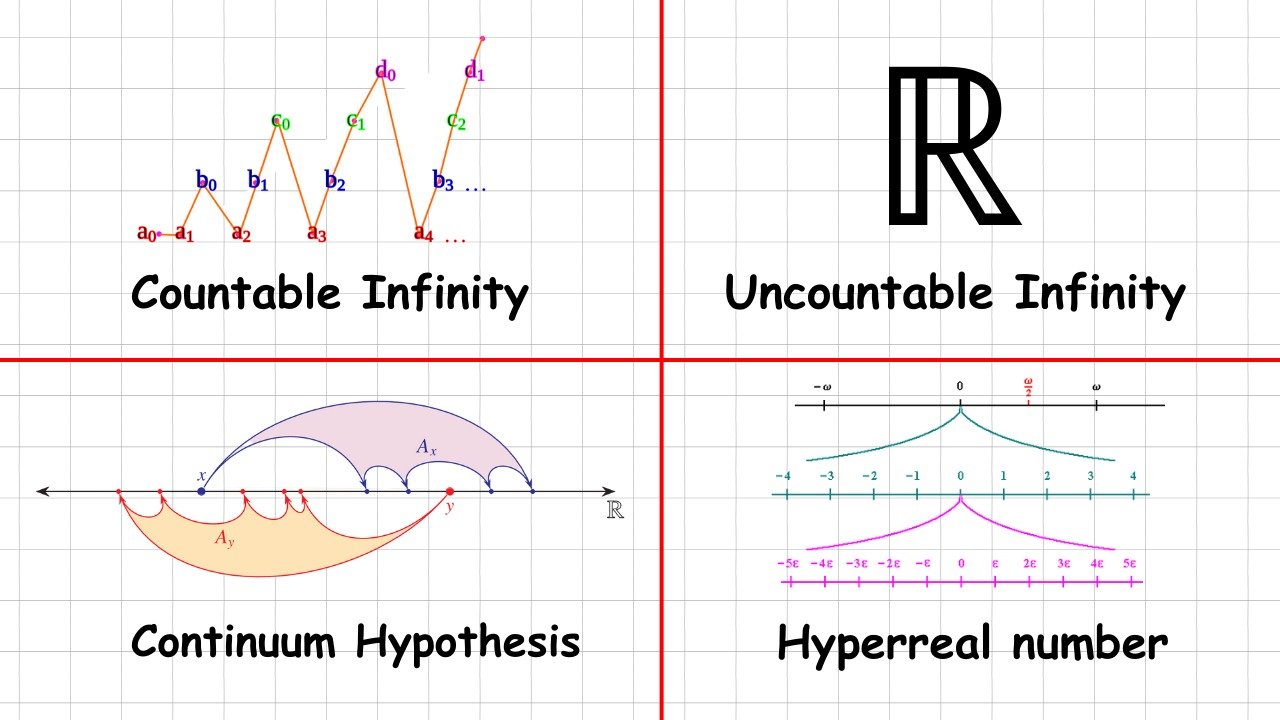
Cantor’s first major step was the concept of countable infinity: an infinite set whose elements can be matched one-to-one with the natural numbers. Classic examples include the natural numbers themselves, the integers, and even the rational numbers. This made the notion of an actual, completed infinite set into a rigorous mathematical object, rather than a philosophical idea.
Uncountable Infinity (The continuum)
Cantor then showed that some infinities are strictly larger than countable infinity. His most famous example is the set of real numbers between 0 and 1. Using his diagonal argument, he proved that no matter how one tries to list all real numbers in a sequence, some will always be left out. This means the set of real numbers is uncountable: its infinity is strictly larger than the countable infinity of the natural numbers.This was the first time that anyone proved some infinities are larger than others.
This uncountable infinity is known as the continuum, the infinity of the real numbers, denoted by the letter ℝ with blackboard bold font. The discovery that the continuum is a larger infinity than that of the natural numbers showed, for the first time, that infinities come in different sizes. Before Cantor, most mathematicians assumed all infinite sets were “the same size,” so this result fundamentally reshaped the conceptual foundations of mathematics.
This means that a tiny segment of the number line contains more numbers than all counting numbers combined. From this point on, infinity was no longer a single idea. It became a hierarchy, where different infinities could hold different ranks in relation to each other.
The Aleph Hierarchy
From there, Cantor developed the aleph hierarchy to classify different sizes of infinity using aleph numbers. It begins with the smallest infinite size and then climbs step by step through ever larger infinite cardinalities.
The starting point is aleph-null, written aleph sub zero . Aleph-null is the size of any countably infinite set, such as the natural numbers, the integers, and the rational numbers. All of these sets can be put into a one-to-one correspondence with the natural numbers, so they all share the same infinite cardinality.
Above Aleph-null comes Aleph-one. By definition, Aleph-one is the smallest cardinal strictly bigger than aleph-zero. More generally, for each ordinal index, there is a corresponding infinite aleph, continuing indefinitely.
The aleph hierarchy continues far beyond aleph-one
Each new aleph-alpha represents a strictly larger infinity than all earlier ones, creating an unending landscape of transfinite sizes.
Modern set theory studies subtle properties of these higher alephs, including large cardinals, which sit very high in the hierarchy and have strong combinatorial and logical consequences.
Ordinal Infinities
So far, infinities have been about “how many” elements a set has, but Cantor also discovered a different kind of infinity that captures “in what order” those elements appear. Ordinal numbers extend the familiar sequence 1, 2, 3, … into the transfinite, describing infinite positions in an ordered list, not just sizes of sets.
The first infinite ordinal, denoted by lowercase omega, corresponds to the natural numbers lined up in their usual order. But new ordinals arise when you keep going past omega. For example, omega plus one is like taking all the natural numbers and then putting one extra element at the end, and omega plus two is like two back-to-back copies of the natural numbers. These transfinite ordinals form their own vast hierarchy.
Power Sets and the Continuum Hypothesis
Cantor’s diagonal argument suggested a general recipe for making bigger infinities: take any set and look at its power set, the set of all its subsets. The power set of a countably infinite set (like the natural numbers) has strictly larger cardinality than the original, and this leap in size is exactly what produces the continuum; the cardinality of the real numbers.
This leads to a natural question: is the continuum the very next step after aleph-null, or are there intermediate sizes of infinity in between? The Continuum Hypothesis asserts that there is no middle size: that the continuum is exactly aleph-one.
Hyperreal Infinities and Infinitesimals
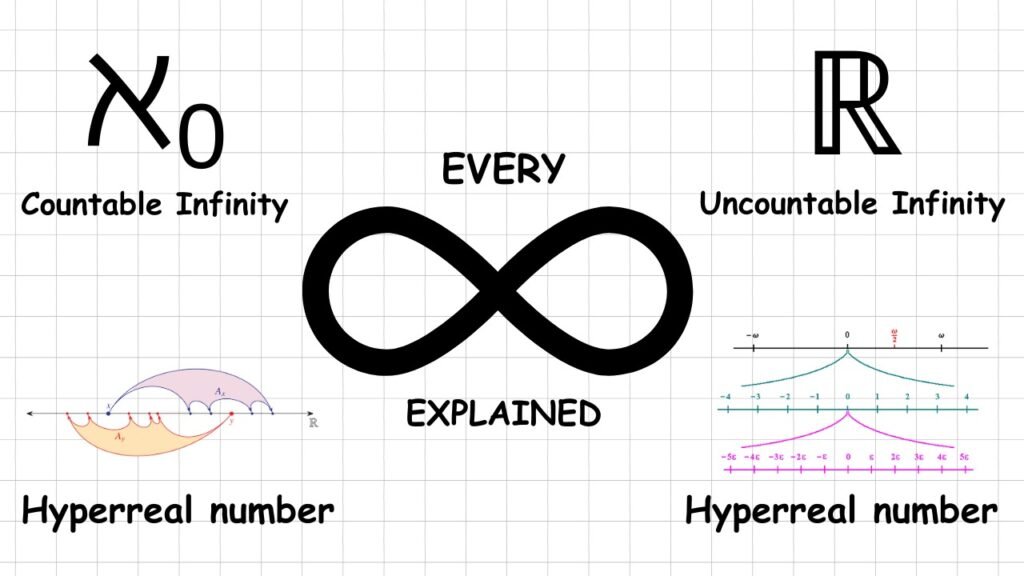
While Cantor focused on infinite sets and their sizes, another line of thought asked whether the infinitesimals of early calculus could be given a rigorous modern life. Nonstandard analysis, developed in the 20th century, constructs the hyperreal numbers: an extension of the real line that includes infinitely small and infinitely large numbers alongside the ordinary reals.
In the hyperreal system, an infinitesimal is a nonzero number smaller in absolute value than any positive real number, and infinite hyperreals are larger than any standard real. This framework lets limits, derivatives, and integrals be recast using infinitesimals in a way that looks very close to the intuitive reasoning of Newton and Leibniz, while resting on a precise set-theoretic foundation.
Large Cardinals and the Edge of Infinity
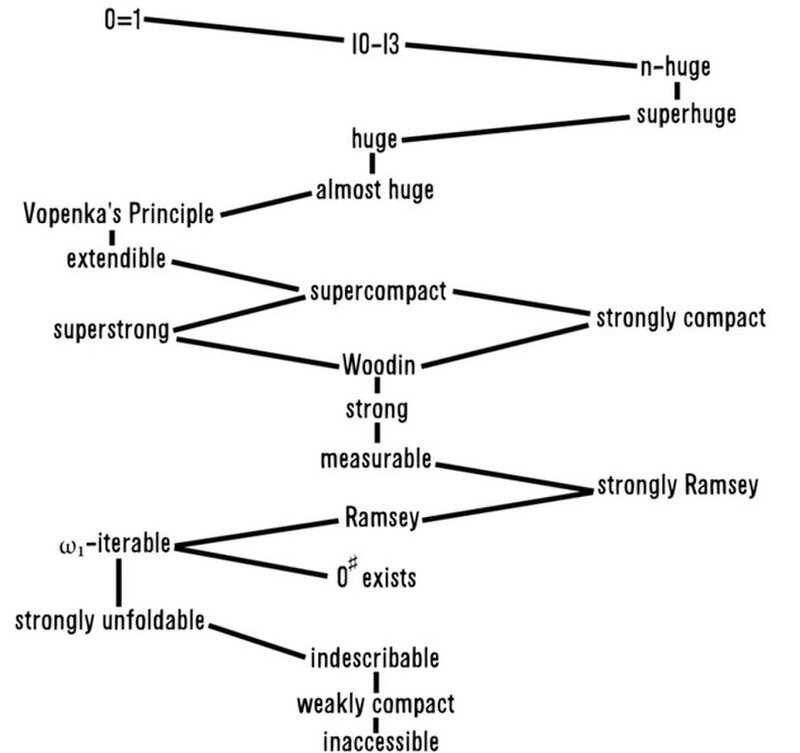
At the highest reaches of the infinite landscape lie the large cardinals; hypothetical infinities so immense that their existence has profound consequences for the rest of mathematics. Each large cardinal axiom says, in effect, “there is an infinite set of such enormous size and structure that certain powerful regularity properties hold.”
Examples include inaccessible, measurable, and supercompact cardinals, each marking a new rung far above the basic aleph hierarchy. Large cardinals often imply regularity results about sets of real numbers and help calibrate the strength of different mathematical theories. They also interact closely with independence phenomena like the Continuum Hypothesis, giving set theorists a kind of “map” of how strong various assumptions about infinity really are.
Large cardinal axioms are far beyond what is needed for normal analysis, algebra, or numerical work, so no one needs a measurable or supercompact cardinal to design a bridge, run machine learning, or compute an orbit. Instead, their value is mainly as tools in foundations and logic, clarifying what standard axioms (like ZFC) can and cannot prove.
The infinity Symbol – Lemniscate of Bernoulli
The infinity symbol itself originates from a curve known as the lemniscate of Bernoulli, an elegant, figure-eight loop studied by Jakob Bernoulli in the 17th century. Bernoulli was fascinated by its self-repeating, endless nature. A few decades later, mathematician John Wallis adopted this shape as a symbol for infinity.
Throughout history infinity has never behaved like a normal number, because it was never meant to be one. It is meant to describe what happens when our rules reach their limit.
Leave a Reply