
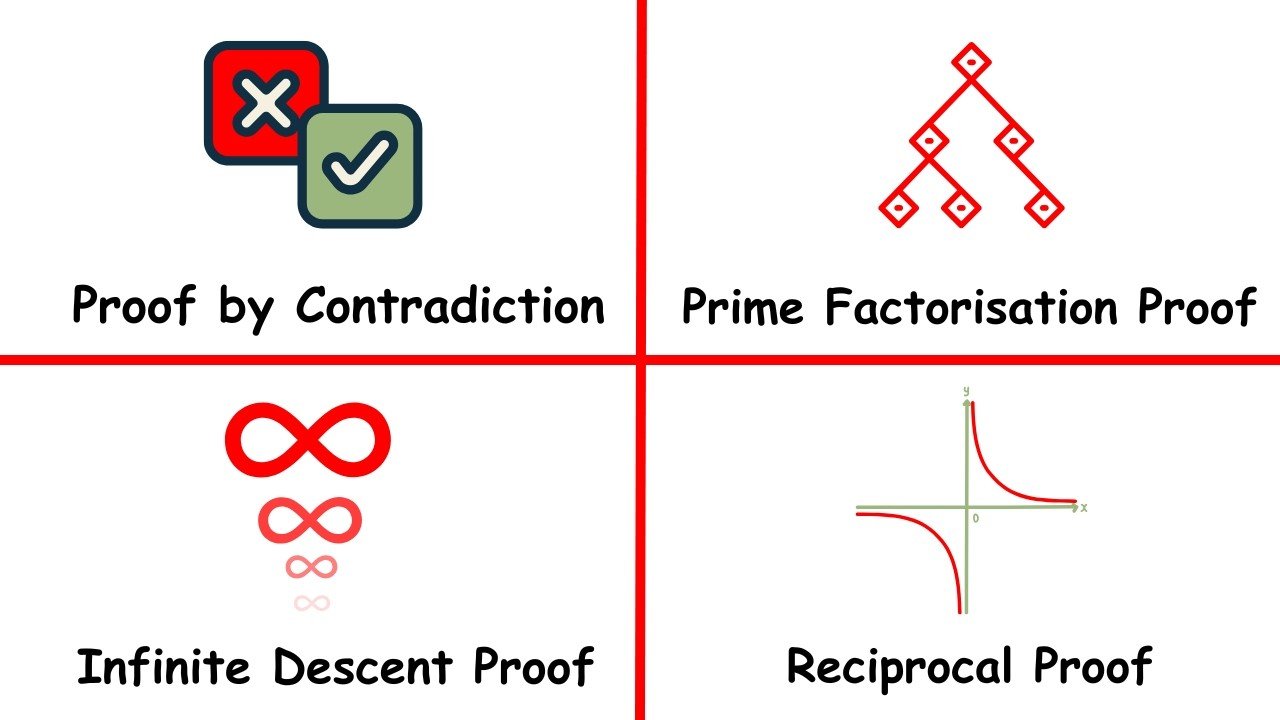
Four Proofs That √2 Is Irrational
The square root of 2, or 2^(1/2), is irrational. That is, it’s a real number that cannot be expressed as the ratio of two integers. Its decimal expansion is non-terminating and non-repeating. Let’s go over a few ways to discover this fact.
Proof by Contradiction
We’ll start with the classic method called proof by contradiction. We begin with a set of assumptions, then show that if those assumptions are true, they must lead to an impossible conclusion. When this happens, it shows that the assumptions we began with must be wrong.
Let’s assume √2 can be represented as a simple fraction of whole numbers, a/b, where a and b have no common factors other than 1. In mathematical terms, they are coprime. From this we can write the equality √2 = a/b. Squaring both sides gives us (√2)² = (a/b)². The square of a square root is just the number itself, so this becomes 2 = a²/b².
Now let’s multiply both sides by b². We find a² = 2b². Since b is a whole number, its square must also be a whole number, and 2 times a whole number is always even, meaning a² must be even. Thus a itself is even, because a whole number must be either odd or even, and the square of an odd number is odd.
But if a is even, we can express it as 2k for some integer k. Substituting a = 2k into a² = 2b² gives (2k)² = 2b². Distributing the exponent, we get 4k² = 2b². Dividing both sides by 2, we find 2k² = b². Similarly to before, k² is a whole number, so 2k² is even, and the equal value b² must be even as well. Since b² is even, b must also be even.
If both a and b are even, they share a common factor of 2, contradicting our initial assumption that a and b share no common factors except 1. Hence √2 cannot be rational.
This is the most famous proof, often attributed to ancient Greek mathematicians like Hippasus or Euclid. However, sources contemporaneous to Hippasus do not describe him as having derived the proof, and the inclusion of the proof in Euclid’s Elements was an interpolation (an inclusion not discovered by Euclid himself). The true origin is unknown.
Prime Factorization Proof
This approach is closely related to the classic proof by contradiction but emphasizes the properties of prime factors explicitly. It begins the same way as the first proof, and again we arrive at a² = 2b² using the same sequence of steps.
Now, for where this proof differs. You may know about the fundamental theorem of arithmetic, if not by name. This theorem states that every natural number greater than 1 can be uniquely written as a product of primes, called that number’s prime factorization.
In particular, let’s focus on the prime factorization of square numbers. An example is 12², or 144, whose prime factorization contains four 2s and two 3s. Notice that each prime number appears an even number of times in the factorization. This even applies to all of the prime numbers other than 2 and 3, because those primes appear zero times, and zero is an even number. The reason this happens is that we multiplied two copies of 12 to get 144. So for each factor that appears in 12, it appears twice as many times in 144. This logic applies to square numbers in general: each prime factor of a square number must appear an even number of times in its prime factorization.
Returning to the proof, remember that a² = 2b². Of course, b² is a square number, so the prime factor 2 must appear an even number of times in its prime factorization. When we multiply by another factor of 2 to get 2b², an even number plus 1 is an odd number. So we must have an odd number of factors of 2 in 2b².
But this is equal to a², which is a square number. So each prime in the prime factorization of a² appears an even number of times. This clash proves √2 is irrational.
Infinite Descent Proof
Proof by infinite descent works on a simple idea: you can’t fall forever into a hole that has a bottom. The idea is to show that if a statement is true for some natural number, then it must also be true for a smaller natural number. This results in an infinitely descending chain of natural numbers. But that’s obviously impossible. The set of natural numbers is well-ordered, which means that any subset must contain a smallest element. So the existence of an infinite descent is impossible, which proves by contradiction that our assumed statement is false.
In this case, we will assume that √2 = a/b for some natural numbers a and b. We will not require a and b to be coprime, as it is not necessary for this proof. Since √2 is positive and any positive rational number can be represented as a ratio of natural numbers, this assumption is valid.
From here, the algebra is mostly the same as before. Letting a = 2k, we found that a² = 2b² and that b² = 2k². As before, these two equalities prove that both a and b are even. So they share a common factor of 2.
However, this is not a contradiction this time, as we had not assumed that the fraction was in simplest form. Instead, if we bring back the equality √2 = a/b, we can divide both top and bottom of the fraction by 2. This gives us another ratio of natural numbers that also represents √2, but the natural numbers will be smaller this time, since dividing any positive number by 2 gives you a smaller number.
From here we can just repeat the same process with the new numerator and denominator serving as the new a and b. Using only the logic of our own assumption that √2 is rational, we can generate yet another pair of even smaller natural numbers whose ratio is again equal to √2. Doing this over and over, the natural numbers involved will just keep getting smaller and smaller forever. This gives us our infinite descent, which is an impossibility, proving by contradiction that √2 is irrational.
Reciprocal Proof
Our last proof is again a proof by contradiction, this time using reciprocals. We will assume that √2 is a rational number. However, instead of writing a fraction to represent √2 itself, we’ll consider the number √2 + 1.
First, we can prove that a rational number plus a rational number is always rational. Represent the sum of two rational numbers as a/b + c/d where a, b, c, and d are all integers and b and d aren’t equal to zero. Giving them common denominators, we get (ad + bc)/(bd). The top and bottom are both integers, so this is a rational number.
Back to √2 + 1. We know that 1 is rational since it’s just 1/1. So if √2 is also rational, then so is √2 + 1, and we can represent it as a ratio of positive integers q/p in simplest form. We know that q/p is greater than 1, and since p is positive, we can multiply both sides of the inequality to find that q > p.
Next, we’ll consider the expression (√2 − 1)(√2 + 1). Distributing, we get (√2)(√2) + (√2)(1) − (1)(√2) − (1)(1). The √2 times itself is just 2 by definition. We have a positive √2 and a negative √2 that cancel out, and finally 2 − 1 = 1.
So (√2 − 1) and (√2 + 1) are reciprocals of each other. You can obtain the reciprocal of a fraction by flipping the numerator and denominator: (a/b)(b/a) = (ab)/(ab) = 1.
We know that √2 + 1 = q/p, so √2 − 1 must be the reciprocal p/q. Now we’ll use another property of fractions: if a fraction is in simplest form, adding an integer gives another fraction with the same denominator in simplest form. We can verify this with the calculation a/b + c = a/b + bc/b = (a + bc)/b. Since a and b are coprime and bc is a multiple of b, we know that a + bc and b must also be coprime.
Notice that (√2 + 1) and (√2 − 1) differ from each other by an integer (that being 2), which can be shown by simple subtraction. With these values being q/p and p/q respectively, we just showed that these fractions must have the same denominator. In other words, p = q.
But the conclusion that p = q contradicts our earlier statement that q > p. So we have arrived at a contradiction once again, and √2 cannot be rational.
Further Reading
- Irrationality of the Square Root of 2 on MathWorld
- Proof by Infinite Descent on Wikipedia
- Fundamental Theorem of Arithmetic on MathWorld
- Euclid’s Elements, Book X, Proposition 117 (the classical source for the irrationality of √2)
Leave a Reply