
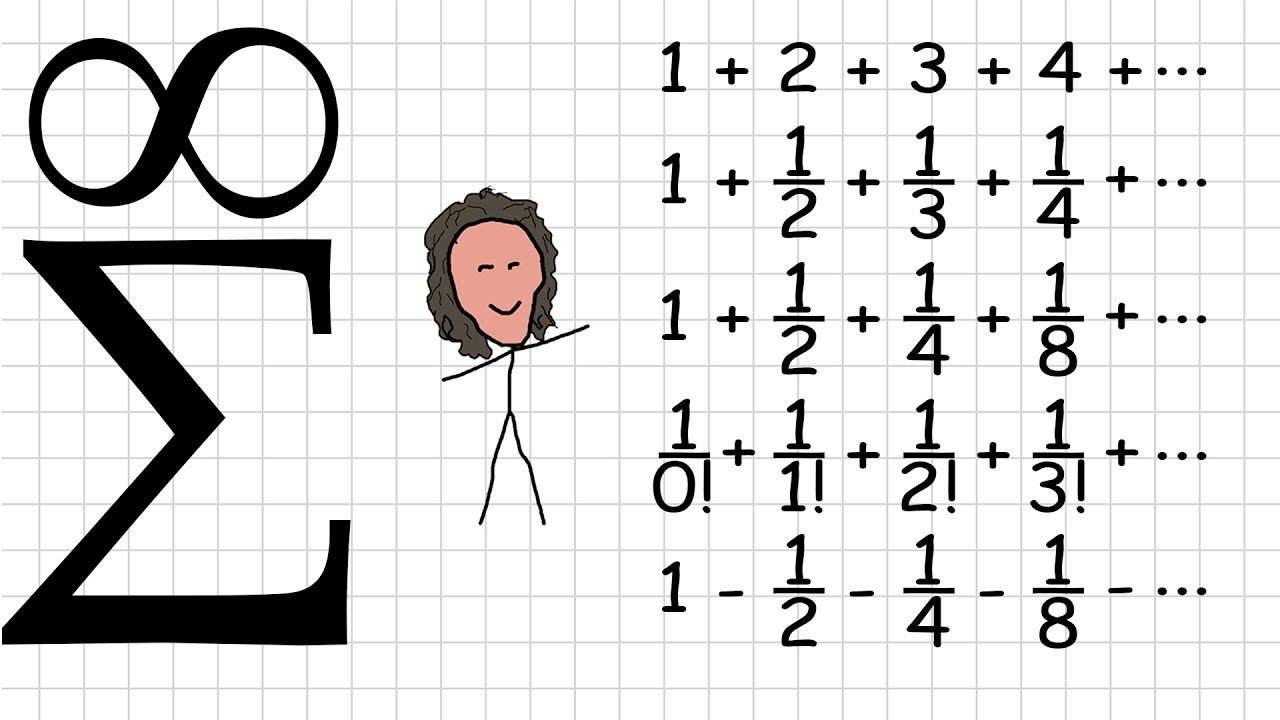
If you’re into mathematics, you may have heard of an operation called addition, where you simply combine two values together. Summation is the addition of a sequence of values or terms to get a result or sum. For example, 1 + 2 + 3 = 6. But what if a summation keeps going forever?
An infinite sum is called a series. One example of a series is 1 + 2 + 3 and so on without end. Let’s try summing the terms of our series. Starting from the first term, that gives us 1, then 1 + 2 = 3, then 1 + 2 + 3 = 6, and so on. These are called the partial sums of the series, since we are summing just a finite part of it.
The value of the series is whatever value these partial sums approach. In this case, when we add more and more terms of this series, we never narrow in on a specific value, not counting ∞. So we say that the series diverges. When this happens, the value of the series does not exist. This is as opposed to a series converging, meaning it has a well-defined value.
Divergence Test
So why did our series diverge? The simple issue is that the terms never got closer to zero. In fact, they only got farther. Because of this, it was impossible for the partial sums to narrow in.
This rule applies in general. If the terms of a series do not approach zero, then the series has no value. It diverges. This is often called the divergence test. However, it’s not the only way to establish a series’ divergence, just the most basic way.
Another example is the series 1 − 1 + 1 − 1 and so on. This is called Grandi’s series, named after Italian mathematician Guido Grandi. The terms of this series alternate between 1 and −1. This means they don’t approach zero, so the divergence test tells us that this series diverges. Indeed, if we evaluate the partial sums of this series, we see that they just bounce between 1 and 0 forever, never converging.
There are alternate definitions of the value of a series that assign this series a value, but we will focus on the conventional definition here.
Though the divergence test tells us that a series diverges if its terms don’t approach zero, the converse is false. Even if a series’ terms approach zero, the series may still diverge. In this case, we call the divergence test inconclusive because it doesn’t give us enough information. An example is a series like 1/1 + 1/2 + 1/3 and so on, where the divergence test doesn’t help us. We will have to return to this series with more advanced tests later.
Geometric Series Test
Think about the series 1 + 1/2 + 1/4 + 1/8 and so on. In this series, each next term is 1/2 of the previous one. So 1/2 is called the common ratio of this series, being the ratio which is common to each consecutive pair of terms. A series with a common ratio between terms is called a geometric series.
We can visualize this series on a number line. Starting from zero, we move 1 to the right, then 1/2, then 1/4, and so on. Each time we halve our distance to the number 2. For those of you who have heard of Zeno’s dichotomy paradox, this setup should sound familiar. Since our partial sums get arbitrarily close to 2, the series converges to 2. So its value is 2.
Finding the answer in this specific case is pretty good. But if you’re a mathematician, you might care about finding a more general result. To analyze this series in more depth, we can express it in a different form.
Let’s begin by just analyzing a specific partial sum of this series, say up to the fourth term. We start with the first term, 1. Since the common ratio of the geometric series is 1/2, the second term is 1 × 1/2. After that is 1 × 1/2 × 1/2. And finally 1 × 1/2 × 1/2 × 1/2.
This repeated multiplication can be represented with exponentiation. For example, the fourth term is 1 × (1/2)³. In this form, each term of the sum follows a clear pattern. Thus, we can condense this using sigma notation, writing the sum using the Greek letter sigma.
Here k is called the indexing variable and its value starts at the lower bound k = 0. Then it increases by one for each next term: k = 1, k = 2, and finally k = 3. In coding terms, this is basically a for loop. The upper bound of 3 tells us that k should keep increasing until it reaches 3, whereupon the final term is added and the sum stops.
We call this partial sum S₃, since the upper bound is 3. This sum has four terms, one more than the value of the upper bound. In general, the nth partial sum is Sₙ.
For a general geometric series, we can call the initial term a and we can call the common ratio r. From there, we can write the nth partial sum as shown. The geometric series we started with is just the specific case where a = 1 and r = 1/2.
We can use algebra to find a compact formula for the value of Sₙ, giving us the final formula Sₙ = a(1 − r^(n+1))/(1 − r). Note that this formula fails for r = 1, in which case the correct result is Sₙ = a(n + 1) instead.
Finally, to evaluate the geometric series, we let n approach ∞. We’ll simply call this value S. Let’s say that r’s magnitude, or distance from zero, is less than 1. Then as n grows, r^(n+1) will approach zero because multiplying by a number smaller than 1 gets you closer to zero. So in the limit, r^(n+1) vanishes.
This gives the formula for a general geometric series: S = a/(1 − r), assuming the absolute value of r is less than 1. A geometric series converges under this condition and diverges otherwise. That concludes the geometric series test.
Direct Comparison Test
Now that we know the convergence of one particular type of series, we can use it to our advantage when testing other series. For example, take the sum of the reciprocals of the factorials, which we’ll call A.
You can take the factorial, written with an exclamation mark, of any non-negative integer. It means multiply together all the positive integers less than or equal to this number. 0! is the product of no numbers, called the empty product. This is equal to 1, like a number to the zeroth power.
So does our series converge? To answer that, let’s consider this geometric series, which we’ll call B. We already know that this series converges. Indeed, we can evaluate it as 4. We also know that each series has only non-negative terms, so it’s impossible for terms ever to get big in the negative direction.
So let’s compare each term with the associated term in the other series. We’ll see if each term in series B is greater than or equal to the one in series A. From this point, the A terms proceed to shrink much faster than the B terms due to the rapid growth of the factorial function. Since each A term individually has a magnitude less than or equal to the corresponding B term, the same must be true of the respective series. Again, we know that series B converges, so series A must converge as well.
The Harmonic Series
A similar idea can be used for the 1/1 + 1/2 + 1/3 series from before, the infinite sum of the reciprocals of positive integers. This series is called the harmonic series, named after the connection to harmonics in music.
Just as comparisons can be used to show convergence, they can also be used to show divergence. Let’s call this series S and we’ll write out several of its terms. From this, we’ll define a new series T. To get each term, take the corresponding term from the harmonic series and round it down to the nearest lower power of 2.
As you can see, each term in S is greater than or equal to the corresponding term in T. Loosely speaking, this means that S must then be greater than or equal to T. If we can prove that T diverges, then S must diverge as well.
Let’s take T and group together all of the terms that are the same as each other. Now we add up everything inside of the parentheses. So this series starts with 1 and then adds 1/2 infinitely many times. As the terms do not approach zero, T diverges by the divergence test. So we have shown that S must diverge as well. And that completes the proof that the harmonic series diverges.
In fact, the harmonic series is a good example of a series that diverges despite its terms approaching zero.
Absolute and Conditional Convergence
Let’s think about the comparison test for convergence. Again, remember that for it to work, we made sure that there were no negative terms in our series. However, we can actually extend this test so that it works even with negative terms, just keeping certain restrictions in mind.
To begin, let’s imagine a convergent series called B. Suppose that this series has a mix of both positive and negative terms. For each term, we’ll take its absolute value, that being its distance from zero on the number line. For instance, 3 remains as 3, whereas −4 becomes 4.
Now we add these absolute values together, getting an entirely new series, perhaps called B′. Does this new series also converge? As it turns out, the answer depends on the series we started with.
If the new series B′ also converges, then the original series B is called an absolutely convergent series. Note the absolute, as in absolute value. If the new series B′ does not converge, then the original series B is called a conditionally convergent series, because it depends on the condition of having both positive and negative terms in order to converge.
With that in mind, we can modify our comparison test. Let’s suppose that our series B is absolutely convergent, so B′ is convergent. Now imagine another series A and the series of the absolute values of its terms, A′. Suppose that for each index k, the kth term in A′ is less than or equal to the kth term in B′.
Using our original comparison test, since we know that B′ converges, A′ converges as well. By definition, this implies that the original series A is absolutely convergent. And so we have our new and improved comparison test. Just ensure that B is absolutely convergent and that the absolute value of each A term is no greater than that of the corresponding B term, and you’ll know that A is also absolutely convergent.
This test can handle negative terms and complex number terms as well, though we won’t cover the latter here.
Leave a Reply