
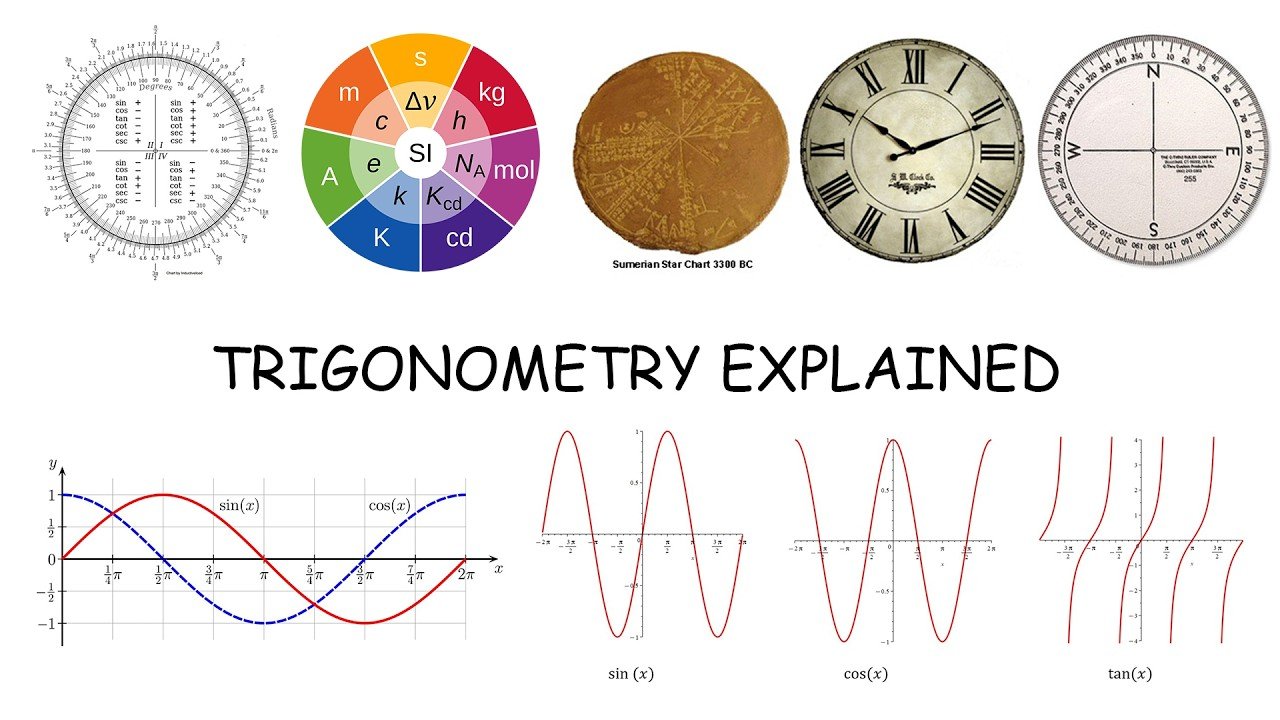
When describing trigonometric functions, it’s necessary to talk about concepts such as radians, sexagesimal degrees, and gradians.
Radians

The radian is the angle made at the center of a circle by an arc equal in length to the radius. The size of the radian remains constant whatever the size of the circle. 1 radian equals 180°/π, or 57.3°.
The angle formed by two radii of a circle, measured in radians, is equal to the length of the arc bounded by the radii divided by the radius. That is, θ = s/r, where θ is the angle, s is the arc length, and r is the radius.
Therefore, the full angle subtending a circle of radius r, measured in radians, is θ = 2πr/r = 2π radians.
Sexagesimal Degrees
Now let’s talk about sexagesimal degrees. Degrees and radians are two different systems for measuring angles. An angle of 360° is equal to 2π radians. An angle of 180° is equal to π radians. In the following graph, it is possible to appreciate the relationship between sexagesimal degrees and radians, in addition to illustrating the signs of the trigonometric functions in each quadrant.
The sexagesimal degree is an angle that describes an arc whose length is the 360th part of the circumference.
So why do we use radians in calculus and not sexagesimal degrees? The answer: calculus uses radians instead of degrees because they can simplify formulas, especially when working with arc lengths. For example, if you have the arc length in two different systems:
Radians: s = αr Sexagesimal degrees: s = (α/360°) × 2πr
As we can see, it is easier to work with radians, but this is a different case for degrees where it can also be done. But it is important to recognize that as far as arc length is concerned, radians indicate how many times the length of the radius is inscribed in the perimeter of the circumference.
Gradians
Now we will talk about a system that is perhaps a little less known: the gradian, or centesimal degree, is a measure of plane angle alternative to the sexagesimal degree and the radian. The value of a gradian is defined as the central angle subtended by an arc whose length is the 400th part of a circumference. Its symbol is a lowercase g in superscript placed after the number in question. For example, 12.4574ᵍ.
The gradian, like the sexagesimal degree, does not belong to the International System of Units.
Converting Angles
When it comes to converting angles, we will focus on the two most commonly used systems: radians and sexagesimal degrees. To do this, we will use conversion factors, as in the following example:
Convert 30° to radians: 30° × (π rad / 180°) = π/6 rad
Convert 2π/3 rad to degrees: (2π/3 rad) × (180° / π rad) = 120°
The angle measurement system normally used in calculus, as we have already analyzed, is radians. The measurement in radians of any given angle is its corresponding real number. On the other hand, sexagesimal degrees are not real numbers because they have 60 as their counting base.
The radian is a unit of angle measure in the International System of Units, whereas in the English system, in its angle measurement system, sexagesimal degrees are used.
Transcendental Functions
Knowing the angle measurement systems, we will base the entire following theory with radians. To illustrate the trigonometric functions, we will first define what is considered a transcendental function.
A transcendental function is a function that does not satisfy a polynomial equation whose coefficients are also polynomials, unlike algebraic functions, which do satisfy this equation. Transcendental functions include trigonometric, logarithmic, and exponential functions.
Trigonometric Functions
A trigonometric function, also called a circular function, is one that is defined by the application of a trigonometric ratio to the different values of the independent variable, which must be expressed in radians. Trigonometric functions are also mathematical relationships that apply to right angles and are defined as the quotient between two sides of a right triangle.
Sine Function
f(x) = sin(x). It is a real and odd function whose domain is R (the set of real numbers) and whose range is the closed interval [−1, 1]. It is denoted f(x) = sin(x) for all x is a real number. It is said to be an odd function because it meets the condition that sin(−x) = −sin(x) for any value of x.
The sine function has a period of 2π. Its graph is symmetric with respect to the origin. In geometry, the sine function represents the relationship between the side opposite an angle and the hypotenuse of a right triangle. The sine function can also be interpreted as the change of the opposite side (y-coordinate) with respect to the angle.
Cosine Function
f(x) = cos(x). The cosine function is an even and continuous function with period 2π, whose domain is R (the set of real numbers) and the range is the closed interval [−1, 1]. Being an even function, it means that cos(−x) = cos(x). Its graph is symmetric with respect to the y-axis.
The cosine function is a trigonometric function that represents in geometry the relationship between the adjacent side and the hypotenuse of a right triangle. The cosine function can also be interpreted as the change of the adjacent side (x-coordinate) with respect to the angle.
Tangent Function
f(x) = tan(x) = sin(x)/cos(x). The tangent is an odd function and is a periodic function of period π with discontinuities at π/2 + nπ, where n is an element of the set of integers Z. It is a transcendental function of a real variable. In trigonometry, the tangent of an angle of a right triangle is defined as the ratio between the opposite and adjacent sides.
Reciprocal Trigonometric Functions
The trigonometric functions previously analyzed have reciprocal trigonometric ratios.
Cotangent function: cot(x) = 1/tan(x). The cotangent, abbreviated as cot, cotg, or ctg, is the reciprocal trigonometric ratio of the tangent, or also its multiplicative inverse. Being the reciprocal of the tangent, it can be defined as the ratio of the adjacent side to the opposite side to the angle in a right triangle. Its range is all real numbers.
Secant function: sec(x) = 1/cos(x). The secant, abbreviated as sec, is the reciprocal trigonometric ratio of the cosine, or also its multiplicative inverse. Graphically, the secant function, being the reciprocal trigonometric ratio of the cosine, represents the relationship between the hypotenuse and the adjacent side of a right triangle.
Cosecant function: csc(x) = 1/sin(x). The cosecant function, abbreviated as csc or cosec, is the trigonometric reciprocal of the sine function. Graphically, the cosecant function, being the reciprocal trigonometric ratio of the sine, represents the relationship between the hypotenuse and the opposite side of a right triangle.
Trigonometric Identities
We cannot talk about trigonometric functions without talking about trigonometric identities. Trigonometric identities are equalities that involve trigonometric functions and that are valid for all values of the variables that are defined on both sides of the equality.
Basic Identities
Pythagorean identities:
- sin²(x) + cos²(x) = 1
- tan²(x) + 1 = sec²(x)
- 1 + cot²(x) = csc²(x)
Even and odd functions: Through trigonometric functions, important trigonometry theorems such as the sine and cosine laws are also derived.
Sine theorem: a/sin(A) = b/sin(B) = c/sin(C)
Cosine theorem: c² = a² + b² − 2ab cos(γ)
Inverse Trigonometric Functions
In mathematics, the inverse trigonometric functions, occasionally also called arc functions, are the inverse functions of the trigonometric functions. Specifically, they are the inverses of the sine, cosine, tangent, cosecant, secant, and cotangent functions, and are used to obtain an angle from any of the angular trigonometric ratios. The inverse trigonometric functions are widely used in engineering, navigation, physics, and geometry.
Hyperbolic Functions
Now we will talk about a concept that is perhaps a little less known: hyperbolic functions. Hyperbolic functions are analogous to trigonometric functions but are defined using the hyperbola instead of the circle. Hyperbolic functions are combinations of exponential functions that have characteristics similar to trigonometric functions. They are used to describe physical phenomena such as the speed of waves or the motion of an object in a fluid. They are also useful for describing the shape of a high-tension cable, a catenary, or the architecture of some structures.
Hyperbolic Sine Function
The hyperbolic sine is a real function of a real variable x that is designated by sinh(x). It is defined by the following equation: sinh(x) = (e^x − e^(−x))/2
Hyperbolic Cosine Function
The hyperbolic cosine is a real function of real variable x, which is designated by cosh(x) and is defined by the formula: cosh(x) = (e^x + e^(−x))/2
Hyperbolic Tangent Function
The hyperbolic tangent of a real number x is denoted by tanh(x) and is defined as the quotient between the hyperbolic sine and the hyperbolic cosine of the real number x: tanh(x) = sinh(x)/cosh(x) = (e^x − e^(−x))/(e^x + e^(−x))
Hyperbolic Cosecant Function
In trigonometry, the hyperbolic cosecant of a real number x is a hyperbolic function defined as the reciprocal of the hyperbolic sine: csch(x) = 1/sinh(x) = 2/(e^x − e^(−x))
Hyperbolic Secant Function
In trigonometry, the hyperbolic secant is a hyperbolic function that assigns to a real number the reciprocal of its hyperbolic cosine: sech(x) = 1/cosh(x) = 2/(e^x + e^(−x))
Hyperbolic Cotangent Function
In trigonometry, the hyperbolic cotangent of a real number x is a hyperbolic function defined as the reciprocal of the hyperbolic tangent. Its equation is: coth(x) = cosh(x)/sinh(x) = (e^x + e^(−x))/(e^x − e^(−x))
Just as in trigonometric functions, hyperbolic functions also present inverse functions. Of course, like its counterpart, hyperbolic functions also exhibit identities.
Complex Trigonometric Functions
Finally, to illustrate the relationships between hyperbolic and trigonometric functions, it is necessary to analyze complex trigonometric functions. These functions involve a combination of trigonometry and complex numbers. In the context of complex variables, sine and cosine are defined as follows.
From Euler’s identity, e^(iφ) = cos(φ) + i sin(φ), the sine and cosine in complex variables are defined as:
sin(φ) = (e^(iφ) − e^(−iφ))/(2i) cos(φ) = (e^(iφ) + e^(−iφ))/2
The trigonometric functions of complex variables and their relationship with the hyperbolic sine and cosine respectively are:
sinh(φ) = −i sin(iφ) cosh(φ) = cos(iφ)
Leave a Reply