
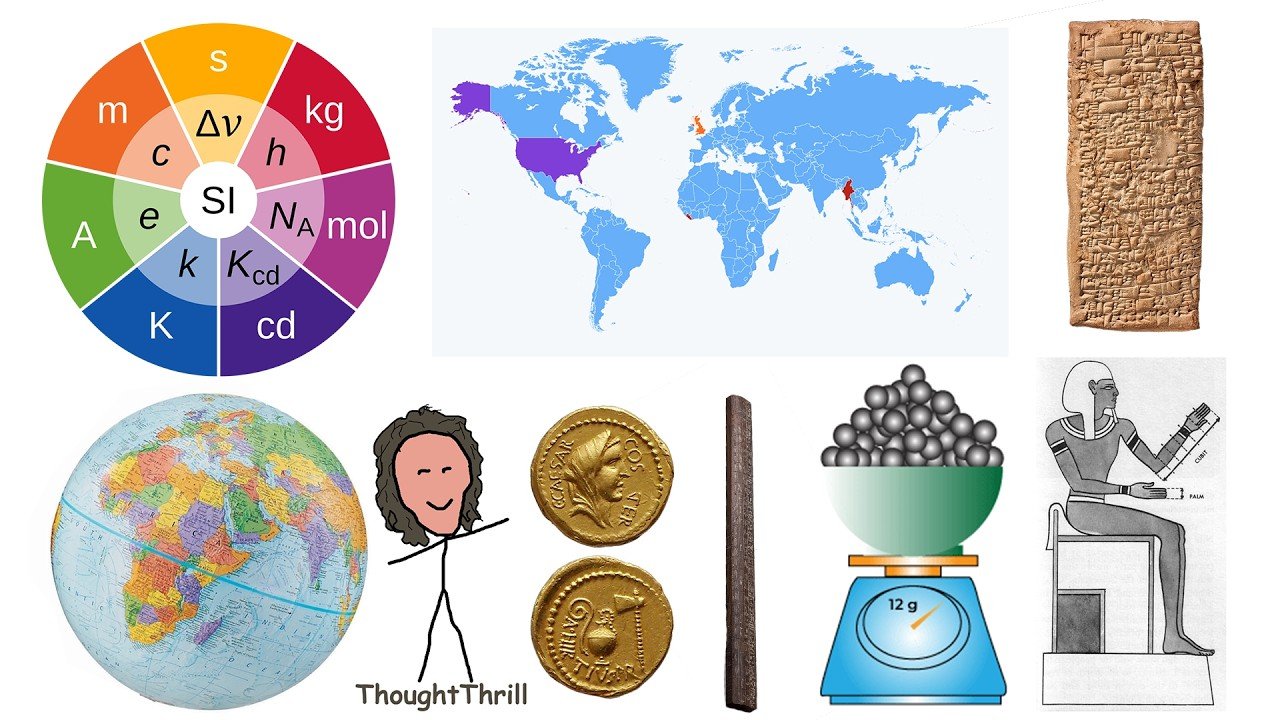
One of the oldest surviving documents is an ancient Mesopotamian tablet that details a complaint by a customer who was sold 1,080 pounds of substandard copper ingots. A Mesopotamian pound was roughly equivalent to a mina, which was made up of 60 shekels and weighed approximately 1.25 pounds.
It was not until after the French Revolution that the decimal metric system was consolidated in Europe. Before the Revolution, France, like much of Europe, used a variety of local and often confusing measurement systems. The Revolutionary government decided to create a standard of measurements, including the meter, which was defined as 1/10,000,000 of the distance from the equator to the North Pole traveling through Paris. This was a practical definition based on the Earth’s dimensions.
Initially, the metric system was based on physical artifacts like the meter bar, which were used as standards for comparison. This meant that accuracy depended on how well these artifacts could be replicated or preserved. However, the initial approach of using physical standards for comparison presented ongoing challenges until science progressed to define units based on unchangeable natural constants, thus enhancing precision and universality in measurement.
The International System of Units
The laws of nature do not depend on the choice of units of measurement, but what if the units of measurement depended on the fundamental constants of nature? It once seemed like an unattainable dream to base patterns neither on traditions nor on perishable objects, but instead on the immutable laws of the universe. Yet this was not only possible, it was accomplished by the General Conference on Weights and Measures (GCWM), a club of nations that meets in France every 4 to 6 years to discuss measurements.
The International System of Units, or Système International, abbreviated SI, is made up of seven base units: meter, kilogram, second, kelvin, ampere, mole, and candela, which are defined by corresponding fundamental physical quantities. The SI was created in 1960 to update the metric system by the 11th meeting of the conference, during which six basic physical units were recognized. The mole was added in 1971.
In 2019, the kilogram, ampere, kelvin, and mole were redefined in terms of fundamental physical constants rather than physical artifacts or arbitrary definitions. The conference defined the measurements using the following fundamental constants of nature.
The Second
Physicists defined the second as the time needed by the cesium-133 atom to make exactly 9,192,631,770 transitions. The cesium atom was used because it offers the highest resonance frequency compared to other atoms. With the advent of atomic time, time is not tied to an astronomical phenomenon but to a fundamental constant of nature. The measurement of time intervals based on the cesium atom’s oscillations are more accurate than those based on Earth’s rotation, because friction caused by the tides and the atmosphere is slowing down the rotation rate of Earth over time.
The Meter
The meter is defined as the length of the path traveled by light in a vacuum during a time interval of 1/299,792,458 of a second. Why not 300 million, you may ask? Originally, in 1793, a meter was defined as 1/10,000,000,000 of the distance from the equator to the North Pole. This definition was then used to create a prototype meter bar in 1799, which then became the definition of the meter. This was eventually used to measure the speed of light, which was approximately 299,792,458 m/s.
The Kilogram
Originally, the kilogram was defined as a physical artifact called the International Prototype of the Kilogram, a platinum-iridium cylinder kept by the Bureau of Weights and Measures in France. This method was vulnerable to physical changes over time. With the 2019 definition, the need for a mass standard is thus eliminated.
Planck’s constant h: The kilogram is now defined such that the Planck constant, which relates the energy of a photon to its frequency, is exactly 6.62607015 × 10⁻³⁴ joule seconds. This redefinition uses quantum mechanics to establish a link between mass and the fundamental constants of nature. This definition ties the kilogram to quantum mechanics and is realized using the Kibble balance, an instrument that measures mass by balancing gravitational force against an electromagnetic force.
The Ampere
The ampere is the base unit of electric current and is defined by fixing the numerical value of the elementary charge e at 1.602176634 × 10⁻¹⁹ ampere seconds. It is equivalent to the current produced by 1 volt applied across a resistance of 1 ohm.
The Kelvin
The kelvin is defined by fixing the numerical value of the Boltzmann constant at exactly 1.380649 × 10⁻²³ joules per kelvin. Every 1 K change corresponds to a thermal energy change equivalent to one Boltzmann constant.
The Mole
The mole is the unit of measurement for the amount of substance and is an aggregate of exactly 6.02214076 × 10²³ elementary entities of a substance. The entities can be atoms, molecules, ions, ion pairs, or other particles. This number is the Avogadro constant and was chosen based on the number of atoms in 12 grams of carbon-12.
The Candela
Finally, the candela. This is the unit of measurement for luminous intensity, defined as the luminous intensity in a given direction of a source that emits frequency 540 × 10¹² hertz and has a radiant intensity in that direction of 1/683 watts per steradian.
Imperial Measurement System
This was standardized in 1824 by the United Kingdom under the name of the imperial system. The modern imperial system is based on the units used in England during the Imperial era, which in turn are based on Roman, Celtic, and Anglo-Saxon units. In the UK, both the imperial and metric systems are in use.
United States Customary Units
The US system was inherited from the imperial system and has many equivalent measurements but also has some distinct differences, particularly in volume measurements.
Ancient Measurement Systems
Ancient Egypt
Units of measurement in ancient Egypt were used from the earliest dynasties. They included units of length, area, volume, weight, and time. Many accounting documents have been found on papyrus, as scribes were tasked with checking the annual maximum level of the Nile River for tax purposes and recording the surface areas of plots of land in order to restore the boundaries and demarcate agricultural land that was blurred by the flooding of the Nile each year.
The royal cubit (52.4 cm) is a measure that was used around the year 2700 BC. An exact example of this measure can be seen in the King’s Chamber of the Great Pyramid of Giza, a masterpiece of granite whose width is 10 royal cubits and its length is 20 royal cubits.
Ancient Greece
The units of measurement of ancient Greece had some influence from the units of measurement in ancient Egypt and later formed the basis of the units of measurement of ancient Rome. Greek measurements in antiquity were quite diverse and not standardized across the different city-states, reflecting the fragmented nature of ancient Greek society. They primarily used systems based on body parts for length, like the daktylos (finger) or pous (foot), volume measures for liquids and dry goods such as kotyle (cup), and weight standards like the mina and talent.
Ancient Rome
The Romans measured and weighed in pounds, aces, and feet, and they opted for the decimal system so they could count with the fingers of both hands. With just their hands, a count of 9,000 was possible.
Ancient India
In ancient India, the yojana was a unit of distance which has widely varied definitions across ancient texts, ranging from 4 to 13 km. The angula corresponded to the width of a finger and in Sanskrit means a finger’s breadth.
Ancient China
Some units of measurement in ancient China were the chi, which equals 33.333 cm, and the jin, a traditional Chinese unit of mass used to weigh food in shops and stores, which is officially defined as 500 grams. China officially uses the decimal metric system, but traditional Chinese measurements are still commonly used in everyday life.
The Aztec
The Aztec used various units of measurement to measure lengths, capacities, and surfaces. To measure distances, they used the tlamatlahuiliztli, a wooden measuring stick which was approximately 2.5 meters long.
Leave a Reply