
Five More Geometry Problems That Are Way Harder Than They Look
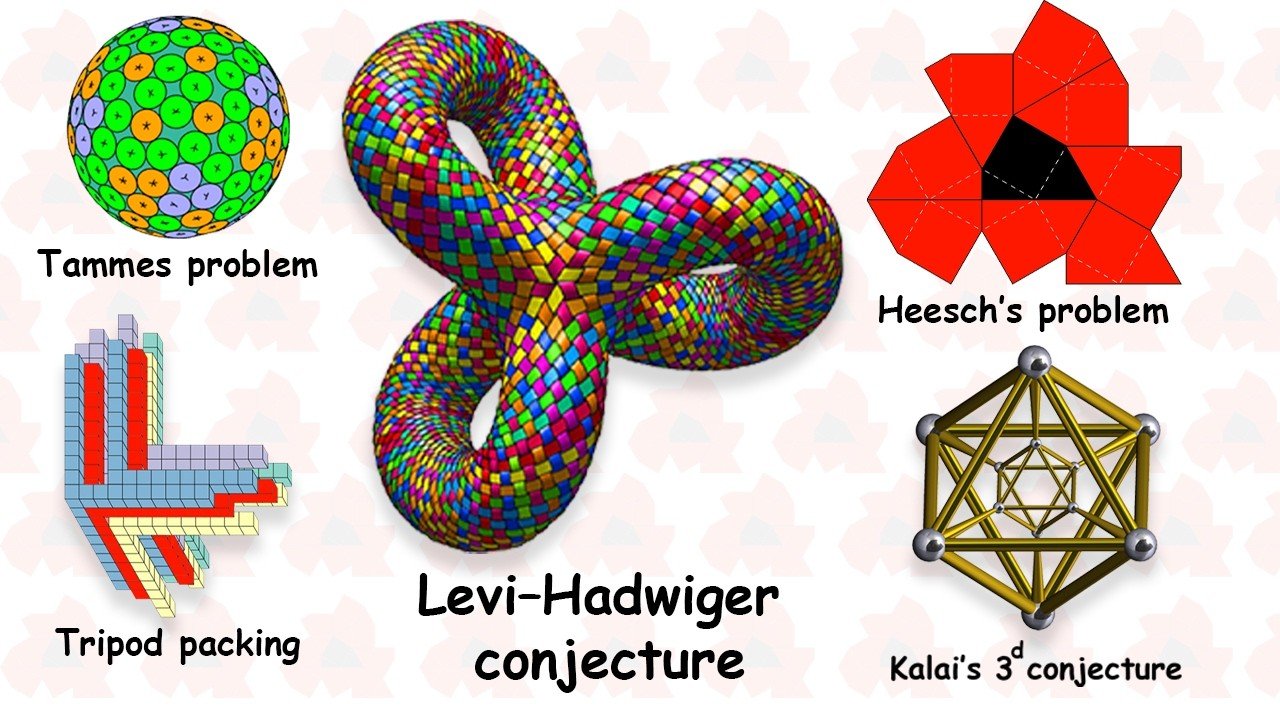
Tripod Packing
Let’s start with a cube existing at some fixed location in 3D space. (This problem can be easier to comprehend if you think of the cubes as Minecraft blocks, which you can do if you prefer.) If you join a bunch of congruent cubes face to face, the resulting structure is known as a polycube. A polycube can also be infinite if it extends forever in at least one direction.
Now let’s build a special type of polycube. Start with one cube called the apex. Now build a long straight string of cubes from the right of the apex. Do the same thing from the top of the apex and from the front of the apex. Imagine these strings of cubes extending forever off to infinity. This polycube is called a tripod, named for its resemblance to a camera tripod. For our purposes, the legs of each tripod will always face the directions considered positive: rightward, forward, and upward.
Now suppose we have a 3 × 3 × 3 cubic region of space, like a Rubik’s Cube. We want to pack this region with the apexes of tripods. The rule is that no two tripods can cross through each other, and we have to fit as many apexes as we can. How many can we fit?
This is an instance of the tripod packing problem, one of the many packing problems in geometry. The answer for a 3 × 3 × 3 cube is 5 apexes. If we consider larger cubes of side length n, the answer is known up to n = 14, where 55 tripod apexes can be packed into a 14 × 14 × 14 cube. However, the problem remains unsolved for larger cubic regions. In particular, we do not know of an algorithm that can give us the answer for every given side length. However, lower and upper bounds have been produced.
The Thomson Problem
Let’s say you’re stranded on a perfectly spherical planet with two other people, but all of you really hate each other. So you agree to get as far apart on the surface of the planet as possible. You want an optimal arrangement: the higher the minimum distance between any two given people, the better. So what is the best arrangement for the three of you to take?
This is a special case of the Thomson problem, named after Dutch botanist Pieter Merkus Lambertus Tammes. In fact, it’s one of the few mathematical problems not actually named after a mathematician. It was posed in 1930, based on the pores found on grains of pollen. Of course, you can also consider this problem involving any number of points on the sphere, which we will call n.
The problem is solved for all n from 3 through 14, as well as n = 24. Guesses for other solutions and solutions in higher dimensions have been proposed, but the general case remains unsolved.
The problem can also be reframed as a packing problem: what is the optimal packing of a given number of circles on a sphere? Alternatively, it can be viewed from the perspective of electrons arranged on a sphere, where the goal is to minimize the Coulomb force between the electrons (the force between particles at rest due to electric charge). Besides those previously mentioned, one practical application comes in the form of spherical corals, whose surfaces are arranged as approximate solutions to the problem.
The Levi-Hadwiger Conjecture
A dilation is a type of transformation determined by a center of dilation and a ratio, or scale factor. When a shape is dilated, each point on the shape has its distance from the center of dilation scaled by the scale factor, while either preserving or reversing the relative direction. This can be thought of in terms of vectors. If the position of each point within the shape is represented by a vector from the center of dilation to that point, then the dilation has the effect of scaling each vector by the scale factor.
Now consider a square with the inside filled in. This is an example of a convex shape: if you choose any two points on the shape and connect them with a line segment, then that line segment will also be entirely contained within that shape.
Imagine creating several scaled copies of the square using various dilations. For each dilation you may use any center of dilation you want. As for the scale factor, it must be strictly between 0 and 1, so that the dilation results in a smaller shape. The goal is to use these dilated squares to completely cover the original square, making as few copies as possible. How many do you need?
The answer turns out to be 4. If you try the same thing with a triangle, the answer is 3 instead.
Now we can ask this question about any convex shape in any dimensional Euclidean space: 2D, 3D, and beyond. A conjecture was made about this problem: in n-dimensional Euclidean space, you will never need any more than 2ⁿ copies. For instance, in 3D space, the conjecture states that the maximum number of required copies is 2³ = 8.
This is called the Levi-Hadwiger conjecture, named after German mathematician Friedrich Wilhelm Levi and Swiss mathematician Hugo Hadwiger. The 2D case was proven by Levi in 1955. In 1957, the general case was included in a list of unsolved problems by Hadwiger. The problem remains open for all higher dimensions today, even the three-dimensional case.
Heesch’s Problem
It is possible to completely surround a square with a layer consisting of eight identical copies of itself, with no overlaps and no gaps. This layer is known as a corona. This corona can itself be surrounded by a second corona of 16 squares, which can also be surrounded, and so on.
On the other hand, a circle cannot be surrounded by even a single corona composed of copies of itself, as there will always be gaps left over.
The Heesch number, named after German geometer Heinrich Heesch, measures the number of possible coronas that can be formed for a given shape. For instance, the equilateral triangle, square, and regular hexagon can all be used to fill up an entire 2D Euclidean space. In other words, they tessellate the plane. Thus they can each form infinitely many coronas, so they are said to have an infinite Heesch number. On the other hand, the circle’s Heesch number is 0.
Now, Heesch’s problem is as follows: what is the set of numbers that can be Heesch numbers? We haven’t ruled out a single positive integer from being a Heesch number. Conversely, many positive integers have been confirmed to be Heesch numbers through concrete examples.
The first known shape with a finite Heesch number was discovered in 1928 by German mathematician Walter Lietzmann, resembling a teardrop shape with a Heesch number of 1. The next such shape would be discovered 40 years later by Heesch himself, consisting of a square, an equilateral triangle, and a 30-60-90 triangle all glued together. Further progress was made throughout the 20th and 21st centuries. The highest known Heesch number of 6 was achieved in 2020 using a polygon discovered by Serbian professor Bojan Bašić.
Kalai’s 3ᵈ Conjecture
A polygon is a 2D shape bounded by line segments. A polyhedron is a 3D shape bounded by polygons. This concept can be generalized to any number of dimensions, and such a generalization is known as a polytope.
Now suppose you have a shape centered at the origin. This shape is centrally symmetric if you can flip any point on the shape across the origin and still remain on the shape. Such a transformation of a point is called a point reflection. In terms of vectors, if each point on the centrally symmetric shape is represented by a vector from the origin to that point, then the negative of each vector should also represent a point on the shape. Indeed, a point reflection is just a dilation with a scale factor of −1. This can also be thought of as rotating by a half turn (180°, or π radians).
Let’s say we have a centrally symmetric polytope. For instance, let’s choose a line segment, a one-dimensional polytope. There are 2 vertices and 1 line segment. Adding these numbers together we get 2 + 1 = 3, which is equal to 3¹.
In 2D, a square is a centrally symmetric polygon. There are 4 vertices, 4 edges, and 1 polygon. Adding these together: 4 + 4 + 1 = 9, which is 3². A regular hexagon is also centrally symmetric, with 6 vertices, 6 edges, and 1 polygon, totaling 13, which is greater than 3².
In 3D, a cube is a centrally symmetric polyhedron. There are 8 vertices, 12 edges, 6 faces, and 1 polyhedron: 8 + 12 + 6 + 1 = 27, which is 3³.
Notice that in each case, the process involves counting up all the components of the polytope and adding them together. These components are called k-faces, where k is the dimension of the component. For any d-dimensional centrally symmetric polytope, the sum of the numbers of k-faces (excluding the empty set) always seems to be greater than or equal to 3ᵈ.
Kalai’s 3ᵈ conjecture, named after Israeli mathematician and computer scientist Gil Kalai, is simply the conjecture that this will always be true. Despite its relative simplicity, this conjecture remains an open problem in polytope theory.
Further Reading
- Thomson Problem on MathWorld
- Hadwiger Conjecture (Combinatorial Geometry) on Wikipedia
- Heesch Number on Wikipedia
- Kalai’s 3ᵈ Conjecture on Wikipedia
- Tripod Packing on Wikipedia
Leave a Reply