
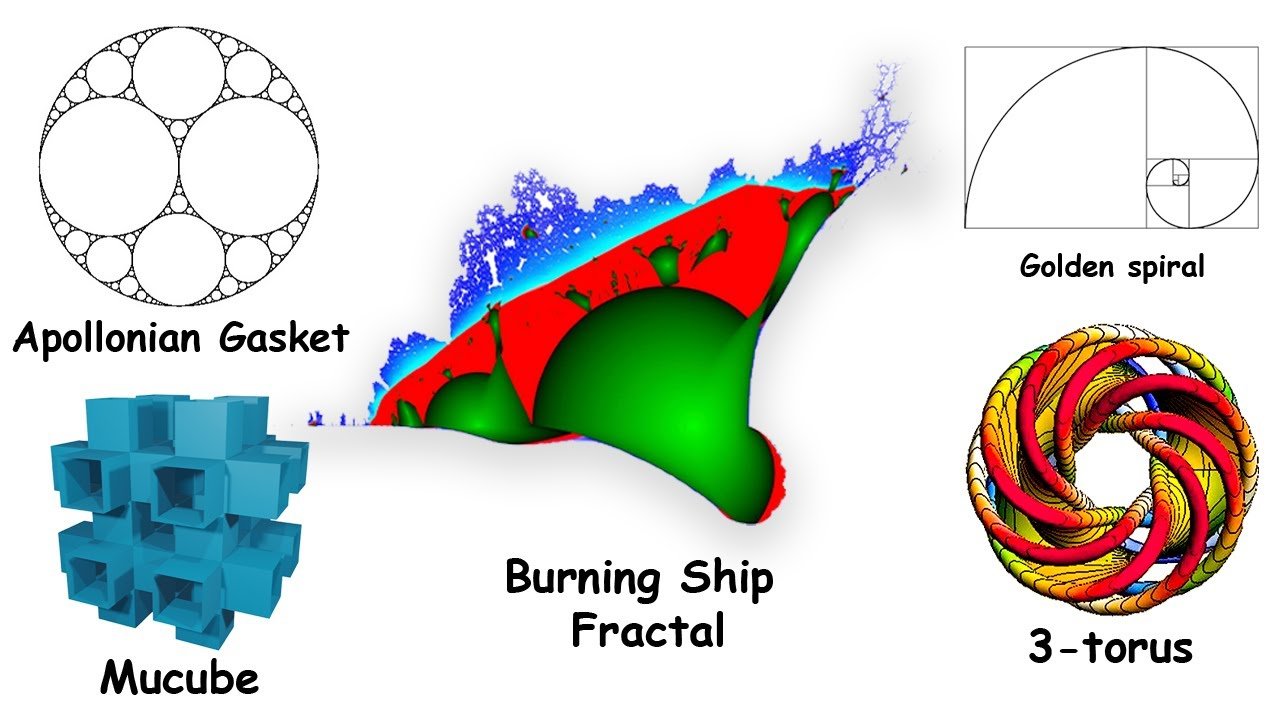
The Apollonian Gasket
Let’s start by drawing a circle named C₁. Note that we’re not including the inside region as part of the circle; that region is called a disc in math terms. Now draw a second circle, C₂, that touches C₁ at just one point. These circles are tangent to each other. You can even draw it so that either circle is inside of the other if you want.
Now draw a third circle, C₃, tangent to both of the first two. Just make sure that it’s not tangent at the same point where C₁ and C₂ are tangent to each other. Now that we have these three circles, we can always draw exactly two more circles that are tangent to all of the first three. This was discovered by the ancient Greek mathematician Apollonius of Perga, who lived from around 240 BC to 190 BC. Because of this, when five circles are arranged in this way, they are called Apollonian circles in his honor.
Now that we have these five circles, let’s keep drawing even more. Inside the largest circle but outside all the circles contained within, there are six gaps that look like curved triangles. If we want, we can draw another circle inside each of these gaps, making the new circle tangent to each of the neighboring circles. Once we are done, we have created 18 new triangular gaps, which we can fill with tangent circles as well. We can just keep repeating this process on and on forever, and in the limit we get an infinitely detailed shape: a fractal. This particular fractal is called the Apollonian gasket.
The Golden Spiral
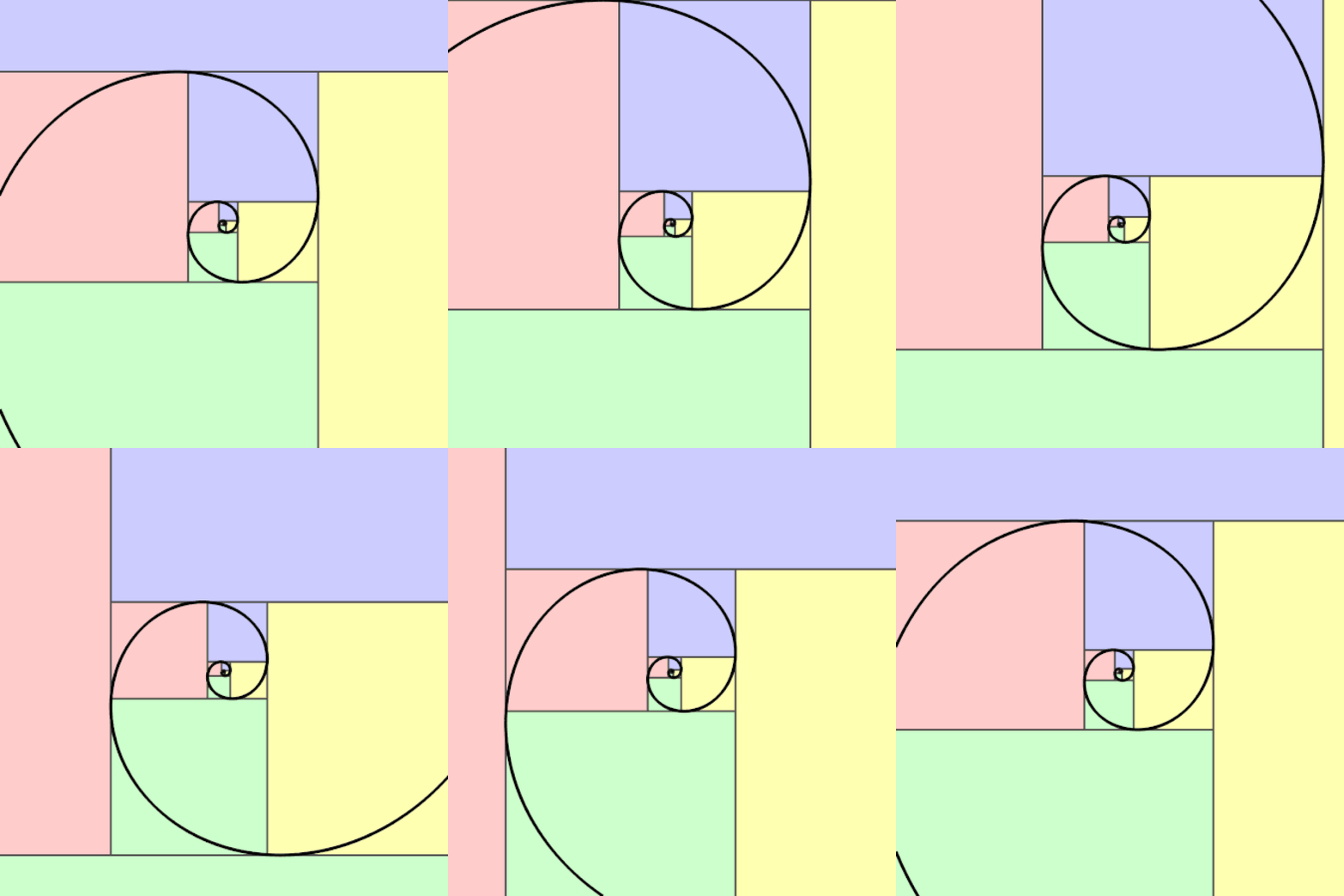
Suppose you have two amounts and the ratio of the larger amount to the smaller amount equals the ratio of the sum of the amounts to the larger amount. In that case, this ratio will always be the same special number: the golden ratio, denoted by the Greek letter φ (phi). If we call the larger amount a and the smaller amount b, the golden ratio can be expressed as a/b = (a + b)/a. It equals (1 + √5)/2, about 1.618.
You may know about Cartesian coordinates (x, y), where x tells you how far horizontally to go and y tells you how far vertically. Another way to label points in 2D space is polar coordinates. Here’s how it works. Starting from the origin, which is now called the pole, draw an infinite ray toward the right called the polar axis. This system has two coordinates, r and θ. The angle θ and the distance r work together: to reach a point, stand at the pole and face along the polar axis, rotate an angle of θ counterclockwise, then walk a distance of r forward. For instance, if the coordinates are (r, θ) = (3, 90°), then rotate 90° counterclockwise and walk three units forward.
Mathematicians prefer using radians rather than degrees. The number of radians in a full turn is 2π, also known as τ (tau), which is about 6.28. Since 90° is a quarter turn, that’s τ/4 radians, so the coordinates (3, 90°) can be rewritten as (3, τ/4).
In Cartesian coordinates, an equation can describe a set of points, like y = 1 or y = x. Similar equations are possible in polar coordinates, like r = 1 or r = θ. Let’s examine another example: r = 2^θ, which generates a spiral shape. By definition, this can be rewritten as θ = log₂(r). This is an example of a logarithmic spiral. The logarithm can use any base, and you can multiply r by a constant. One example is θ = ln(3r), also written as r = (1/3)e^θ, where e is Euler’s number, about 2.718.
Now imagine a logarithmic spiral that grows by a factor of φ each quarter turn. We want φ as the base of exponentiation, and each quarter turn should increase the exponent by 1. That gives us r = φ^(θ/(τ/4)), or equivalently r = φ^(4θ/τ). And with that, we have the golden spiral.
The Three-Torus
A torus is simple: it’s just a donut shape. Note that the torus is hollow. If the inside is included, it’s called a solid torus instead.
Now let’s imagine that the torus is actually a space. We will consider a creature living on the torus. Just as we can never leave our own space, this creature cannot ever leave the torus. However, it is free to move along the torus, and it has two degrees of freedom to do so. This is similar to a plane, which also allows two degrees of freedom for movement. Therefore the torus is topologically two-dimensional.
One way to construct a torus is to start with a rectangle, glue one pair of opposite edges together to form a tube, and then glue the ends of the tube together. Of course, the rectangle should be made of an elastic material for this to work properly. You could simply imagine the creature moving around on this rectangle, looping around when it reaches an edge. If it keeps traveling upward, it’ll just loop back to where it began. The same goes for traveling rightward. The creature’s universe is finite, but it has no boundary.
We can do a similar thing for a 3D object: a solid cube. However, this requires stretching and folding the cube up into a higher dimension, so it’s harder to visualize. Nevertheless, we can glue each pair of opposite faces of the cube together, similarly to what we did for the rectangle. If we do this for the cube, the shape we get is called a three-torus.
Since you are a 3D creature, you can imagine yourself living in this space. Similarly to how the 2D creature could not see the seams while living in the two-torus, you cannot see the walls of the cube while living in the three-torus. In fact, they do not really exist to you. Within the three-torus, you can simply travel forward in a straight line and loop back on yourself.
In terms of our own universe, much remains unknown about its shape. Multiple different hypotheses have been proposed. One possibility is that it simply loops back on itself forever and ever, just like the three-torus.
The Mucube
Think of the usual polygons: triangles, quadrilaterals, pentagons, and so on. Using these polygons in 3D space, you can join their edges to form a 3D shape known as a polyhedron. Each polygon is called a face of the polyhedron. If all of the polyhedron’s vertices, edges, and faces are the same, it is called a regular polyhedron. More precisely, you must be able to move each vertex, edge, or face to another of the same kind while keeping the polyhedron identical.
Imagine cutting off a corner of a polyhedron and looking at the cross-section. The shape you see is known as a vertex figure. For instance, if you cut off the corner of a cube, the shape you get is a triangle. The number of angles of the vertex figure is always equal to the number of edges of the polyhedron that join at the vertex.
Now, the vertices of a polygon usually lie in the same flat space, or plane. In other words, they are coplanar. However, it is possible to have a polygon with non-coplanar vertices, known as a skew polygon. A polyhedron may be made out of skew polygons, or it may have a skew polygon as a vertex figure. In that case it is called a skew polyhedron. In particular, it is called a regular skew polyhedron if the skew polygons in question are regular. An infinite regular skew polyhedron is called a regular skew apeirohedron.
Now imagine an infinite grid of cubes, known as a cubic honeycomb. If you remove two opposite faces from each cube in a certain way, you will get a special shape called a mucube (short for “multiple cube”). Any vertex, edge, or face of the mucube can be moved to any other while keeping it the same, so it is a regular polyhedron, specifically a regular skew apeirohedron.
The Burning Ship Fractal
You may recall the definition of the Mandelbrot set. To quickly recap: we choose a complex number c and define a complex function f_c with the equation f_c(z) = z² + c. Starting with z = 0, we apply this function over and over again. If we get a sequence that doesn’t diverge to infinity, then we include the number c as a member of the Mandelbrot set.
The burning ship fractal is defined in a very similar way. The function is almost the same, but before we take the square, we first set the real and imaginary parts to their absolute values. That results in the function f_c(z) = (|Re(z)| + |Im(z)|i)² + c.
Let’s go through an example. Suppose we have the complex number z = −3 − 2i. The real part is −3 and the imaginary part is −2. Replacing each of these with their absolute value, we get the number 3 + 2i. This can be represented graphically in the complex plane: we flip −3 − 2i across the vertical axis and then across the horizontal axis so that it ends up in the upper right quadrant. Meanwhile, if we had started with a number like 4 + 5i, that would remain the same, because taking the absolute values of each part doesn’t change their value.
Now we just have to evaluate the function as a whole on −3 − 2i. The rest of the process is just like the Mandelbrot set. We start by selecting a value of c, then we take the function and apply it over and over starting with z = 0. If the value stays bounded, then c is in the burning ship. Drawing all such values, coloring other values based on their speed of divergence, and vertically flipping the image (because it looks nicer), we get the burning ship fractal.
Further Reading
- Apollonian Gasket on MathWorld
- Golden Ratio on MathWorld
- Logarithmic Spiral on MathWorld
- Three-Torus on Wikipedia
- Burning Ship Fractal on Wikipedia
- Regular Skew Apeirohedron on Wikipedia
Leave a Reply