
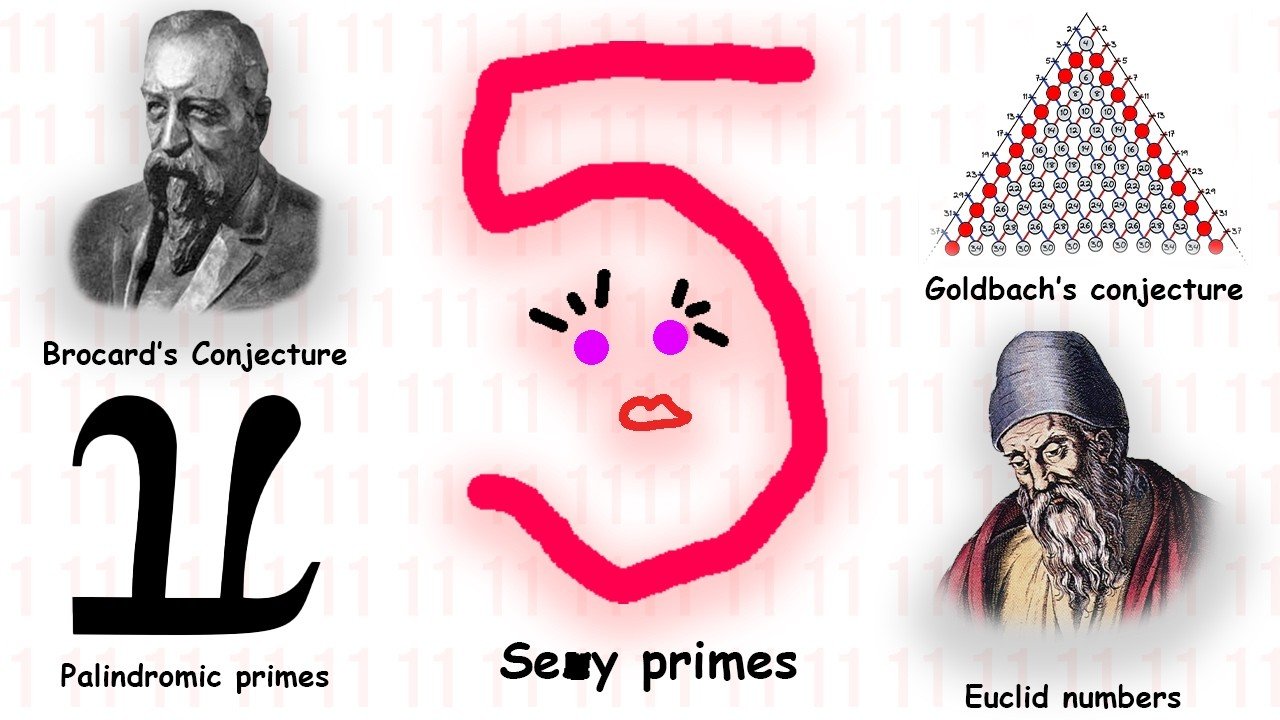
Brocard’s Conjecture
A prime number is a positive whole number that has exactly two divisors: 1 and itself. Pick a prime number greater than 2, like 3. Then take the next prime number after that, in this case 5. Then take the square of each number: 3² = 9 and 5² = 25. Now, how many prime numbers are between 9 and 25? Those prime numbers are 11, 13, 17, 19, and 23, so our answer is 5. And that’s the end of the game. Starting with the prime number 3, we got a final result of 5.
We can keep playing this game starting with other prime numbers as well (except you’re not allowed to pick 2). This game was considered by French meteorologist and mathematician Henri Brocard, who came up with a guess about the game: no matter which prime number you choose, your final result will always be at least 4. This idea is known as Brocard’s conjecture, and it remains an unsolved problem in the field of number theory, a field of math which studies integers and arithmetic functions.
Now, if you do allow the game to be played with 2, then you will get a result of 2. For the next few prime numbers, the results are 5, 6, 15, 9, and so on. A computer algorithm can be used to check the results for higher and higher prime numbers, which is known as a brute-force search. However, such efforts have failed to produce a solution to the problem.
Brocard’s conjecture is related to a similar prime number conjecture known as Legendre’s conjecture, named after French mathematician Adrien-Marie Legendre. For that one, take two consecutive positive whole numbers and then square both of them. Legendre predicted that there would always be a prime number in between the two resulting numbers. Legendre’s conjecture also remains without proof or disproof to this day. It is the third of Landau’s problems, a list of prime number problems compiled by German mathematician Edmund Landau in 1912, all of which remain unsolved.
Twin, Cousin, and Sexy Primes
Consider the prime numbers 3 and 5. These are two apart, so they are known as twin primes. The primes 3 and 7 are four apart, so they are known as cousin primes. The primes 5 and 11 are six apart, so they are known as sexy primes.
The twin prime conjecture proposes that there are infinitely many twin primes. It is the second of Landau’s problems and has been considered one of the most important unsolved problems in number theory for many years. In a similar vein, it is also conjectured that there are infinitely many cousin primes. The same goes for sexy primes as well. In fact, there is a conjecture stating that this actually applies to all even-number gaps between prime numbers, known as Polignac’s conjecture, named after French mathematician and aristocrat Alphonse de Polignac.
Though none of the preceding problems have been solved, research has obtained many related results about prime gaps, where a prime gap is the difference between two consecutive prime numbers. In 2013, Chinese-American mathematician Yitang Zhang proved that there are infinitely many prime gaps of a certain size n, where n must be less than 70 million. This was improved to less than or equal to 600 by English mathematician James Maynard later that same year. The following year, this number was further improved to 246, where the record stands today.
Palindromic Primes
A palindrome is a word or phrase that is spelled the same forward and backward, like “racecar” or “madam.” A palindromic number in a given base is a number whose representation in digits is the same forward and backward, like 373. Most often the base in consideration is decimal (base 10), since that’s the one we use on an everyday basis, but other bases can be used as well, such as binary (base 2) and ternary (base 3).
One type of palindromic number is a palindromic prime (or “palprime” for short), which is exactly what it sounds like. The simplest palindromic primes are the single-digit ones, whose primality is obvious. In base 10, these are 2, 3, 5, and 7. After that is 11, 101, 131, and so on.
As is common in mathematics, you may ask whether the sequence goes on forever. The answer: we don’t know. This is still an open question. And indeed there is nothing special about base 10. Such sequences exist in other bases as well. For instance, unlike the 10 digits of decimal, binary has only two digits: 0 and 1. The sequence of palindromic primes in binary is 11, 101, 111, 10101, and so on.
In the most general case, the question is: does every base have an infinite sequence of palindromic primes? We’d only need to find a single base with finitely many palindromic primes in order for the answer to be no, but we haven’t been able to. Some progress has been made in this area. For instance, in 2004 it was shown that almost all palindromes in any base are composite numbers (having more than two divisors). Essentially, the more palindromic numbers you take into account in a given base, the closer to 100% of them will be composite.
As for computing the actual values of palindromic primes, a search was performed by Gupta in 2009 finding all palindromic primes up to 10²¹. The largest known palindromic prime has 47,451 digits.
Euclid Numbers
The factorial of a non-negative integer n, denoted by n!, is equal to the product of all positive integers less than or equal to n. Zero factorial is the product of no numbers, in other words the empty product. Similar to raising a number to the zeroth power, the empty product is defined as equal to the multiplicative identity, which is 1, since multiplying a number by 1 is equivalent to not multiplying at all.
The primorial, denoted by a number sign (n#), is similar to the factorial. However, it instead returns the product of all the prime numbers less than or equal to n. For instance, 11# = 2 × 3 × 5 × 7 × 11 = 2,310. In general, the primorial of a prime number can be written with product notation using uppercase pi.
A Euclid number, denoted eₙ, is a number of the form eₙ = pₙ# + 1, where pₙ is the nth prime number. For instance, consider the case where n = 3. The third prime number is 5, and the primorial of 5 is 2 × 3 × 5 = 30, so the third Euclid number is 31.
These numbers are named after the ancient Greek mathematician Euclid, in reference to Euclid’s theorem stating that there are infinitely many prime numbers. It is a common misconception that Euclid explicitly referred to primorials in the proof of his theorem, but in actuality his proof merely began by considering any arbitrary finite set of primes.
Now for the unsolved problems. First: are there infinitely many prime Euclid numbers? The sequence of Euclid numbers starts with 3, 7, 31, 211, and 2,311, which are all prime. However, this is followed by a string of five composite Euclid numbers in a row, the first of which is e₆ = 30,031 = 59 × 509. As of now, it is unknown whether the prime Euclid numbers ever stop.
The second unsolved problem involves a concept known as a squarefree integer. A square number is a number obtained by squaring an integer; for instance, 3² = 9 is a square number. An integer is called squarefree if it is not divisible by any square number except 1. So the second unsolved problem is: is every Euclid number squarefree? Unfortunately, these are two problems that we seem a long way from solving.
Goldbach’s Conjecture
Consider the even number 4. It can be expressed as the sum of two prime numbers: 4 = 2 + 2. Similarly, 6 is also the sum of two prime numbers, being 3 + 3. The same goes for 8, which is 3 + 5. So can we keep going? Is every even number greater than 2 the sum of two primes?
In 1742, Prussian mathematician Christian Goldbach guessed that the answer was yes, so this conjecture is called Goldbach’s conjecture. This is the first of Landau’s problems and is often considered one of the most prominent unsolved problems in number theory.
There is also a related conjecture known as Goldbach’s weak conjecture. It states that every odd number greater than 5 can be expressed as the sum of three primes (not necessarily unique primes). For example, 7 can be expressed as 2 + 2 + 3.
In mathematics, two statements are called “strong” and “weak” with respect to each other if the strong statement immediately implies the weak statement. In our case, the strong statement (the standard Goldbach’s conjecture) would immediately imply Goldbach’s weak conjecture. If every even number starting from 4 is the sum of two primes, then you can just add 3 to each one to get a sum of three primes, producing the odd numbers starting from 7.
Many partial results have been obtained on this problem, both by hand and by computer. In particular, it has been verified for all numbers less than or equal to 4 quintillion (4 × 10¹⁸). However, nearly 300 years after its initial proposal, the problem remains unsolved.
Further Reading
- Brocard’s Conjecture on MathWorld
- Legendre’s Conjecture on MathWorld
- Twin Prime Conjecture on MathWorld
- Goldbach’s Conjecture on MathWorld
- Euclid Number on MathWorld
- Polignac’s Conjecture on MathWorld
Leave a Reply