
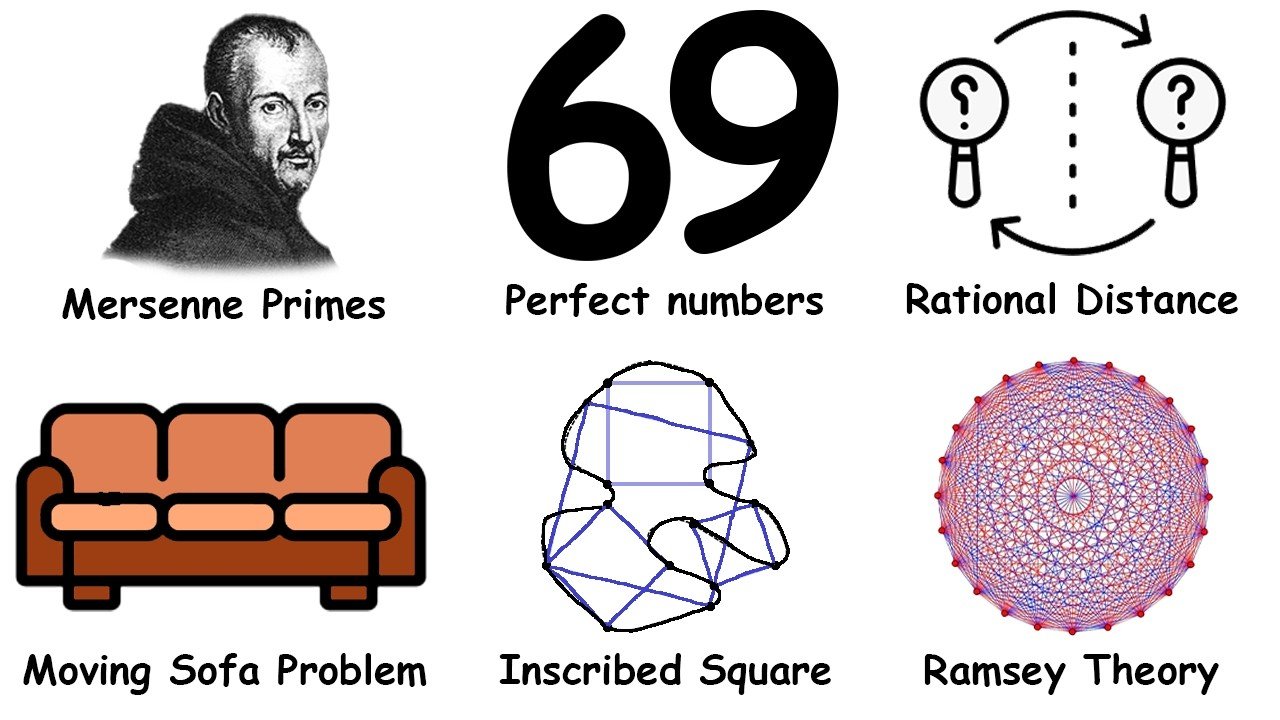
Six Deceptively Simple Unsolved Problems in Mathematics
Mersenne Primes
One unsolved problem in mathematics concerns whether or not there are infinitely many Mersenne primes. In order to understand what a Mersenne prime is, consider the expression 2ᵖ − 1 for a non-negative integer n. A number of this form is called a Mersenne number, named after Marin Mersenne, a French mathematician.
For some prime number values of p, the value of the whole expression is also a prime number. For example, plugging in p = 2, the expression evaluates to 2² − 1 = 3, which is prime. A prime number of the form 2ᵖ − 1, where p is also a prime number, is known as a Mersenne prime.
As it turns out, p must be a prime number for 2ᵖ − 1 to have any chance of being prime. However, there are some prime number values of p that do not produce a prime number. For example, if p = 11, then the expression evaluates to 2,047, which is a composite number with factors 1, 23, 89, and itself. As a result, you can’t just plug in Mersenne primes themselves for p in order to keep getting new Mersenne primes forever. Indeed, there is no consistent, reliable formula for generating Mersenne primes. Finding new ones primarily comes down to using guess-and-check computer algorithms.
Currently only 51 Mersenne primes are known, with the largest one being 2⁸²,⁵⁸⁹,⁹³³ − 1. Incidentally, this is also the largest known prime number overall. Based on our computations, Mersenne primes seem to be exceedingly rare among the Mersenne numbers. However, whether or not they eventually stop remains a mystery.
Perfect Numbers
A perfect number is a positive integer equaling the sum of its proper divisors, which are the number’s divisors other than the number itself. For example, the proper divisors of 6 are 1, 2, and 3, and 1 + 2 + 3 = 6, so 6 is a perfect number. The next few perfect numbers are 28, 496, and 8,128.
There are two main unsolved problems relating to perfect numbers. The first asks whether or not there are any odd perfect numbers. Odd numbers tend to miss out on divisors thanks to not being divisible by 2 or by any multiple thereof. Currently all 51 known perfect numbers are even. However, much progress has been made in regards to this problem. Mathematicians have come up with an incredibly long and strict list of rules that an odd perfect number must follow, if such a number exists at all. Going over the whole list would take all day, but needless to say, odd perfect numbers must be either very rare and special or completely nonexistent. In general, mathematicians guess that the latter is true. The set of conditions required for an odd perfect number just seems far too restrictive. As English mathematician James Joseph Sylvester put it, “a prolonged meditation on the subject has satisfied me that the existence of any one such odd perfect number, its escape, so to say, from the complex web of conditions which hem it in on all sides, would be little short of a miracle.”
The second problem asks whether there are infinitely many perfect numbers. There are some known facts related to this. The Mersenne primes are closely related to the perfect numbers. Consider the expression 2ᵖ⁻¹ × (2ᵖ − 1), where 2ᵖ − 1 is a Mersenne prime. No matter what Mersenne prime we have, this expression always gives us an even perfect number. If p = 2, our Mersenne prime is 3, and this expression evaluates to 6. If p = 3, our Mersenne prime is 7, and this expression evaluates to 28. And so on. This fact was proven by the Greek mathematician Euclid.
Conversely, given any even perfect number, we can find the Mersenne prime that would have yielded it when using this expression. In other words, there exists a bijection, a one-to-one correspondence, between the set of even perfect numbers and the set of Mersenne primes. This was proven by Swiss mathematician Leonhard Euler. In honor of both, this theorem is called the Euclid-Euler theorem. Because of it, as soon as anyone finds out whether or not there are infinitely many Mersenne primes, we will also know whether or not there are infinitely many even perfect numbers, and vice versa.
The Rational Distance Problem
In geometry, a plane is a flat 2D space that extends to infinity in all directions, basically an infinitely large sheet of paper. Imagine a unit square, a square with side length equal to one unit, living in this space. The rational distance problem asks: does there exist a point in the plane that is a rational distance away from every vertex of a unit square?
To elaborate, suppose that this plane has a Cartesian coordinate system, the usual x-y coordinates you may be familiar with. For simplicity, we’ll place this square’s vertices at (0, 0), (0, 1), (1, 0), and (1, 1). Now pick any point in this plane. Calculate the distance between this point and each vertex of the unit square, using the distance formula d = √((x₂ − x₁)² + (y₂ − y₁)²). For the chosen point and the four vertices of the unit square, the goal is to have every one of the four distances be a rational number.
Despite the apparent simplicity of this task, no one has succeeded at it yet, nor has anyone proven that it is impossible.
One option is to examine regular polygons of unit side length other than the square. The simplest example is the equilateral triangle, for which we know that a point can be chosen to result in all distances being rational. This also holds for the regular hexagon. However, the answer for squares, octagons, 12-gons, and 24-gons remains unknown. For all remaining regular polygons, the answer is known to be no.
The Moving Sofa Problem
Imagine a hallway one unit wide with a 90° L-shaped bend. You want to slide some kind of shape, let’s say it’s a sofa, from one side of this bend to the other. What is the maximum possible area that such a shape can have? Whatever this maximum value for the area is, it is called the sofa constant.
We can start with a half-disc of unit radius (where a disc is the region enclosed by a circle). The unit disc has an area of π, and half of that is π/2, about 1.57. This gives us a simple lower bound on the sofa constant, but we can do better.
In 1968, British mathematician John Hammersley proposed a sofa roughly in the shape of a telephone handset. This sofa has an area of π/2 + 2/π, about 2.2074. Later sofas have surpassed this number, with the current record being about 2.2195, believed to be close to the true sofa constant.
Upper bounds on the sofa constant have also been obtained. Hammersley found an upper bound of 2√2, about 2.82. Later, in 2018, Yoav Kallus and Dan Romik lowered this to about 2.37. Their approach involved using computers to rotate the hallway around the sofa rather than the other way around.
The Inscribed Square Problem
A curve is closed if it loops back on itself, and it is simple if it doesn’t cross over itself. A simple closed curve in a plane is called a Jordan curve. A polygon is inscribed in a curve if all of its vertices are on the curve. The question: does every Jordan curve have an inscribed square?
We can start with some simple examples of Jordan curves. A circle is a Jordan curve, and it has infinitely many possible inscribed squares. A square itself is also a Jordan curve, and infinitely many inscribed squares can be found in this curve as well. As for triangles, an obtuse triangle has exactly one inscribed square, a right triangle has two, and an acute triangle has three.
In the general case, the problem has proven to be difficult. However, some special cases have been proven. For example, in 1916, Arnold Emch showed that a piecewise analytic curve must have inscribed rhombuses, and at least one of these rhombuses is a square. It has also been shown that all symmetric curves have at least one inscribed square. Another case involves an annulus, the region bounded by two concentric circles, where the outer radius is at most (1 + √2) times the inner radius. If the Jordan curve is inscribed in such an annulus and separates the annulus’s inner and outer circles, then a sequence of squares leading to a square inscribed in the Jordan curve can be found.
The Ramsey Theory Problem
Ramsey theory is a branch of combinatorics named after British mathematician and philosopher Frank P. Ramsey. It is primarily focused on the size of mathematical structures needed to guarantee certain properties.
One problem goes as follows. Consider the vertices of an n-dimensional hypercube (1D is a line segment, 2D is a square, 3D is a cube, and so on). Draw edges from every vertex to every other vertex, forming what is known as a complete graph. Each edge can be colored either red or blue. Depending on the number of dimensions, it may be possible to color these edges so that if you take the complete graph on any four coplanar vertices, not all of the edges are the same color. This complete graph on four vertices can be visualized as a square with the diagonals drawn in. What is the smallest number of dimensions in which this coloring is possible?
Lower and upper bounds for this problem have been obtained. In 1971, American mathematicians Ronald Graham and Bruce Lee Rothschild found a lower bound of 6. In 2003, Jeffrey Exoo improved this to 11, which was later improved to 13 by Jerome Barkley in 2008.
As for the upper bound, it can only be reasonably expressed using operations known as the hyper-operations, which extend the usual operations of addition, multiplication, and exponentiation. The most famous upper bound found for this problem is a number called Graham’s number, which once held the world record for the largest number used in a serious mathematical proof. Graham’s number is too large for an ordinary decimal representation of it to fit into the observable universe, even if each digit occupied only one Planck volume, and even that astronomically undersells its size. In any case, the current upper bound is a much smaller number, though still extraordinarily large by any normal standard.
Further Reading
- Mersenne Primes at the Great Internet Mersenne Prime Search (GIMPS)
- Perfect Numbers on MathWorld
- The Moving Sofa Problem on MathWorld
- The Inscribed Square Problem on MathWorld
- Graham’s Number on MathWorld
- Kallus, Y. and Romik, D. “Improved upper bounds in the moving sofa problem.” arXiv:1706.06630
Leave a Reply