
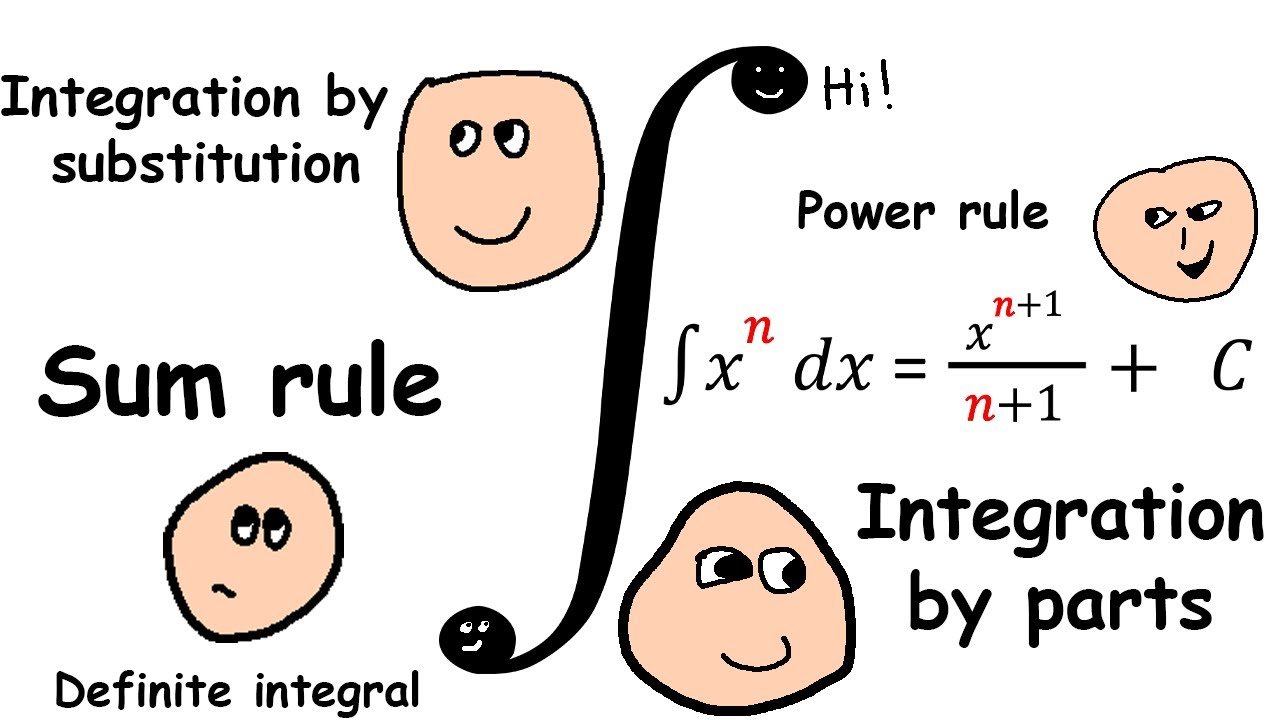
A Complete Guide to Integrals
What Are Integrals?
An integral is a mathematical operation that computes the area under a curve or the accumulation of a quantity over a given interval. It’s like finding the total amount of something, like the area of a region or the volume of a solid. Differentiation and integration are inverse operations.
We denote an integral with the elongated S symbol. For example, ∫ f(x) dx reads as “the integral of f(x) with respect to x,” where f(x) is the function being integrated, x is the variable of integration, and dx is the differential of the variable.
There are two main types of integrals. A definite integral has a specific upper and lower bound and is used to find the area between a curve and the axis over a specific interval. It is denoted as ∫ₐᵇ f(x) dx = F(b) − F(a). An indefinite integral is used to find the antiderivative of a function. It is denoted as ∫ f(x) dx = F(x) + C.
The Power Rule
The power rule states that if we’re integrating xⁿ, we can simply add one to the exponent and divide by the new exponent: ∫ xⁿ dx = xⁿ⁺¹/(n + 1) + C. Remember, it only works for powers of x (where n ≠ −1), and don’t forget to add the constant of integration.
Let’s try an example. ∫ x² dx = x³/3 + C.
The Sum Rule
This rule allows us to integrate a sum of functions by integrating each function separately. The sum rule states that ∫ [f(x) + g(x)] dx = ∫ f(x) dx + ∫ g(x) dx. In other words, the integral of a sum of functions is equal to the sum of their integrals. Similarly, when two functions are being subtracted: ∫ [f(x) − g(x)] dx = ∫ f(x) dx − ∫ g(x) dx.
Let’s consider an example. Suppose we want to evaluate ∫ (x² + 3x) dx. Using the sum rule, we can break this down into two separate integrals: ∫ x² dx + ∫ 3x dx. Evaluating each gives us x³/3 + 3x²/2 + C.
Integration by Substitution
Integration by substitution is a powerful technique that allows us to simplify complex integrals by substituting a new variable. It’s a change of variables that makes the integral easier to evaluate. Just as the chain rule is used to differentiate composite functions, integration by substitution is used to integrate them.
The formula for integration by substitution is ∫ f(g(x)) · g′(x) dx = ∫ f(u) du, where we substitute u = g(x).
For example, in the integral ∫ (2x + 1)³ dx, we substitute u = 2x + 1, giving du = 2 dx, or dx = du/2. The new integral becomes (1/2) ∫ u³ du = (1/2)(u⁴/4) + C = u⁴/8 + C = (2x + 1)⁴/8 + C.
Integration by Parts
Integration by parts is a powerful technique that allows us to integrate products of functions. One function is differentiated and the other is integrated.
The formula for integration by parts is ∫ f(x) · g′(x) dx = f(x) · g(x) − ∫ g(x) · f′(x) dx, or more simply: ∫ u dv = uv − ∫ v du. Remember to choose carefully which function to differentiate and which to integrate, and don’t forget to subtract the integral of the product.
Let’s work through ∫ x² · sin(x) dx. Let f(x) = x² and g′(x) = sin(x). Differentiating: f′(x) = 2x. Integrating: g(x) = −cos(x).
Applying the formula: ∫ x² sin(x) dx = x²(−cos x) − ∫ (−cos x)(2x) dx = −x² cos x + 2 ∫ x cos(x) dx.
We need to apply integration by parts a second time to evaluate ∫ x cos(x) dx. Letting u = x and dv = cos(x) dx gives us x sin(x) + cos(x) + C.
Putting it all together: ∫ x² sin(x) dx = −x² cos x + 2(x sin x + cos x) + C = −x² cos x + 2x sin x + 2 cos x + C.
Integration by Partial Fractions
Integration by partial fractions is a technique used to integrate rational functions. It works by breaking down a fraction into smaller pieces that are easier to integrate. The key requirement is that the degree of the numerator must be less than the degree of the denominator.
Let’s integrate ∫ (2x + 1)/(x² + 3x + 2) dx. First, factor the denominator: x² + 3x + 2 = (x + 1)(x + 2). Set up the partial fractions: (2x + 1)/((x + 1)(x + 2)) = A/(x + 1) + B/(x + 2). Solving for A and B gives A = −1 and B = 3.
Now integrate: ∫ −1/(x + 1) dx + ∫ 3/(x + 2) dx = −ln|x + 1| + 3 ln|x + 2| + C.
Definite Integrals
A definite integral is a type of integral that has a specific upper and lower bound. It’s denoted as ∫ₐᵇ f(x) dx = F(b) − F(a), where a is the lower bound, b is the upper bound, and F(x) is the antiderivative of f(x).
Let’s find the definite integral of x² from 0 to 2. Using the power rule: ∫₀² x² dx = [x³/3]₀² = (2³/3) − (0³/3) = 8/3.
A Real-Life Application
Integrals have many practical applications, such as finding areas of regions, calculating volumes of solids, and determining the work done by a force on an object. If you have a function that describes the velocity of an object, the integral of that function gives you the distance traveled.
Here’s an example. A water tank has a circular leak at the bottom with a radius of 0.5 m. Water is flowing out of the leak at a rate of 0.2 m/s. Find the total amount of water that leaks out in 5 minutes.
The area of the leak is A = πr² = π(0.5)² = 0.25π m². The volumetric flow rate is the flow speed times the cross-sectional area: 0.2 × 0.25π m³/s. We want the total volume over 300 seconds (5 minutes × 60 seconds per minute).
The integral: ∫₀³⁰⁰ 0.2 × 0.25π dt = 0.05π × 300 = 15π m³.
The total amount of water that leaks out is 15π m³, or approximately 47.12 m³ (about 47,120 liters).
Further Reading
- Integration on MathWorld
- Integration by Parts on MathWorld
- Partial Fractions on MathWorld
- MIT OpenCourseWare: Single Variable Calculus (free course covering all integration techniques)
Leave a Reply