
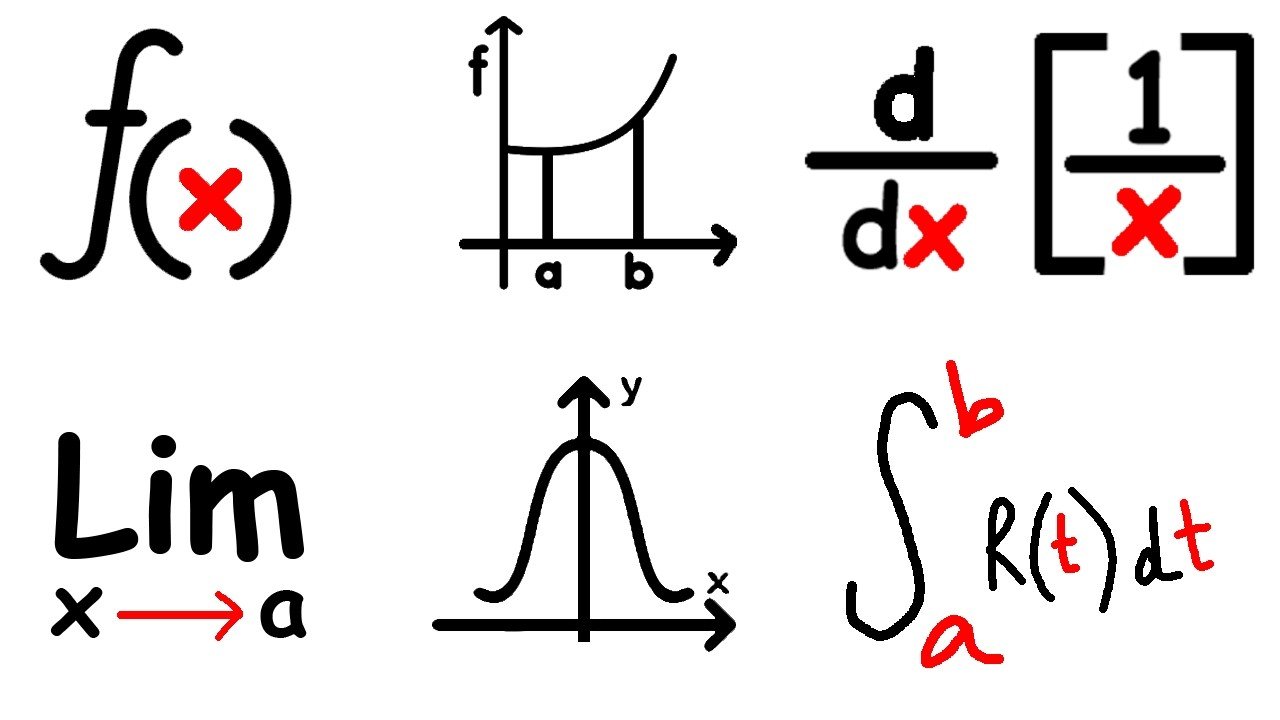
A Complete Walkthrough of Calculus
What Is Calculus?
Calculus is the branch of mathematics involving the study of the continuous rate of change of quantities, particularly in the context of functions and limits. It’s a fundamental subject with numerous applications in various fields, including physics, engineering, economics, and computer science. Calculus is divided into two main branches: differential calculus and integral calculus. Before diving in, we need to discuss some major prerequisites: functions and limits.
Functions
A function is a mathematical relationship between a set of inputs (the domain) and a set of possible outputs (the range). It is a way of assigning each input exactly one output. The input is called the independent variable and the output is called the dependent variable. A function is often denoted by the letter f and the input by the letter x. The application of the function f to the input x is written as f(x), and it is equal to the output of the function for that input. The output is often denoted by y, and the equation y = f(x) is read as “y is a function of x.”
In the calculus of real numbers, we study real functions, which take real numbers as inputs and give real numbers as outputs. Functions can be represented in various forms, such as equations, graphs, and tables. For example, f(x) = 2x + 5 is a function because for every value of x we get exactly one answer for f(x). Consider another example: f(x) = ±√x. This is not a function because each value of x gives more than one value of f(x).
Operations on functions involve combining two or more functions in different ways to make a new function. Here are some common operations, using f(x) = x² and g(x) = 2x as examples. Addition: (f + g)(x) = f(x) + g(x) = x² + 2x. Subtraction: (f − g)(x) = f(x) − g(x) = x² − 2x. Multiplication: (f · g)(x) = f(x) · g(x) = x² · 2x = 2x³. Division: (f/g)(x) = f(x)/g(x) = x²/(2x) = x/2, where g(x) ≠ 0.
Composition of functions has no analog with basic arithmetic operations. When two functions are composed, one’s output is used as the input of the other. For example: (f ∘ g)(x) = f(g(x)) = (2x)² = 4x². And (g ∘ f)(x) = g(f(x)) = 2x². And (f ∘ f)(x) = f(f(x)) = (x²)² = x⁴. And (g ∘ g)(x) = g(g(x)) = 2(2x) = 4x.
Functions are a powerful tool that help us understand and analyze complex phenomena across various disciplines. They have countless applications: calculating the trajectory of a projectile, modeling population growth and decline, optimizing electronic circuit design, predicting stock prices, modeling the spread of diseases, analyzing and visualizing data, and training machine learning models.
Limits
Limits are a way to study the behavior of the output of a function in response to inputs as they approach some number or go to infinity. In other words, it’s the value that a function gets closer and closer to, but may not necessarily reach. Limits are denoted by the symbol “lim” and are written as lim(x→a) f(x) = L, where f(x) is the function applied to the variable x, a is the point where the limit is being evaluated, and L is the limit value.
Limits help us understand how functions behave, define continuity, derivatives and integrals, and solve optimization problems.
As an example, evaluate lim(x→0) of x/x. The expression x/x is undefined for x = 0 since that leads to division by zero. However, we can plug in values of x that get closer and closer to zero. Coming from the positive side, we can plug in 0.01, 0.001, and 0.00001. These give us 0.01/0.01 = 1, 0.001/0.001 = 1, and 0.00001/0.00001 = 1. So for values of x arbitrarily close to zero from above, x/x = 1. We can also plug in negative values like −0.01, −0.001, and −0.00001. These values also give us x/x = 1. Thus the limit from the negative side is also 1. Since the limits from above and below match, we can say that lim(x→0) x/x = 1.
Derivatives
Derivatives are a fundamental concept in calculus that measure how sensitive a function is to changes in its input. The derivative of a function f, denoted by f′, is another function that measures the rate of change of f at a given input value. For inputs around which f is rapidly increasing, the derivative has a high positive value. If f is only slowly increasing, the derivative has a small positive value. If f is neither increasing nor decreasing, the derivative is zero. And if f is decreasing, the derivative is negative.
Let’s say we’re trying to find the rate of change of f around the input x. The value of the function at that point is f(x). Now let’s change x by a small amount, which we’ll call Δx. This takes us to the point x + Δx, and the function’s value there is f(x + Δx). To find the average rate of change over the interval from x to x + Δx, we take the ratio: Δf/Δx = (f(x + Δx) − f(x)) / Δx.
Now we just need to consider what happens for smaller and smaller values. Using a limit: lim(Δx→0) (f(x + Δx) − f(x)) / Δx. This is the formal definition of the derivative. It is more commonly written with the letter h: f′(x) = lim(h→0) (f(x + h) − f(x)) / h.
This process can be visualized on a graph. The points (x, f(x)) and (x + h, f(x + h)) can be plotted, and a line drawn through them represents the average rate of change over that interval. As h approaches zero, this line approaches the tangent line to the graph at x. So the derivative has a nice visual representation: it is the slope of the tangent line to the graph of the function at the input point.
Since the derivative is defined using a ratio of the change in f to the change in x, it can also be written as df/dx, where dx means a tiny difference in x and df is the resulting tiny difference in f. This is read as “the derivative of f with respect to x,” meaning the speed at which f changes as x changes.
One simple example is velocity. Velocity is the rate at which your position changes over time, making it the derivative of position with respect to time. Assuming forward is the positive direction: going forward very fast means a large positive velocity, going forward slowly means a small positive velocity, not moving means a velocity of zero, and going backward means a negative velocity. Note that velocity and speed are different things. Velocity has both direction and magnitude, while speed is just the magnitude with no regard for direction.
Derivative Rules
Constant rule. The derivative of a constant function is zero: if y = f(x) = c, then dy/dx = 0.
Constant multiple rule. The derivative of a constant times a function equals the constant times the derivative: d/dx [c · f(x)] = c · d/dx [f(x)].
Power rule. The derivative of xⁿ is n · xⁿ⁻¹. For example, if f(x) = x², then f′(x) = 2x²⁻¹ = 2x.
Derivatives of sine and cosine. d/dθ sin θ = cos θ, and d/dθ cos θ = −sin θ.
Sum rule. The derivative of a sum of functions equals the sum of their derivatives: d/dx [f(x) + g(x)] = d/dx f(x) + d/dx g(x). Similarly for subtraction: d/dx [f(x) − g(x)] = d/dx f(x) − d/dx g(x). For example, if f(x) = 3x² + 2x, the sum rule gives f′(x) = d/dx(3x²) + d/dx(2x) = 6x + 2.
Product rule. When we have a function h(x) that’s the product of two functions f(x) and g(x), we can’t simply multiply their derivatives. Instead, the product rule states: if h(x) = f(x) · g(x), then h′(x) = f′(x) · g(x) + f(x) · g′(x). For example, if f(x) = x² sin(x), then f′(x) = x² · cos(x) + 2x · sin(x).
Quotient rule. When we have a function h(x) that’s the quotient of two functions, the quotient rule states: if h(x) = f(x)/g(x), then h′(x) = (f′(x) · g(x) − f(x) · g′(x)) / [g(x)]². For example, the derivative of f(x) = (2x + 1)/(x + 2): f′(x) = ((x + 2)(2) − (2x + 1)(1)) / (x + 2)² = (2x + 4 − 2x − 1) / (x + 2)² = 3/(x + 2)².
Chain rule. When we have a composite function, meaning a function inside another function, we use the chain rule. It states: if f(x) = g(h(x)), then f′(x) = g′(h(x)) · h′(x). It’s essential to identify the outer and inner functions and evaluate their derivatives separately. For example, to find the derivative of f(x) = sin(x²), we identify g(x) = sin(x) and h(x) = x². Their derivatives are g′(x) = cos(x) and h′(x) = 2x. Applying the chain rule: f′(x) = cos(x²) · 2x = 2x cos(x²).
Derivatives of All Six Trigonometric Functions
There are six basic trigonometric functions: sine, cosine, tangent, cotangent, secant, and cosecant. These functions are related to the ratios of the sides of triangles and are used to describe periodic phenomena such as sound waves, light waves, and circular motion. Their derivatives are:
d/dθ sin θ = cos θ
d/dθ cos θ = −sin θ
d/dθ tan θ = sec²θ
d/dθ cot θ = −csc²θ
d/dθ sec θ = sec θ · tan θ
d/dθ csc θ = −csc θ · cot θ
A Real-Life Application of Derivatives
Derivatives have many real-life applications, such as optimizing functions, finding maximum and minimum values, determining the rate of change of physical quantities, and analyzing population growth and chemical reactions.
Here’s an example. Say you are a manager at a company that produces smartphones. You want to know the rate at which your profit is changing with respect to time. Your profit function is P(t) = 1000t² − 500t + 100, where t is time in months. To find the rate at which your profit is changing, find the derivative of P(t). Using the power rule and sum rule, we get P′(t) = 2000t − 500.
What does this mean? It means your profit is increasing at a rate of 2000t − 500 dollars per month. If we want to know the rate at a specific time, we can plug in that value of t. For example, after 5 months: P′(5) = 2000(5) − 500 = 9500. So your profit is increasing at a rate of $9,500 per month after 5 months.
Leave a Reply