
The Cosmological Constant and the Static Universe
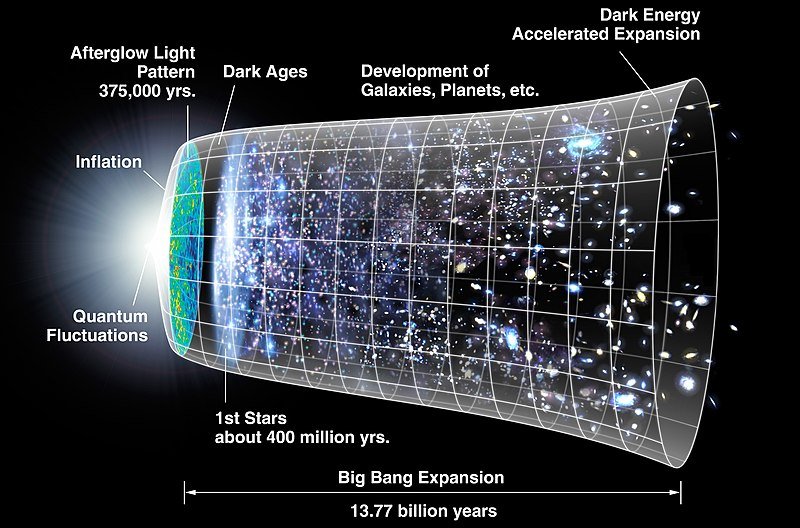
When working on the theory of general relativity, Einstein proposed an equation that explained gravity better than Newton’s equations and accurately predicted the orbit of Mercury. Later, he used it to describe the universe as a whole, but ran into a problem: his equations implied a universe that was dynamic, not static. Einstein believed the universe was unchanging, so he cleverly added a term called the cosmological constant, a repulsive force to balance out the attractive force of gravity and keep the universe static.
A Russian physicist, Alexander Friedmann, plugged the universe into Einstein’s equations and found that the universe was expanding. Einstein didn’t like this and criticized Friedmann. He held firmly to the static universe model and didn’t want his equations predicting expansion. He eventually agreed when Friedmann wrote a letter explaining that Einstein had made a calculation error.
In 1929, Edwin Hubble discovered that the universe is expanding and that galaxies and stars are moving away from each other. Scientists removed the cosmological constant from the equation. But years later, they brought it back because it explained the mysterious force called dark energy, which drives the accelerated expansion of the universe.
Black Holes and Singularities
In the early 20th century, when Einstein formulated his theory of general relativity, the concept of black holes, regions of space where gravity is so intense that nothing, not even light, can escape, was not fully understood. In 1939, Einstein was skeptical about the existence of such objects. He believed that singularities, where the curvature of spacetime becomes infinite as predicted by his equations, might not occur in nature but rather were a sign of flaws in the theory.
He misinterpreted the Schwarzschild solution and believed that as matter collapsed under its own gravity, it would reach speeds approaching the speed of light, which he thought would prevent further collapse, thereby avoiding the formation of a black hole. However, Einstein later corrected this mistake in 1946 when he realized that his previous argument was flawed. He acknowledged that general relativity does allow for the formation of black holes, even though the details of gravitational collapse were beyond the computational abilities of the time.
Clock Synchronization
In 1905, Einstein presented a thought experiment involving synchronized clocks, which aimed to illustrate his theory of special relativity. He imagined two clocks placed at different locations and synchronized in one frame of reference, then observed from another moving frame. Initially, Einstein made an error in his thought experiment by assuming that the observer in the moving frame would see the clocks as synchronized simultaneously in their frame as well. This assumption led to inconsistencies and contradictions when reconciling with the principles of relativity.
He developed the concept of Einstein synchronization, where clocks are synchronized based on the principle that the speed of light is constant in all inertial frames of reference. This resolved the inconsistencies and formed a fundamental basis of special relativity.
Gravitational Waves
Gravitational waves are ripples in the fabric of spacetime caused by massive accelerating objects such as binary star systems or merging black holes. Although his theory suggested the existence of gravitational waves, Einstein didn’t believe they could be detected. In 1936, Einstein had grown skeptical about the physical existence of gravitational waves. In a paper co-authored with Nathan Rosen, he concluded that gravitational waves could not exist in the full nonlinear theory. They submitted their paper to the journal Physical Review, but it was rejected due to errors.
An important mistake of Einstein’s was differentiating between real physical effects and artifacts of the coordinate system used in his equations. Real coordinates represent physical locations, while artifact coordinates are mathematical representations of spacetime. Einstein also struggled with the concept of how gravitational waves could carry energy.
In 2015, gravitational waves were detected originating from the merger of two black holes approximately 1.3 billion light-years away from Earth, proving his doubts wrong.
The Unified Theory of Everything
For the last 30 years of his life, Einstein worked on a unified theory of everything that would ideally explain all fundamental forces (electromagnetism, gravity, strong nuclear force, and weak nuclear force) within a single coherent mathematical framework. But he failed to do so.
In his ambitious attempts, he tried to modify his field equations of general relativity, often adding extra terms and introducing hypothetical fields and forces that made it more complicated. He also completely neglected quantum mechanics and particle physics, new ideas and advancements that were flourishing during his later years. This isolation yielded no results that could put everything into one theory.
The Equivalence Principle
The equivalence principle states that acceleration in uniform gravity (flat spacetime) is locally indistinguishable from gravity. This implies that the laws of physics in a small region of spacetime are the same whether the frame is accelerating in the absence of gravity or at rest in a gravitational field, like in the classic elevator thought experiment.
Einstein thought the equivalence principle could be applied universally and mistakenly equated gravitational forces from mass-energy curving spacetime with inertial forces experienced in accelerating reference frames. But the equivalence only works in small regions. The difference becomes significant in non-uniform gravity, large regions, and in the presence of strong gravitational gradients.
The Bending of Light
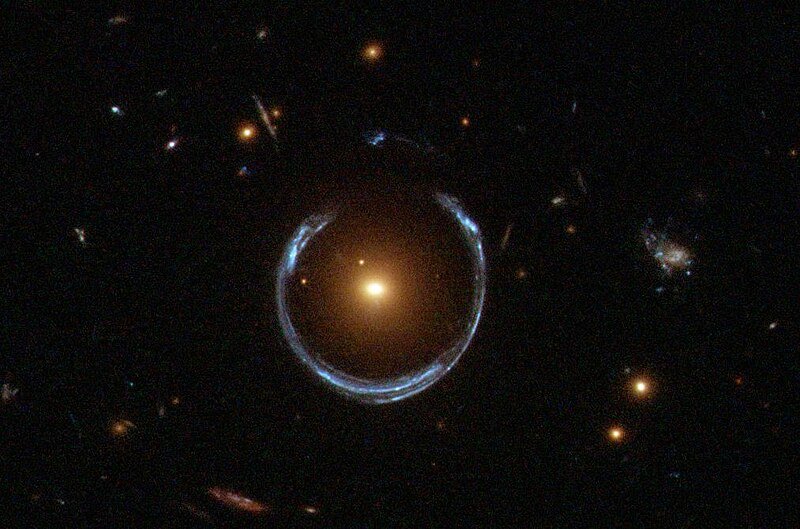
In his early work around 1911, Einstein initially proposed that gravity might affect the speed of light but not its direction significantly. This underestimated the true nature of gravity’s effect on light. However, by 1915, with his theory of general relativity, Einstein corrected this misconception. He realized that gravity actually curves the fabric of spacetime itself in the presence of mass and energy. This breakthrough allowed him to accurately predict, and later confirm through observations like those during the 1919 solar eclipse, that light bends around massive objects like the Sun, validating his new theory and overturning his earlier misunderstanding.
Thermal Radiation and Quanta of Light
In 1905, Einstein initially struggled to apply the concept of light photons (packets of light particles) to explain thermal radiation, especially black-body radiation. A black body is an ideal object that absorbs all incident radiation without reflecting light and emits radiation perfectly, which was not well understood at the time.
According to Max Planck, electromagnetic energy can be absorbed in the form of discrete packets, or quanta, from quantized oscillators. Combining the particle nature of light with existing theory required rethinking the interaction of light and matter. Einstein’s earlier quantization attempts didn’t align with experimental and theoretical predictions based on classical physics.
Collaborating with Planck and others, Einstein refined his theory, integrating light quanta into a coherent quantum theory of radiation. This corrected his initial errors, laying crucial groundwork for quantum mechanics and his Nobel Prize-winning work on the photoelectric effect and the quantum nature of light.
The Einstein-de Haas Experiment
In 1915, Einstein made a mistake in his interpretation of the results from the Einstein-de Haas experiment, which demonstrated that changing a magnetic field induces rotational motion in a metal bar. Einstein incorrectly concluded that this proved the existence of Amperian molecular currents, hypothetical microscopic current loops inside atoms. The experiment actually demonstrated the existence of quantum mechanical properties of electron spin, angular momentum, and magnetic properties that were unknown at the time.
Quantum Mechanics
In classical physics, we can determine velocity, acceleration, momentum, and kinetic energy given the position and time of a body. But in the quantum world, nothing is certain. Einstein didn’t like the foundations of quantum mechanics, including Born’s probabilistic rule, the Copenhagen interpretation, Schrödinger’s cat, and Heisenberg’s uncertainty principle.
In 1927, Einstein engaged in heated debates with Niels Bohr over the interpretation of quantum mechanics. Einstein rejected the probabilistic nature of quantum theory, famously declaring that “God does not play dice.” He believed that there must be a more deterministic underlying explanation for the behavior of particles at the quantum level. Bohr defended the probabilistic interpretation of quantum mechanics, emphasizing its success in predicting experimental results and challenging Einstein’s philosophical objections with the famous reply, “Don’t tell God what to do.”
Quantum mechanics proved to be one of the leading frontiers of physics and explained atoms better than classical assumptions, replacing outdated models of electrons circling the nucleus like planets orbiting a star with electron cloud models. Today we have quantum computers with extraordinary computational power, and quantum mechanics remains an active research field whose complexity and applications continue to grow.
Leave a Reply