
Famous and Influential Mathematicians from 600 BC to the 21st Century
These are some of the most famous and influential mathematicians from 600 BC to the 21st century. Let’s take a closer look at the lives and groundbreaking discoveries of legendary minds who shaped the world with their innovative ideas in geometry, algebra, calculus, and beyond.
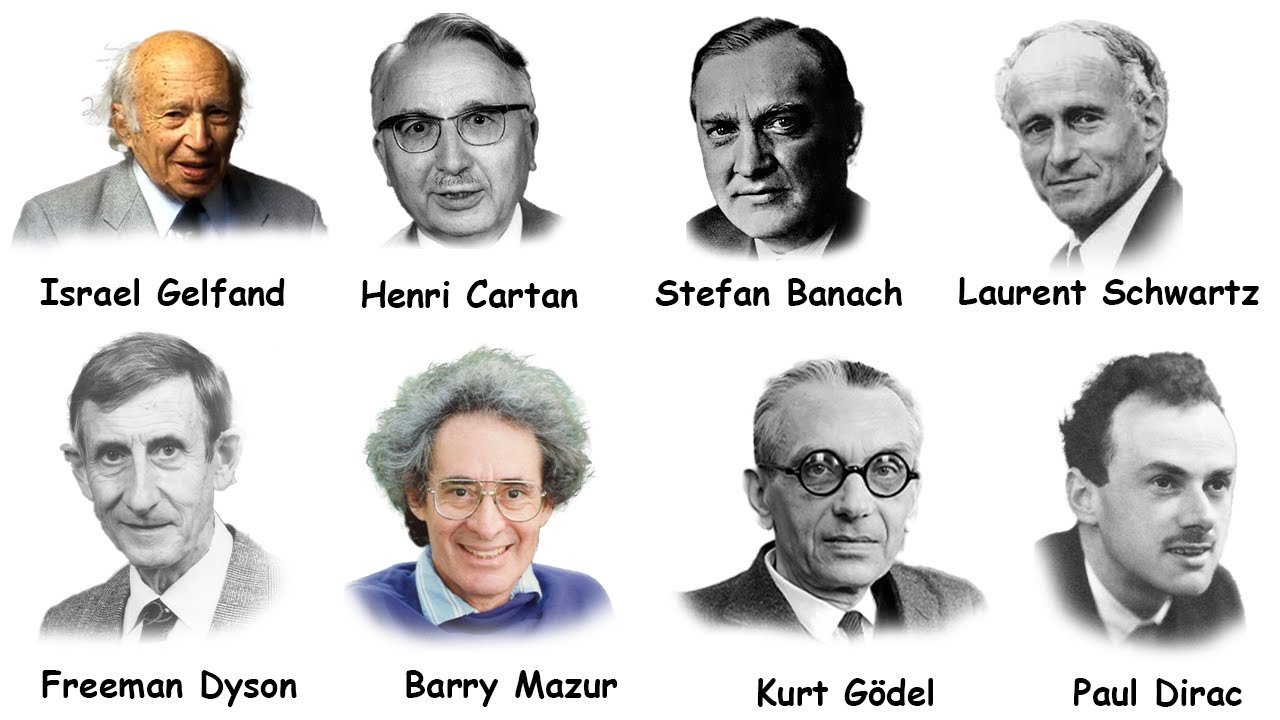
Stefan Banach
Stefan Banach was a Polish mathematician and one of the founders of modern functional analysis. He introduced the concept of Banach spaces, which are complete normed vector spaces fundamental in the study of various types of functional and differential equations. Banach also co-founded the influential mathematical journal Studia Mathematica.
Henri Cartan
Henri Cartan was a French mathematician notable for his profound contributions to algebraic topology and homological algebra. He was a central figure in the development of sheaf theory and co-authored the Cartan-Eilenberg book on homological algebra, which laid the groundwork for much of modern algebraic topology. Cartan was also a member of the Bourbaki group, contributing to the collective effort to reformulate and modernize mathematics.
Israel Gelfand
Israel Gelfand was a Soviet mathematician who made pivotal contributions to various fields including functional analysis, representation theory, and algebraic geometry. He developed the Gelfand representation, which is fundamental in the theory of Banach algebras, and the Gelfand-Naimark theorem, which characterizes commutative C*-algebras. His work has had lasting impacts on both pure and applied mathematics.
Laurent Schwartz
Laurent Schwartz was a French mathematician best known for creating the theory of distributions, which generalizes functions and allows for the rigorous analysis of objects like the Dirac delta function. His work provided new methods for solving partial differential equations and has applications in quantum mechanics and signal processing. Schwartz was awarded the Fields Medal in 1950 for his groundbreaking contributions.
David Mumford
David Mumford is an American mathematician who significantly advanced the field of algebraic geometry. His research on the geometric structures of moduli spaces of curves has been instrumental in the development of modern algebraic geometry. Mumford’s work has applications in fields such as computer vision and pattern theory. He was awarded the Fields Medal in 1974.
Alain Connes
Alain Connes is a French mathematician distinguished for his work in operator algebras and non-commutative geometry. He formulated the Connes embedding conjecture and developed the theory of non-commutative spaces, providing new insights into quantum mechanics and spacetime geometry. Connes received the Fields Medal in 1982, recognizing his innovative contributions that bridged multiple areas of mathematics.
Karen Uhlenbeck
Karen Uhlenbeck is an American mathematician known for her pioneering work in geometric partial differential equations and gauge theory. Her contributions to the theory of minimal surfaces and the calculus of variations have profound implications in both mathematics and physics. Uhlenbeck’s work on the Yang-Mills equations and integrable systems has been particularly influential, earning her the Abel Prize in 2019.
Freeman Dyson
Freeman Dyson was a British-American theoretical physicist and mathematician celebrated for his work in quantum electrodynamics, particularly the Dyson series and Dyson-Schwinger equations, which provided a framework for understanding the interactions of particles. Dyson also made significant contributions to number theory, random matrices, and the study of infinite-dimensional Lie algebras, influencing both mathematics and theoretical physics.
Barry Mazur
Barry Mazur is an American mathematician who has made seminal contributions to number theory and algebraic geometry. He is known for Mazur’s torsion theorem, which classifies the possible torsion subgroups of elliptic curves over the rational numbers. His work on the arithmetic of elliptic curves and modular forms has deep connections to the proof of Fermat’s Last Theorem and has influenced many subsequent developments in number theory.
Peter Lax
Peter Lax is a Hungarian-American mathematician recognized for his contributions to partial differential equations, numerical analysis, and fluid dynamics. He developed Lax pairs, which are fundamental in the study of integrable systems. His work on hyperbolic conservation laws and shock waves has had a profound impact on both theoretical and applied mathematics.
Yakov Sinai
Yakov Sinai is a Russian mathematician noted for his work in dynamical systems, statistical mechanics, and mathematical physics. He introduced the concept of Sinai’s billiards, a model for chaotic motion, and developed the Kolmogorov-Sinai entropy, a measure of the complexity of dynamical systems. Sinai was awarded the Abel Prize in 2014.
George Dantzig
George Dantzig was an American mathematician and operations researcher known as the father of linear programming. He developed the simplex algorithm, a pivotal method for solving linear programming problems with applications in economics, engineering, and military planning. His work laid the foundation for the field of optimization.
Enrico Bombieri
Enrico Bombieri is an Italian mathematician who made significant contributions to number theory, algebraic geometry, and mathematical analysis. He is known for the Bombieri-Vinogradov theorem, which provides a major advance in the understanding of the distribution of prime numbers. Bombieri was awarded the Fields Medal in 1974 for his work in analytic number theory.
David Hilbert
David Hilbert was a German mathematician whose work in invariant theory, algebraic number theory, and the foundations of geometry has profoundly influenced modern mathematics. He formulated Hilbert’s problems, a list of 23 unsolved problems that guided much of 20th century mathematical research. Hilbert space theory is fundamental in functional analysis and quantum mechanics.
Claude Shannon
Claude Elwood Shannon was an American mathematician and electrical engineer known as the father of information theory. He developed the concept of the bit as the fundamental unit of information and established the principles of digital circuit design theory. Shannon’s work laid the groundwork for modern telecommunications and data compression.
Felix Hausdorff
Felix Hausdorff was a German mathematician known for his contributions to set theory, topology, and functional analysis. He introduced the concept of Hausdorff spaces, which are fundamental in topology, and made significant contributions to measure theory and dimension theory. Hausdorff’s work has influenced various branches of mathematics.
Alfred Tarski
Alfred Tarski was a Polish-American logician and mathematician renowned for his work in model theory, metamathematics, and algebraic logic. He developed Tarski’s undefinability theorem and contributed to the theory of truth and formal languages. Tarski’s work has had a lasting impact on logic, mathematics, and the philosophy of language.
Marshall H. Stone
Marshall H. Stone was an American mathematician known for his contributions to functional analysis, Boolean algebras, and topology. He developed the Stone-Weierstrass theorem, a fundamental result in approximation theory, and the Stone duality theorem, which connects Boolean algebras and topological spaces.
Saunders Mac Lane
Saunders Mac Lane was an American mathematician who co-founded category theory, a unifying framework for understanding mathematical structures and relationships between them. His book Categories for the Working Mathematician is a foundational text in the field. Mac Lane also made contributions to algebra and homological algebra.
Paul Dirac
Paul Dirac was a British theoretical physicist and mathematician known for his contributions to quantum mechanics and quantum electrodynamics. He formulated the Dirac equation, which describes the behavior of fermions and predicted the existence of antimatter. Dirac’s work has had a profound impact on both physics and mathematics.
Pierre de Fermat
Pierre de Fermat was a French lawyer and mathematician known for his work in number theory, analytic geometry, and probability. Fermat’s Last Theorem, conjectured by him in the 17th century, remained unsolved until 1994. He also contributed to the development of calculus and the theory of probability.
Alfred North Whitehead
Alfred North Whitehead was a British mathematician and philosopher known for his work in algebra, logic, and the philosophy of science. He co-authored Principia Mathematica with Bertrand Russell, an attempt to ground mathematics in formal logic. Whitehead’s work has influenced both mathematics and philosophy.
André Weil
André Weil was a French mathematician and a founding member of the Bourbaki group. He made significant contributions to number theory and algebraic geometry, particularly the Weil conjectures, which were later proved by others and led to the development of modern algebraic geometry. Weil’s work has had a lasting influence on mathematics.
Daniel Kan
Daniel Kan was a Dutch-American mathematician known for his work in algebraic topology and category theory. He introduced the concepts of Kan complexes and Kan fibrations, which are fundamental in homotopy theory and the study of simplicial sets. His work has been influential in the development of modern topology and categorical methods.
Daniel Quillen
Daniel Quillen was an American mathematician known for his work in algebraic K-theory, homotopical algebra, and cohomology. Quillen introduced the concept of Quillen model categories and Quillen adjunctions, which are fundamental in abstract homotopy theory. He was awarded the Fields Medal in 1978 for his contributions to algebraic K-theory.
Jacob Lurie
Jacob Lurie is an American mathematician recognized for his groundbreaking work in higher category theory and homotopical algebra. Lurie’s work on the foundations of derived algebraic geometry and the development of ∞-category theory has had a transformative impact on the field, particularly with his influential book Higher Topos Theory.
Ada Lovelace
Ada Lovelace was an English mathematician and writer known for her work on Charles Babbage’s early mechanical general-purpose computer, the Analytical Engine. Lovelace is often considered the first computer programmer for her development of an algorithm intended for implementation on the machine, as well as her visionary insights into its potential applications beyond pure calculation.
Élie Cartan
Élie Cartan was a French mathematician who made significant contributions to differential geometry and the theory of Lie groups and Lie algebras. His work on exterior differential systems and the theory of spinors has had a lasting impact on mathematics and theoretical physics. Cartan’s classification of simple Lie algebras remains a cornerstone in the field.
Kurt Gödel
Kurt Gödel was an Austrian logician, mathematician, and philosopher known for his incompleteness theorems, which demonstrate inherent limitations in every formal axiomatic system capable of modeling basic arithmetic. Gödel’s work has profound implications for the philosophy of mathematics and the foundations of computer science.
Richard Dedekind
Richard Dedekind was a German mathematician known for his work in abstract algebra, number theory, and the foundations of real numbers. Dedekind introduced the notion of Dedekind cuts, which provided a rigorous foundation for the construction of the real numbers. His contributions also include important work on ideals and ring theory.
John Milnor
John Milnor is an American mathematician known for his work in differential topology, K-theory, and dynamical systems. Milnor’s discovery of exotic spheres showed that there are differentiable structures on the seven-sphere that are not equivalent to the standard one. He received the Fields Medal in 1962 and the Abel Prize in 2011.
Simon Donaldson
Simon Donaldson is a British mathematician renowned for his work in differential geometry and topology. Donaldson’s theorems on the differential structure of smooth four-dimensional manifolds have had a profound impact on the field. He was awarded the Fields Medal in 1986 for his work on gauge theory and the topology of four-manifolds.
Andrew Wiles
Andrew Wiles is a British mathematician celebrated for proving Fermat’s Last Theorem, a problem that had remained unsolved for over 350 years. Wiles’s proof, which used sophisticated techniques from algebraic geometry and modular forms, was published in 1994. He was awarded the Abel Prize in 2016 for his monumental achievement.
John Tate
John Tate was an American mathematician known for his extensive contributions to number theory and arithmetic geometry. Tate’s work includes the development of Tate modules, Tate cohomology, and the Tate conjecture. He was awarded the Abel Prize in 2010 for his profound impact on number theory and related fields.
Michael Freedman
Michael Freedman is an American mathematician recognized for his work in topology, particularly for proving the four-dimensional Poincaré conjecture. Freedman’s proof demonstrated that any smooth simply connected closed four-dimensional manifold is homeomorphic to the four-dimensional sphere. He was awarded the Fields Medal in 1986.
Shing-Tung Yau
Shing-Tung Yau is a Chinese-American mathematician known for his contributions to differential geometry and geometric analysis. Yau’s proof of the Calabi conjecture, which demonstrated the existence of Ricci-flat Kähler metrics, has profound implications in both mathematics and theoretical physics, particularly in string theory. He was awarded the Fields Medal in 1982.
Max Dehn
Max Dehn was a German mathematician who made significant contributions to topology and group theory. He is known for Dehn’s algorithm for solving the word problem in group theory and Dehn’s lemma in topology, which is a foundational result in the study of three-dimensional manifolds.
Harish-Chandra
Harish-Chandra was an Indian-American mathematician and physicist known for his work in representation theory and harmonic analysis on semisimple Lie groups. His development of the theory of Harish-Chandra modules and characters has had a lasting impact on the field. Harish-Chandra’s work has influenced both mathematics and theoretical physics.
Jean Bourgain
Jean Bourgain was a Belgian mathematician known for his work in functional analysis, harmonic analysis, and combinatorial number theory. Bourgain made significant contributions to the study of Banach spaces, the theory of nonlinear partial differential equations, and ergodic theory. He was awarded the Fields Medal in 1994.
Artur Avila
Artur Avila is a Brazilian-French mathematician recognized for his contributions to dynamical systems and spectral theory. Avila’s work on one-dimensional dynamical systems and the spectral theory of Schrödinger operators has been highly influential. He was awarded the Fields Medal in 2014 for his profound insights and innovative methods in these fields.
Further reading:
- The MacTutor History of Mathematics Archive provides detailed biographies of mathematicians throughout history (University of St Andrews)
- The Abel Prize website includes profiles and lectures from laureates (Abel Prize)
- The Fields Medal archive at the International Mathematical Union (IMU)
This article was generated from the video transcript of “Greatest Mathematicians – Final Part (Pt 3)”.
Watch the full video above for visual explanations and diagrams.
Leave a Reply