
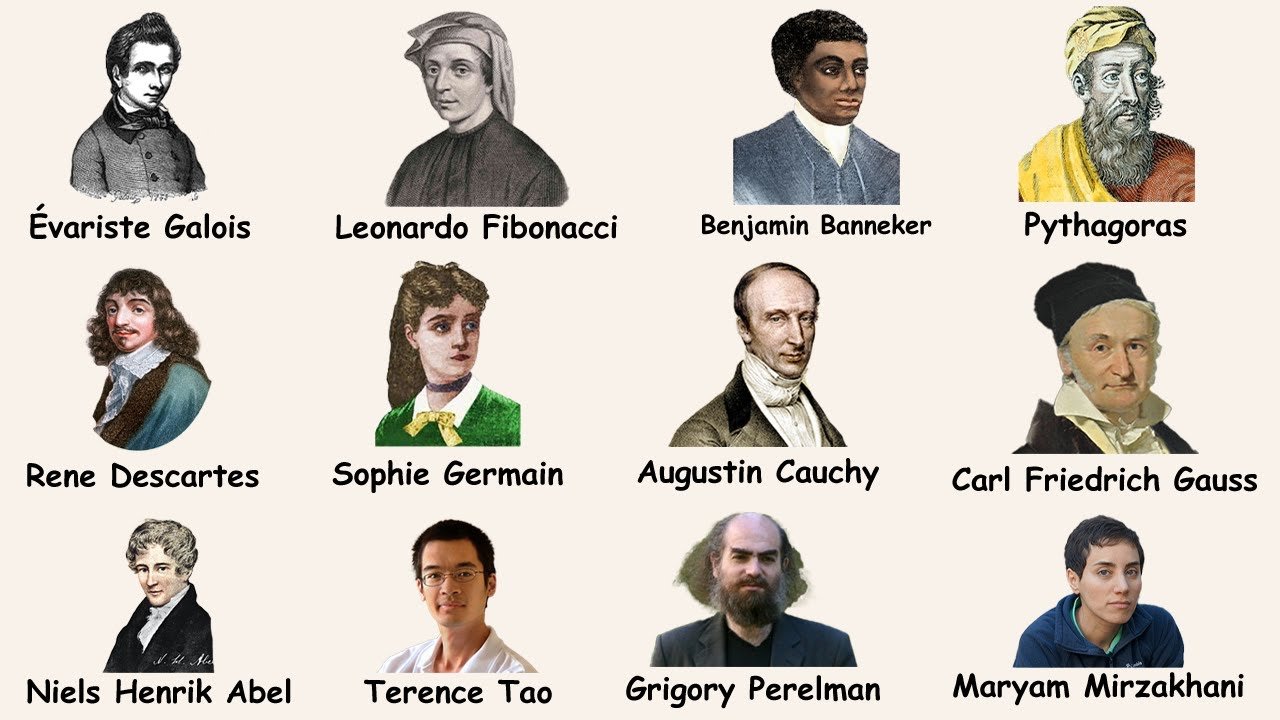
You will see some of the famous and greatest mathematicians from 500 BC to the 21st century. Let’s dive into the lives and groundbreaking discoveries of legendary mathematicians who shaped the world with their innovative ideas.
Pythagoras
Pythagoras, an ancient Greek mathematician, philosopher, and founder of the Pythagorean school, is best known for discovering the Pythagorean theorem. This theorem states that in a right-angled triangle, the square of the length of the hypotenuse (the side opposite the right angle) is equal to the sum of the squares of the lengths of the other two sides.
Euclid
Euclid was a Greek mathematician who authored Elements, a foundational work in mathematics. In this treatise, he presented a systematic and comprehensive compilation of geometrical knowledge. Elements covers the basics of geometry and is renowned for its clarity and logical rigor. It served as the primary textbook for teaching mathematics until the late 19th or early 20th century.
Archimedes
Archimedes, an ancient Greek mathematician, physicist, engineer, and inventor, made significant contributions to mathematics, physics, and engineering. Among his accomplishments, he calculated an approximation of the mathematical constant pi, developed the principles of buoyancy and the lever, and formulated the law of the lever.
Leonardo Fibonacci
Leonardo Fibonacci, an Italian mathematician, introduced the Hindu-Arabic numeral system to Europe through his book Liber Abaci. He is best known for the Fibonacci sequence, a series of numbers in which each number is the sum of the two preceding ones. This sequence has applications in various fields, including mathematics, biology, art, and finance.
René Descartes
René Descartes, a French philosopher, mathematician, and scientist, is often referred to as the father of modern philosophy and the father of analytic geometry. He developed Cartesian coordinates, a system that allows geometric shapes to be described using algebraic equations. Descartes’s work laid the foundation for analytic geometry, which combines algebra and geometry.
Blaise Pascal
Blaise Pascal was a French mathematician, physicist, inventor, and philosopher who made significant contributions to mathematics and the physical sciences. He formulated Pascal’s triangle, a triangular array of numbers with various properties and applications in combinatorics and probability theory. Pascal also invented the mechanical calculator known as the Pascaline, considered one of the earliest mechanical calculators.
Isaac Newton
You have probably heard of him. Newton was an English mathematician, physicist, and astronomer. He is one of the most influential scientists in history. He formulated the laws of motion and universal gravitation, which laid the foundation for classical mechanics and provided a unified explanation of the motion of celestial bodies. Newton also developed calculus independently of Gottfried Wilhelm Leibniz.
Gottfried Wilhelm Leibniz
Gottfried Wilhelm Leibniz was a German mathematician, philosopher, and polymath. He independently developed calculus, a branch of mathematics that deals with rates of change and accumulation. Leibniz made significant contributions to other areas of mathematics, such as the binary system and symbolic logic, and is known for his work on the principle of sufficient reason and the metaphysical concept of monads.
Benjamin Banneker
Benjamin Banneker was an African American mathematician, astronomer, inventor, and writer. Banneker is known for his achievements in astronomy and mathematics despite limited formal education. He constructed a wooden clock that kept accurate time and published almanacs containing astronomical calculations and tide predictions. Banneker’s work challenged racial stereotypes and contributed to the advancement of science and mathematics.
Carl Friedrich Gauss
Carl Friedrich Gauss was a German mathematician who made significant contributions to many areas of mathematics, including number theory, statistics, and differential geometry. He proved the fundamental theorem of algebra, developed the method of least squares, and contributed to the study of electromagnetism and astronomy. Gauss is often referred to as the “Prince of Mathematicians” for his extraordinary contributions to the field.
Sophie Germain
Sophie Germain, a French mathematician and physicist, made important contributions to number theory and elasticity theory. Despite facing gender barriers in academia, she corresponded with renowned mathematicians and made significant advancements in Fermat’s Last Theorem. Germain’s work laid the groundwork for future developments in mathematics and inspired generations of mathematicians.
Augustin-Louis Cauchy
Augustin-Louis Cauchy was a French mathematician who made significant contributions to mathematical analysis and rigor. He formulated Cauchy’s integral theorem and the Cauchy distribution, which are fundamental concepts in complex analysis and probability theory, respectively. Cauchy’s work played a crucial role in the development of calculus and its rigorous foundation.
Niels Henrik Abel
Niels Henrik Abel was a Norwegian mathematician best known for his work in group theory and the unsolvability of the general quintic equation by radicals. He made foundational contributions to the study of elliptic functions and proved several theorems that laid the groundwork for modern algebra. Despite his short life, Abel’s mathematical legacy continues to inspire mathematicians worldwide.
William Rowan Hamilton
William Rowan Hamilton was an Irish mathematician and physicist who made significant contributions to mechanics, optics, and algebra. He introduced Hamiltonian mechanics and quaternion algebra, a mathematical extension of complex numbers with applications in rotational dynamics and quantum mechanics. Hamilton’s work revolutionized mathematical physics and laid the foundation for modern theoretical physics.
Évariste Galois
Évariste Galois, a French mathematician, developed group theory and Galois theory, which have applications in various fields, including cryptography and particle physics. He made significant contributions to the understanding of polynomial equations and their solvability by radicals. Galois’s work had a profound impact on modern algebra and laid the groundwork for abstract algebra.
George Boole
George Boole, an English mathematician and logician, is best known for developing Boolean algebra, a branch of algebra that deals with logical operations and truth values. His work laid the foundation for modern digital logic and computer science. Boole’s contributions to mathematical logic have had a profound impact on the development of computer algorithms and artificial intelligence.
Arthur Cayley
Arthur Cayley, a British mathematician, made significant contributions to algebra, geometry, and group theory. He studied matrices and introduced many concepts that are now fundamental in linear algebra. Cayley’s work laid the foundation for the abstract algebraic structures known as groups, rings, and fields.
Bernhard Riemann
Bernhard Riemann, a German mathematician, made groundbreaking contributions to differential geometry and analysis. He introduced the concept of Riemannian geometry, which extends the ideas of Euclidean geometry to spaces with variable curvature. Riemann’s work laid the mathematical groundwork for Albert Einstein’s theory of general relativity, which describes the curvature of spacetime due to gravity. His contributions revolutionized our understanding of geometry and its applications in physics.
Felix Klein
Felix Klein was a German mathematician known for his work in geometry and group theory. He developed the Erlangen program, which aimed to classify geometries based on their underlying symmetry groups, unifying various branches of geometry under the framework of group theory. Klein’s work had a profound influence on the development of modern geometry and its applications in physics.
Sofia Kovalevskaya
Sofia Kovalevskaya, a Russian mathematician, made significant contributions to mathematical analysis, particularly in the study of partial differential equations. Despite facing gender discrimination in academia, she became the first woman to obtain a doctorate in mathematics and made pioneering advancements in the understanding of mathematical concepts. Kovalevskaya’s work laid the foundation for future developments in mathematical physics and analysis.
Henri Poincaré
Henri Poincaré, a French mathematician and physicist, made significant contributions to various fields of mathematics, including topology, celestial mechanics, and the theory of dynamical systems. He introduced the concept of homology and topology and played a key role in the development of the theory of special relativity.
David Hilbert
David Hilbert, a German mathematician, contributed to numerous areas of mathematics, particularly in algebra, number theory, and mathematical logic. He formulated Hilbert’s problems, a list of 23 unsolved problems that influenced 20th-century mathematics profoundly. Hilbert also made significant contributions to geometry and the foundations of mathematics.
G.H. Hardy
G.H. Hardy, an English mathematician, is known for his work in number theory and mathematical analysis. He collaborated with Indian mathematician Srinivasa Ramanujan and played a crucial role in recognizing and nurturing Ramanujan’s talent. Hardy made significant contributions to the theory of prime numbers and the distribution of zeros of the Riemann zeta function.
Emmy Noether
Emmy Noether, a German mathematician, made groundbreaking contributions to abstract algebra and theoretical physics. She developed Noether’s theorem, which relates symmetries and conservation laws in physics. Noether’s work laid the foundation for modern algebra and had a profound impact on the development of theoretical physics.
Niels Bohr
Niels Bohr, a Danish physicist, formulated the Bohr model of the atom, which introduced the concept of quantized electron orbits around the nucleus. His work revolutionized our understanding of atomic structure and played a crucial role in the development of quantum mechanics. Bohr also made significant contributions to the understanding of nuclear physics and quantum field theory.
Srinivasa Ramanujan
Srinivasa Ramanujan, an Indian mathematician, made substantial contributions to mathematical analysis, number theory, and infinite series. Despite his lack of formal training, he independently discovered numerous theorems and identities, many of which have applications in modern mathematics and physics.
Carl Ludwig Siegel
Carl Ludwig Siegel, a German mathematician, made significant contributions to number theory, algebraic geometry, and celestial mechanics. He developed the Siegel mass formula and made foundational contributions to the theory of Diophantine equations. Siegel’s work had a profound influence on the development of modern mathematics.
Emil Artin
Emil Artin, an Austrian mathematician, made significant contributions to algebra and number theory. He developed the Artin reciprocity law and contributed to the study of class field theory. Artin’s work laid the foundation for modern algebraic number theory and algebraic geometry.
Mary Cartwright
Mary Cartwright, an English mathematician, made significant contributions to the theory of nonlinear differential equations and chaos theory. She studied the stability of solutions to differential equations and made advancements in the understanding of dynamical systems.
Andrey Kolmogorov
Andrey Kolmogorov, a Russian mathematician, made fundamental contributions to probability theory, topology, and classical mechanics. He developed the modern axiomatic foundation of probability theory and introduced the concept of Kolmogorov complexity. Kolmogorov’s work had a profound impact on various branches of mathematics and science.
John von Neumann
John von Neumann, a Hungarian-American mathematician and physicist, made significant contributions to mathematics, physics, and computer science. He played a key role in the development of game theory, quantum mechanics, and the design of digital computers.
Stanisław Ulam
Stanisław Ulam, a Polish-American mathematician, made contributions to many areas of mathematics, including set theory, number theory, and nuclear physics. He co-invented the Monte Carlo method and made significant advancements in the study of cellular automata.
Alan Turing
Alan Turing, an English mathematician and computer scientist, is considered the father of theoretical computer science and artificial intelligence. He played a crucial role in breaking the German Enigma code during World War II and developed the Turing machine, a theoretical model of computation that laid the foundation for the modern computer.
Paul Erdős
Paul Erdős, a Hungarian mathematician, was one of the most prolific mathematicians in history, known for his collaborations with numerous mathematicians worldwide. He made significant contributions to combinatorics, graph theory, and number theory, and he introduced the concept of the Erdős number to quantify collaboration in academic research.
Frederick Mosteller
Frederick Mosteller, an American statistician, made significant contributions to the field of statistics and social science research. He conducted influential studies in education, healthcare, and public policy, and he played a key role in the development of Bayesian statistics.
Richard Feynman
Richard Feynman, an American physicist, made profound contributions to theoretical physics, particularly in quantum mechanics and quantum electrodynamics. He developed the Feynman diagrams, which provide a graphical representation of the mathematical expressions describing the behavior of subatomic particles. Feynman also contributed to the development of the atomic bomb during World War II and was awarded the Nobel Prize in Physics in 1965.
Benoit Mandelbrot
Benoit Mandelbrot, a French-American mathematician, is known for his work in fractal geometry and chaos theory. He developed the Mandelbrot set, a complex mathematical object with fractal properties, which has applications in diverse fields such as computer graphics, finance, and physics.
Nancy Grace Roman
Nancy Grace Roman, an American astronomer, was one of the first female executives at NASA and played a crucial role in the development of the Hubble Space Telescope. She advocated for space-based astronomy and made significant contributions to our understanding of the universe’s structure and evolution.
Jean-Pierre Serre
Jean-Pierre Serre, a French mathematician, made groundbreaking contributions to algebraic geometry and number theory. He developed the theory of sheaves and cohomology, which has applications in diverse areas of mathematics. Serre’s work has had a profound influence on modern algebraic geometry and algebraic topology.
Alexander Grothendieck
Alexander Grothendieck, a German-born French mathematician, made significant contributions to algebraic geometry and algebraic topology. He developed the theory of schemes, which provides a powerful framework for studying algebraic varieties and their geometric properties. Grothendieck’s work revolutionized algebraic geometry and laid the foundation for modern algebraic methods in mathematics.
John Forbes Nash Jr.
John Forbes Nash Jr., an American mathematician, made significant contributions to game theory, differential geometry, and partial differential equations. He is known for the Nash equilibrium, a concept in game theory that has applications in economics, political science, and evolutionary biology. Nash was awarded the Nobel Prize in Economics in 1994 for his work on game theory.
Gordon Bell
Gordon Bell, an American computer engineer, is known for his pioneering work in computer architecture and high-performance computing. He contributed to the development of many computers and digital systems and played a key role in the development of the VAX and PDP series of computers at Digital Equipment Corporation.
John Horton Conway
John Horton Conway, an English mathematician, made significant contributions to many areas of mathematics, including group theory, number theory, and combinatorial game theory. He is known for the invention of the Game of Life, a cellular automaton with fascinating emergent properties, and for his work on surreal numbers and the classification of finite simple groups.
Stephen Cook
Stephen Cook, an American-Canadian computer scientist, made groundbreaking contributions to theoretical computer science, particularly in the theory of computational complexity. He formulated the concept of NP-completeness, which identifies a class of decision problems that are difficult to solve efficiently, and introduced the notion of polynomial-time reducibility. Cook’s work has had a profound impact on algorithms and computer science theory.
Gregory Margulis
Gregory Margulis, a Russian mathematician, made significant contributions to the fields of ergodic theory, Lie groups, and discrete subgroups. He proved the superrigidity theorem, which provides conditions under which certain homomorphisms between Lie groups are rigid. Margulis was awarded the Fields Medal in 1978 for his work on lattices in Lie groups.
William Thurston
William Thurston, an American mathematician, made profound contributions to topology and geometric topology. He developed the theory of hyperbolic three-manifolds and introduced the concept of geometrization of three-manifolds. Thurston’s work provided new insights into the structure and classification of three-dimensional spaces.
Edward Witten
Edward Witten, an American mathematical physicist, has made significant contributions to theoretical physics, particularly in the areas of quantum field theory and string theory. He is known for his work on the AdS/CFT correspondence, which relates certain quantum field theories to string theory in a higher-dimensional spacetime.
Grigori Perelman
Grigori Perelman, a Russian mathematician, is known for his proof of the Poincaré conjecture, one of the most famous unsolved problems in mathematics. He declined the Fields Medal and the Millennium Prize for his work. Perelman’s proof revolutionized the field of topology and earned him international recognition.
Terence Tao
Terence Tao, an Australian-American mathematician, has made significant contributions to various areas of mathematics, including harmonic analysis, partial differential equations, and combinatorics. He is known for his work on the distribution of prime numbers and his contributions to the theory of nonlinear dispersive equations. Tao was awarded the Fields Medal in 2006 for his work on partial differential equations and harmonic analysis.
Maryam Mirzakhani
Maryam Mirzakhani, an Iranian mathematician, made significant contributions to the study of hyperbolic geometry and the dynamics of moduli spaces. She was the first woman to win the Fields Medal, awarded in 2014 for her work on the geometry of Riemann surfaces and their moduli spaces. Mirzakhani’s work has had a profound impact on the fields of mathematics and theoretical physics.
Leave a Reply