
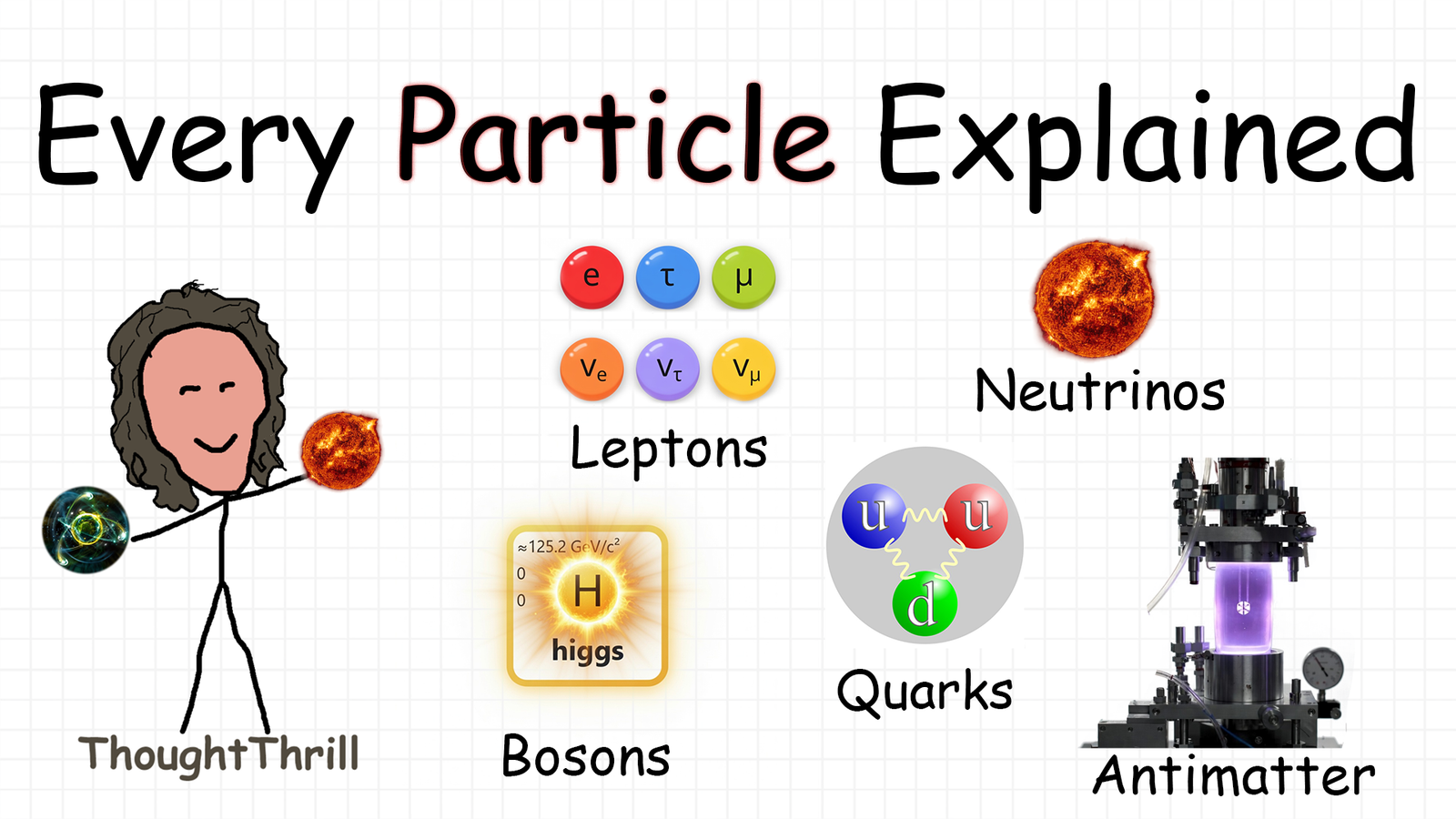
Fermions vs. Bosons
In particle physics, all fundamental entities are divided into two categories: fermions and bosons. This distinction is based on spin, a quantum property that represents intrinsic angular momentum. Fermions have half-integer spin (such as 1/2), while bosons have integer spin (such as 0 or 1).
Fermions make up matter. They include electrons, quarks, and neutrinos. They obey the Pauli exclusion principle, which prevents two identical fermions from occupying the same quantum state. This restriction is responsible for the electronic structure of atoms and, therefore, for the chemical diversity and stability of matter.
Bosons, on the other hand, are force carriers. The photon mediates the electromagnetic interaction, gluons mediate the strong interaction, and the W and Z bosons mediate the weak interaction. Unlike fermions, bosons can occupy the same quantum state, which allows for collective phenomena such as Bose-Einstein condensation. Bose-Einstein condensation is a state of matter in which a large number of bosons occupy the same quantum state, behaving collectively as a single quantum entity. This phenomenon occurs at extremely low temperatures and reveals quantum properties on a macroscopic scale.
Quarks
Quarks are fundamental particles that make up protons and neutrons. There are six types (or “flavors”): up, down, charm, strange, top, and bottom. Each one has mass, electric charge, and a key quantum property called color charge.
The strong interaction, described by quantum chromodynamics (QCD), is responsible for holding quarks together. This force acts through the exchange of gluons, which also carry color charge. Unlike other forces, the strong interaction becomes stronger as the distance between quarks increases, leading to the phenomenon of confinement: quarks cannot be observed in isolation.
Quarks group together in combinations with neutral color charge. Baryons, such as the proton and neutron, contain three quarks, while mesons are made of a quark and an antiquark. These combinations explain the observable properties of nuclear matter. Although quarks cannot be detected individually, their existence is confirmed through scattering experiments and high-energy collisions, where jet patterns reveal their internal dynamics.
Leptons
Leptons are elementary particles that, unlike quarks, do not interact via the strong force. They are grouped into three generations: the electron and electron neutrino, the muon and muon neutrino, and the tau and tau neutrino. Each has an antiparticle with opposite charge.
The electron is stable and essential for ordinary matter, being responsible for electrical and chemical phenomena. The muon and tau are more massive and decay quickly. Neutrinos are neutral particles with extremely small mass, which allows them to pass through large amounts of matter with almost no interaction.
Although they do not participate in the strong interaction, charged leptons respond to the electromagnetic force, and all leptons experience the weak force and gravity. Due to their simplicity, leptons are ideal for studying fundamental interactions in experimental physics.
The Electron
The electron is an elementary particle with negative electric charge and spin 1/2. It belongs to the first generation of leptons and has a mass of approximately 0.511 MeV/c², making it the lightest known charged particle.
Within the atom, electrons are distributed in orbitals determined by quantum principles. Their interaction with the nucleus, mediated by the electromagnetic force, defines the chemical properties of elements and enables the formation of chemical bonds.
Beyond chemistry, the electron is essential in electrical and technological phenomena. Electric current consists of a flow of electrons through conducting materials. Its quantum behavior revealed the wave-particle duality, demonstrated in experiments such as the double-slit experiment. The study of the electron has been key to the development of quantum electrodynamics (QED), a theory that describes with high precision the interaction between charged particles and the electromagnetic field.
Neutrinos
Neutrinos are elementary particles belonging to the lepton family, characterized by their neutral charge, extremely small mass, and weak interaction with matter. There are three types: electron, muon, and tau, each associated with its corresponding charged lepton.
Unlike other particles, neutrinos interact only through the weak force and gravity, which allows them to pass through large amounts of matter without being stopped. Every second, trillions of neutrinos pass through the human body without leaving a trace.
One of the most surprising discoveries related to neutrinos is their ability to oscillate between different flavors during propagation, which implies that they have mass, although much smaller than that of any other known particle. This phenomenon, confirmed experimentally, represents a significant deviation from the original Standard Model, which assumed neutrinos were massless.
Neutrinos play a determining role in astrophysical processes such as nuclear reactions in the Sun and supernovae. They are also being studied as possible keys to understanding the matter-antimatter asymmetry in the universe, through the investigation of their CP symmetry-violating properties.
Force Carriers
In the Standard Model, the fundamental forces are transmitted by particles known as force carriers, all of which are bosons. The photon is the carrier of the electromagnetic interaction. It has no mass or charge, which allows this force to act over long distances between charged particles.
The weak interaction is transmitted by the W⁺, W⁻, and Z⁰ bosons. These bosons have high masses, which limits the range of this force to subatomic scales. The weak interaction is essential in nuclear decay processes and in the behavior of neutrinos.
Gluons are the carriers of the strong interaction. They act exclusively between quarks that possess color charge. Unlike the photon, gluons also carry color charge, allowing them to interact with one another. This characteristic is responsible for the complexity of confinement in quantum chromodynamics.
Each force carrier defines the specific behavior of its interaction. Although the Standard Model successfully explains three of the four fundamental forces, gravity still remains outside its theoretical framework.
The Higgs Boson
The Higgs boson is a fundamental particle associated with the mechanism that gives mass to other elementary particles. Proposed in the 1960s as part of the spontaneous symmetry-breaking mechanism, its existence was confirmed in 2012 by the Large Hadron Collider (LHC) through the ATLAS and CMS experiments.
This mechanism involves an omnipresent scalar field: the Higgs field. Particles interact with this field to varying degrees. Those with stronger interaction acquire greater mass. For example, the W and Z bosons interact strongly and are massive, while the photon does not interact with the Higgs field and remains massless.
The Higgs boson is the quantum excitation of that field. Its discovery completed the Standard Model and raised questions about phenomena beyond it, such as vacuum stability, supersymmetry, or the origin of dark matter. The detailed analysis of its properties is important for determining whether the Standard Model describes all of particle physics or whether it is only an approximation within a deeper theory.
Antimatter
Antimatter is a form of matter composed of antiparticles, which have the same properties as ordinary particles except for electric charge and other quantum charges, which are reversed. For example, the antiparticle of the electron is the positron, with the same mass but positive charge.
Each particle in the Standard Model has an associated antiparticle: quarks have antiquarks, leptons have antileptons, and so on. When a particle and its antiparticle meet, they can annihilate each other, releasing energy in the form of photons or new particles.
In laboratory settings, antimatter can be produced in high-energy colliders, and atoms of antihydrogen have been briefly confined. However, its production and storage are extremely costly and difficult due to its tendency to annihilate upon contact with matter.
One of the major questions in modern physics is why the observable universe is composed almost entirely of matter, when the Big Bang should have produced matter and antimatter in equal amounts. This imbalance suggests the existence of processes that violate the symmetry between matter and antimatter, known as CP (charge-parity) symmetry violations. This symmetry combines two principles: charge conjugation (C), which swaps particles with antiparticles, and parity (P), which inverts spatial coordinates. A CP violation occurs when a physical process does not behave the same under these combined transformations, which could explain why matter came to dominate over antimatter in the early universe.
What the Standard Model Can’t Explain
The Standard Model is extraordinarily successful, but incomplete. It doesn’t incorporate gravity, can’t explain why neutrinos have mass, and says nothing about dark matter or dark energy, which together make up roughly 95% of the universe.
Several ideas aim to fill these gaps. Supersymmetry proposes heavier “superpartners” for every known particle. Grand unification theories attempt to merge the three fundamental forces into one. And string theory tries to bring gravity into a coherent quantum framework.
Experiments at the Large Hadron Collider, neutrino detectors, and dark matter observatories are actively searching for cracks in the Standard Model. Any confirmed discovery beyond it would reshape our understanding of the universe at its most fundamental level. The deepest questions in physics remain open, and the answers may rewrite everything we think we know.
Further Reading
- The Standard Model at CERN
- Quarks on Wikipedia
- Neutrino Oscillation on Wikipedia
- Higgs Boson at CERN
- CP Violation on Wikipedia
- Quantum Chromodynamics on Wikipedia
Leave a Reply