
When Tiny Math Errors Caused Massive Disasters
Aircraft Carrier Landing Strip Angles
An aircraft carrier is a ship that essentially acts like a seaborne airport. During wartime, they were in wide use by World War II due to the increasing significance of air power. However, they had a major problem. If an airplane landed on the runway and didn’t stop in time, it would run straight ahead and crash into other planes parked ahead.
Landing on an aircraft carrier was significantly more difficult than landing on the ground due to the ship’s vastly smaller size, motion on the ocean, and it often being crowded with other planes. In addition, the plane had to be stopped with a mechanism called an arresting wire, which was somewhat difficult to catch. One attempt to rectify this problem was the installation of nets on aircraft carriers to catch the planes, but this often failed, as it was possible for the planes to accidentally bounce over.
World War II ended in 1945, by which time the aircraft carrier problem had still not been properly solved. A solution would not arrive until 1952, when the idea was conceived to construct the runway at an angle of approximately 9° from the line down the center. Using this construction, if an airplane failed to stop in time during an attempted landing, it could just abort the attempt, run off the end, and try again. Meanwhile, parked planes were stored at the bow of the aircraft carrier. This construction also allowed for simultaneous landings and takeoffs, which greatly improved efficiency. From the 1950s onwards, angled landing strips were the standard for newly constructed aircraft carriers.
The Vasa
The Vasa was a massive warship launched by Sweden on the 10th of August, 1628. After about 20 minutes of sailing and traveling less than a mile from shore, the ship was hit by two gusts of wind, causing it to capsize and sink into the ocean. This resulted in the deaths of 30 crew members. Afterward, the King was contacted regarding this event and he responded by demanding that the guilty parties receive proper punishment. However, despite a lengthy and detailed inquest, they couldn’t find anyone to be held responsible for the sinking.
The ship was rediscovered in the late 1950s and salvaged in 1961. After being placed at a temporary museum called Wasavarvet, it was moved to and put on display at the Vasa Museum in 1988.
After some measurements, historians figured out that the ship was built using two separate units of length: the Swedish foot, which is 12 inches, and the Amsterdam foot, which is 11 inches. As a result, the weight of the ship was not properly distributed. One side was heavier than the other, and the ship was very top-heavy. The wind was easily able to tip it over.
The Laufenburg Bridge
In 2003, Germany and Switzerland commenced a project to build a bridge over the Rhine between Laufenburg, Germany and Laufenburg, Switzerland. Both sides would build half of the bridge starting from their side. Each party built the bridge with respect to their definition of sea level: Germany uses the North Sea and Switzerland the Mediterranean Sea.
However, the North Sea is 270 mm higher than the Mediterranean Sea, so the engineers involved in the project ensured that this difference was accounted for in their calculations. Later, as the project neared completion, they discovered that they had made an error. As it turned out, the German side was actually 540 mm higher than the Swiss side. Upon review, they determined that this was the result of a sign error in their calculations. Instead of subtracting the 270 mm difference, someone had added it, doubling the discrepancy.
Eventually the German side of the bridge was lowered, finally allowing the two halves to be connected. However, this ended up being a costly endeavor. This incident is one of the motivations for proposals to standardize a single universal definition of altitude, which would be based solely on the distance from the center of the Earth.
French High-Speed Trains
France has a large number of high-speed trains. In 2014, the SNCF, France’s national railway company, ordered 1,860 new trains from two companies: Alstom, a French rail transport company, and Bombardier, a Canadian public transit company. However, the SNCF soon found that their new trains were too wide to fit in 1,300 French stations. They were forced to modify the trains to reduce their widths, which ended up costing them millions of euros. Many French people expressed their disappointment with this occurrence, including the Minister of Transport, Frédéric Cuvillier.
The cause of this mishap was the fact that the train stations in France have differing sizes. In particular, there were 1,300 older stations that were narrower than modern ones. When the SNCF was in the process of planning to get new trains, they requested RFF to survey some stations and measure how much space surrounded each train track. However, RFF only took the modern stations into account when performing their calculations, skipping over the older, narrower ones, resulting in the overly wide train designs.
Air Canada Flight 143
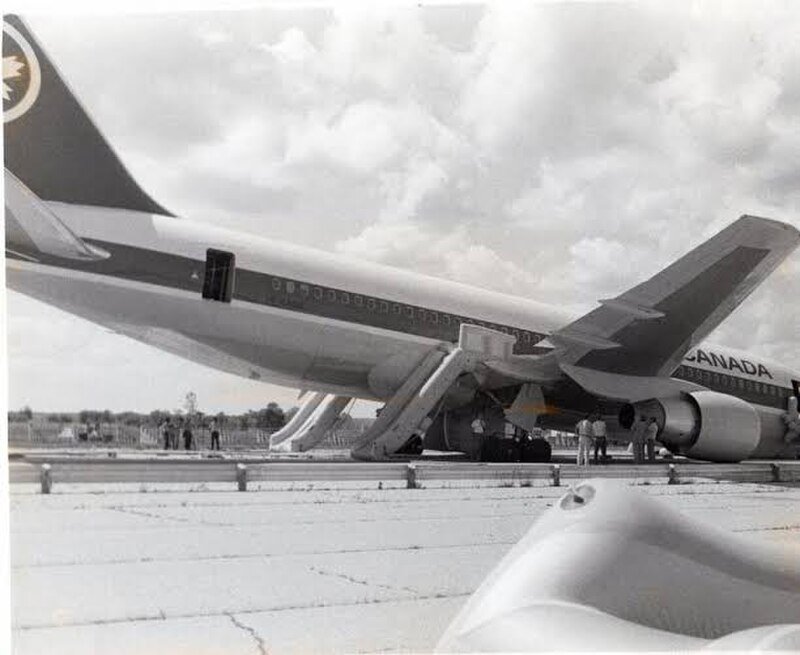
Air Canada Flight 143 was a flight from Ottawa to Edmonton on a Boeing 767 on the 23rd of July, 1983. The flight had 69 people on board. During the flight, the plane ran out of fuel when it was 12,500 m in the air. Due to the loss of power in the engines, the plane was forced to glide toward the ground and make a crash landing. After approximately 100 km of gliding, it landed in Gimli, Manitoba on a racetrack that was formerly a runway. This landing resulted in two minor injuries and the destruction of the nose gear, but no deaths.
The cause of this incident turned out to be an error of converting units of weight. At the time, Air Canada was in the process of converting from the imperial system to the metric system. This particular plane already used metric, which measures mass in kilograms, but the ground crew in charge of refueling measured the fuel using imperial, which measures weight in pounds. A kilogram is approximately equal to 2.2 pounds, so the plane was filled with less than half the fuel it should have been, which went unnoticed by the pilots due to a faulty fuel gauge.
The S-80 Plus Class Submarines
The S-80 Plus class submarines are four submarines built by Navantia, a Spanish state-owned company, for the Spanish Navy. The program began in 2003 with a budget of $3 billion. However, it ran into a problem. By May 2013, the program had spent over $680 million of its budget and one of the submarines was nearing completion, but it was found to be about 70 tons heavier than it should have been. It was so heavy that calculations showed it would not be able to resurface after going underwater. In fact, this same problem affected the three other submarines under construction as well.
The error was traced back to a misplaced decimal point in calculations, causing a value to be off by a factor of 10. Due to this error, it was decided that the submarine should be redesigned to be about 7 to 8 meters longer. This would give more space for air inside the submarine, thereby increasing its buoyancy and enabling it to resurface. For assistance with this redesign, Navantia enlisted the help of the US company General Dynamics Electric Boat. In the end, the redesign ended up being about 10 meters longer, and Navantia had to pay GDEB several million dollars. The error that caused this incident is sometimes called the most expensive math mistake ever.
Amsterdam Housing Benefits
In 2013, the city of Amsterdam planned to send out €1.88 million in order to support over 10,000 poor families throughout the city. The calculations performed by the software were done in cents, so the number they ended up with was 188,000,000. However, this was misinterpreted as €188 million, 100 times the expected value.
This error went unnoticed by the entirety of Amsterdam’s tax office. Therefore, households ended up receiving tens of thousands of euros in support rather than the expected hundreds. Some households received up to €34,000 in support. Amsterdam was forced to scramble to recover the erroneous payments, of which they were able to recover all but €2.4 million. On top of that, they had to spend €300,000 fixing the situation in the first place. By the end of the incident, Amsterdam decided to exercise stricter regulations on their tax office to ensure that this kind of thing did not happen again.
The Titanic
The Titanic was a ship that collided with an iceberg and sank in 1912 during its maiden voyage from Southampton to New York City. The sinking resulted in the deaths of approximately 1,500 passengers. Immediately following this disaster, the circumstances behind the sinking were heavily investigated. Attention was soon drawn to the Titanic’s lack of basic safety features.
However, aside from that, one intentional piece of the Titanic’s design bears some of the blame for the incident: the fact that the central propeller couldn’t go in reverse. The Titanic had three propellers. Two of them used piston engines, whereas the central propeller used a steam turbine. Even though steam turbine engines excel over piston propellers in terms of size and efficiency, there is one main drawback. A steam turbine only goes one way, because the steam can only flow in a single direction, and this is what determines the propeller’s direction of rotation.
When First Officer Murdoch became aware of the iceberg ahead, he immediately put the piston propellers in reverse and shut off the central propeller. However, because the central propeller had stopped moving and was directly in front of the rudder, water wasn’t hitting the rudder in the same way, giving the Titanic exceptionally poor handling. Thus the ship failed to avoid the iceberg, and that was what sank the so-called unsinkable ship.
Leave a Reply