
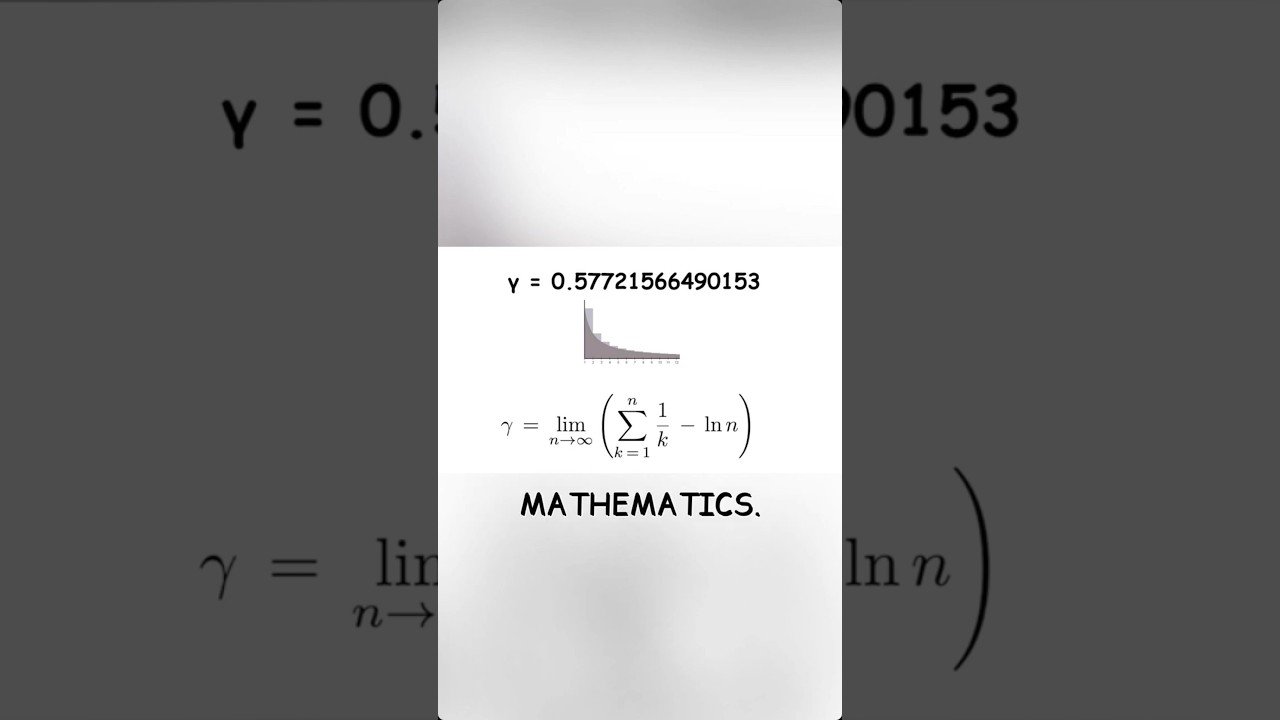
The Euler–Mascheroni constant, denoted by γ (gamma), is approximately equal to:
γ ≈ 0.57721…
This constant appears in various areas of mathematics, especially in number theory and analysis. It is defined as the limiting difference between the harmonic series and the natural logarithm:
γ = lim(n→∞) (1 + 1/2 + 1/3 + … + 1/n − ln(n))
Is It Rational or Irrational?
Whether the Euler–Mascheroni constant is rational or irrational remains an open question in mathematics, making it one of the longest-standing unsolved problems in the field.
Where Does γ Appear?
The Euler–Mascheroni constant shows up in a surprising number of places across mathematics. It appears in expressions involving the gamma function, which generalizes factorials to non-integer values. It also plays a role in the distribution of prime numbers, particularly in estimates related to the prime harmonic series. Beyond pure math, γ surfaces in physics and engineering. For example, in calculations involving Laplace transforms, quantum field corrections, and the analysis of algorithms in computer science.
Leave a Reply