
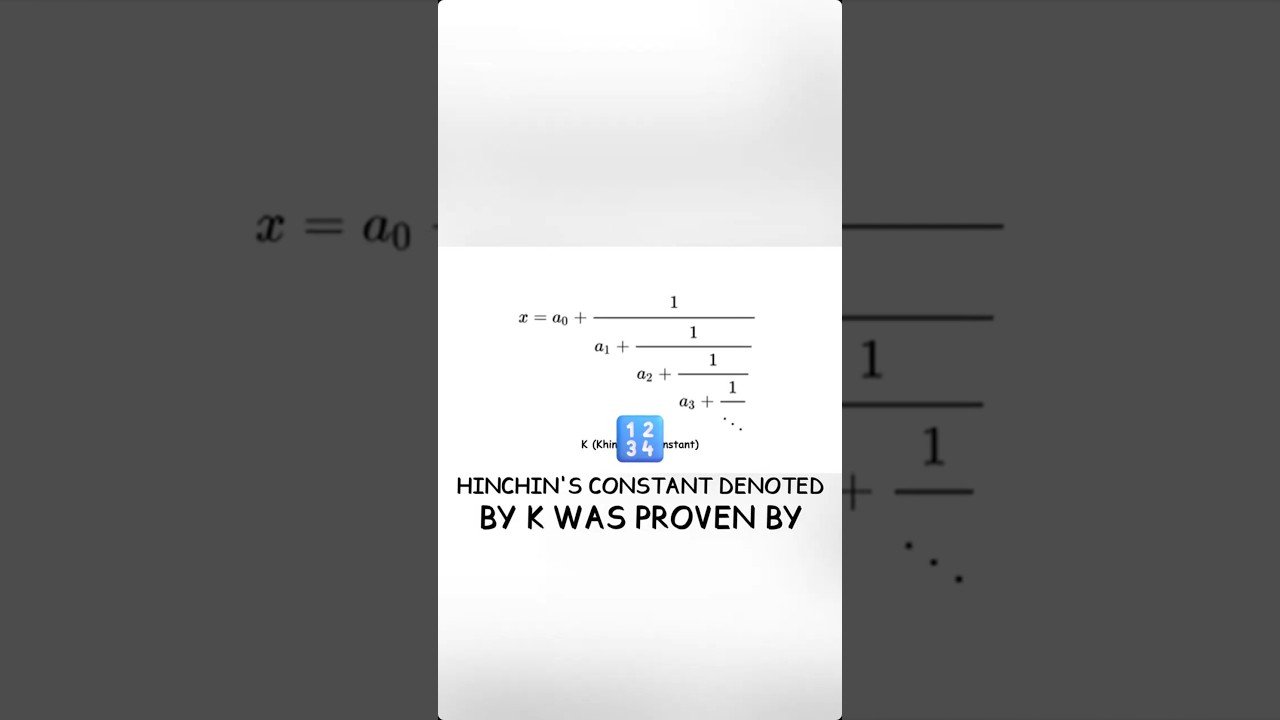
Khinchin’s constant, denoted by K, was proven by the Russian mathematician Alexander Khinchin in 1934.
Definition
Let x be a real number with a continued fraction expansion where a₀ is an integer and a₁, a₂, a₃, … are positive integers (the partial denominators). Khinchin proved that for almost all real numbers x (with respect to Lebesgue measure), the geometric mean of the partial denominators a₁, a₂, a₃, …, aₙ converges to a constant K as n → ∞.
Its value is approximately:
K ≈ 2.68545…
Open Questions
Khinchin’s constant is an irrational number, but it is not known whether it is transcendental. While K is known to exist for almost all real numbers, it has not been rigorously proven for any specific real number, including π, e, and Khinchin’s constant itself.
Why Is This So Remarkable?
Khinchin’s result is one of the most surprising theorems in number theory. It says that if you take virtually any real number, write out its continued fraction, and compute the geometric mean of its partial denominators, you will always get the same answer: approximately 2.685. This is true regardless of whether the number is rational, irrational, algebraic, or transcendental. The constant is universal in a statistical sense, yet paradoxically, no one has ever been able to verify it for a single named number. It remains one of those rare mathematical results where we know something is true “almost everywhere” but cannot point to a single concrete example.
Leave a Reply