
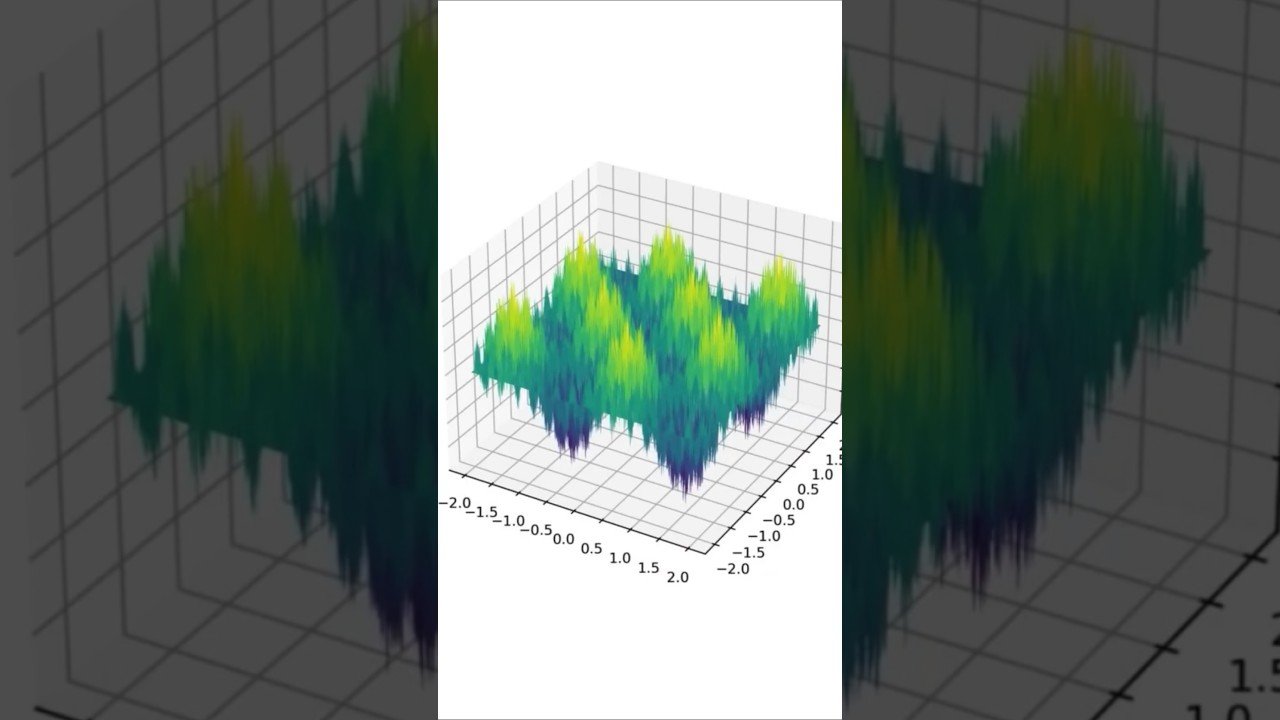
For a long time, mathematicians assumed that no function could be continuous everywhere and differentiable nowhere. The Weierstrass function proved them wrong.
Discovery
The Weierstrass function was discovered by German mathematician Karl Weierstrass and first published in 1872. Weierstrass defined it using an infinite sum called a Fourier series. In the definition, a must be strictly between 0 and 1, b must be a positive odd integer, and ab must be greater than 1 + (3/2)π. Whatever values you pick for a and b that follow these rules, you will get the exact same resulting behavior: a function that is continuous at every point but has no well-defined tangent line anywhere.
A Fractal Before Fractals
The graph of the Weierstrass function is a self-similar fractal curve, though such curves were hard to visualize in the 19th century. No matter how far you zoom in, the curve never smooths out. It just keeps revealing more jagged detail at every scale.
Why Did This Matter?
Before 1872, many mathematicians believed that any continuous function must be smooth (differentiable) at most points. Several published proofs relied on this assumption. The Weierstrass function destroyed those proofs overnight. It forced the mathematical community to abandon geometric intuition and adopt the rigorous epsilon-delta definitions of limits and continuity that are now standard in analysis. A single counterexample rewrote the rules.
Leave a Reply