
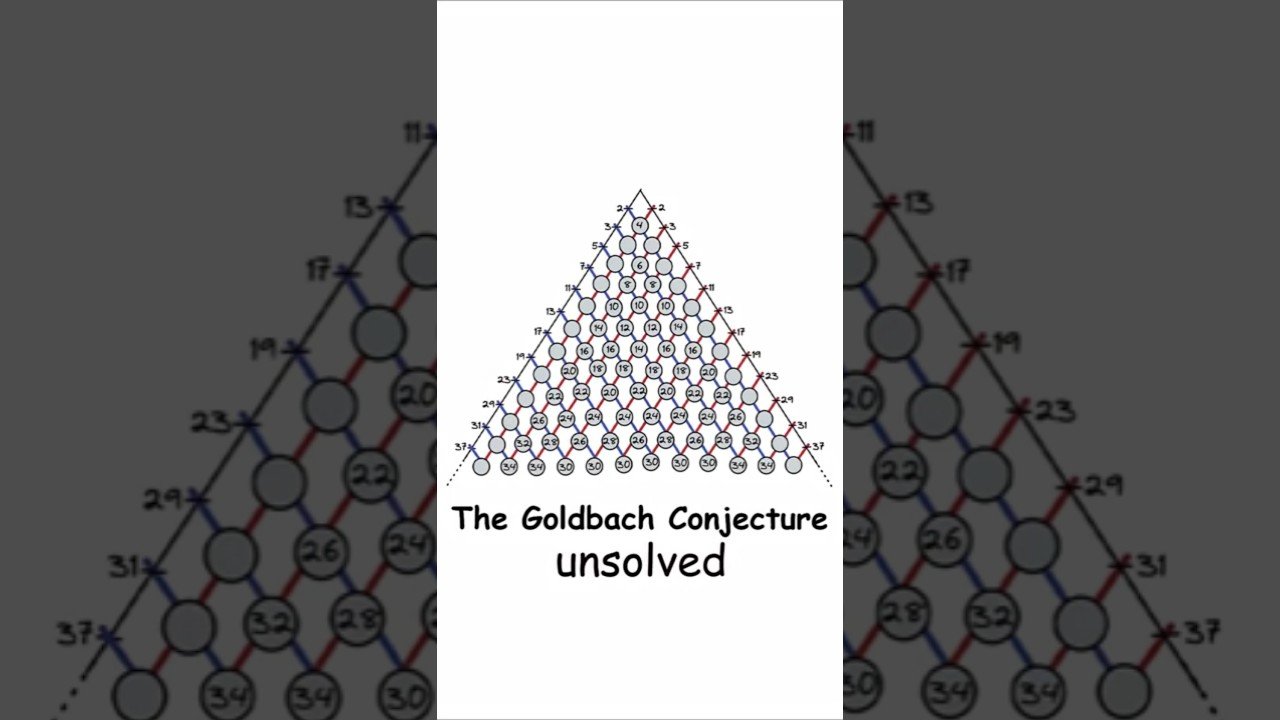
Goldbach’s Conjecture
Goldbach’s conjecture, one of the greatest unsolved mysteries in math, is also very easy to write. Every even number greater than two is the sum of two primes. You can check this in your head for small numbers. 18 = 13 + 5, and 42 = 23 + 19. Computers have checked the conjecture for numbers up to 4 × 10¹⁸, but we need proof for all natural numbers.
A Problem Born from Letters
Goldbach’s conjecture emerged from letters in 1742 between German mathematician Christian Goldbach and legendary Swiss mathematician Leonhard Euler. As Euler put it, “I regard it as a completely certain theorem, although I cannot prove it.”
Why Can’t We Prove It?
Euler may have sensed what makes this problem counterintuitively hard to solve. When you look at larger numbers, they have more ways of being written as sums of primes, not less. You would think that would make a proof easier, but the additive behavior of primes is notoriously difficult to pin down. Primes are defined by multiplication (a number divisible only by 1 and itself), so making guarantees about how they behave under addition is a fundamentally different kind of question. A proof for all numbers eludes mathematicians to this day, and it stands as one of the oldest open questions in all of math.
Leave a Reply