
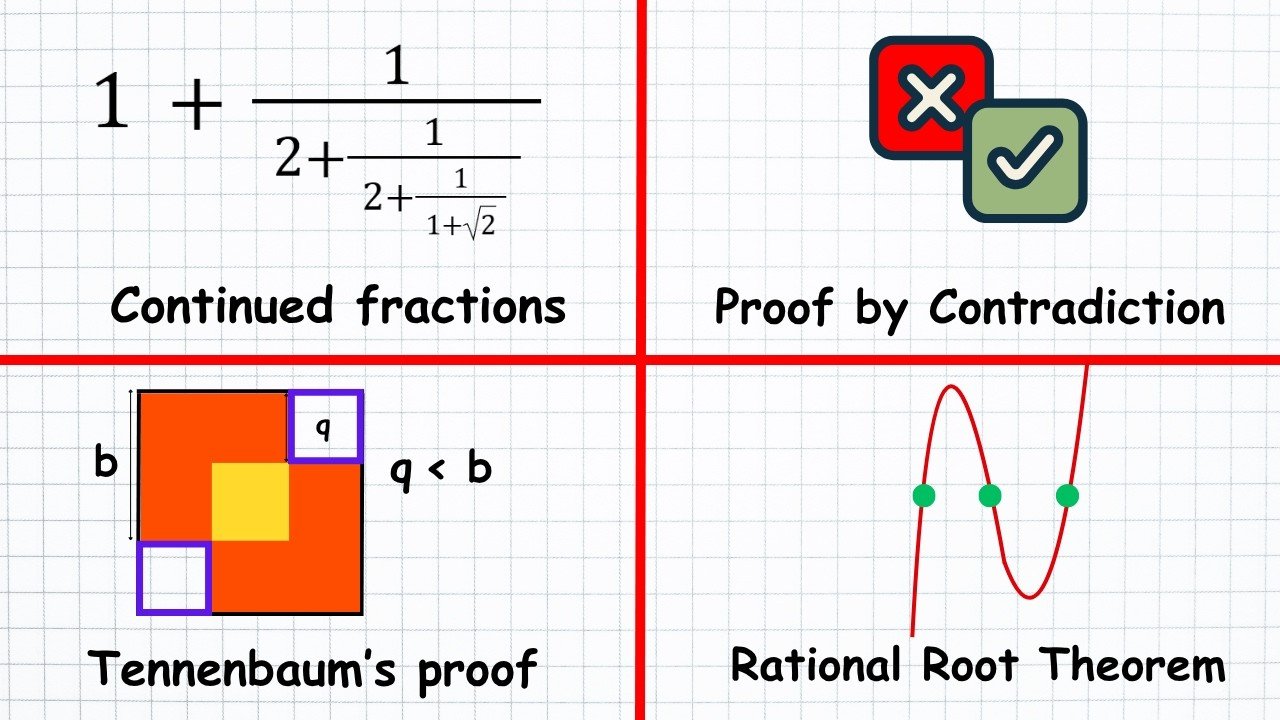
Continued Fractions
A continued fraction is one possible way to represent a number, consisting of a collection of nested fractions. Here we will focus on the case where the numerators of the fractions are all equal to one and where each denominator has the integer part separated out. This is called a simple continued fraction.
As an example, let’s write the continued fraction of 156/49. First, write this in mixed number form, which gives us 3 + 9/49. Next, we can rewrite 9/49 as 1/(49/9). We flip the numerator and the denominator and then take 1 divided by the result, which is the same as taking the reciprocal twice. Once again, separate out the integer part of 49/9. Rewrite the remaining fractional part and repeat the process. Once you reach a purely integer denominator, you are done. In this case, carrying out this process gives us:
3 + 1/(5 + 1/(2 + 1/4))
This can be rewritten in a shorter notation as [3; 5, 2, 4].
Every rational number has a finite simple continued fraction. However, it turns out that if a simple continued fraction is infinite, it always represents an irrational number. This can be used to prove the irrationality of √2. But we first need to know how to find its continued fraction representation.
First, what does (√2 + 1)(√2 − 1) simplify to? You can verify with simple algebra that this is equal to 1. Now take this equality and divide both sides by (√2 + 1). Rearrange the denominator and add one to both sides. Note that √2 appears on the right-hand side. Since we know that it is equal to 1 + 1/(1 + √2), we can substitute that expression recursively. Then we do it again. This continues forever, giving us an infinite continued fraction:
√2 = 1 + 1/(2 + 1/(2 + 1/(2 + …)))
Or in short notation, [1; 2, 2, 2, …]. Since the continued fraction is infinite, √2 is irrational.
Tennenbaum’s Proof
Here is a proof found by American mathematician Stanley Tennenbaum. We let √2 be equal to some fraction of positive integers a/b, where this fraction is in simplest form. That is, a and b are the smallest positive integers that make this equality work. Our goal is to prove that this is impossible, which will prove by contradiction that √2 is irrational.
Start by squaring both sides of √2 = a/b. The left-hand side becomes 2 and the right-hand side becomes a²/b². Now multiply both sides by b² to get 2b² = a².
Here is where the proof deviates from the standard approach. We will find a geometric way to represent each side of this equality. Draw a square with side length a, which we will call A. Its area must be a². Next, draw two separate squares, each with side length b and area b², so that their combined area must be 2b². We will call these squares B₁ and B₂. We already know that 2b² = a², which geometrically means that the area of A is equal to the area of B₁ and B₂ combined.
With that in mind, place B₁ and B₂ inside A in opposite corners. Now that we have our diagram, we can start labeling things and see what results pop out, which is the way that many geometric proofs go.
B₁ and B₂ have a certain amount of overlap, and there are two smaller squares within A formed by the regions that B₁ and B₂ do not cover. If the area of A is equal to the combined areas of B₁ and B₂, then the overlap should have the same area as the uncovered regions so that they balance out.
So what are these areas? Looking at the side length of each small square gap, let’s call that length q. This is equal to a − b, making the area of each gap (a − b)² and the combined area of both gaps 2(a − b)².
As for the side length of the square overlap, let’s call that p. Consider one of the sides of B₁ that touches the overlap, which has length b, and subtract off the part of that length that goes along the adjacent square gap, which we just established has length a − b. This gives us b − (a − b), which simplifies to 2b − a. So now we have the value of p.
This is the side length of the square overlap, giving it an area of (2b − a)². Now we can write the area equality we wanted:
(2b − a)² = 2(a − b)²
In other words, substituting the definitions of p and q, we have p² = 2q².
If you are sharp, you will notice that this equality looks awfully familiar. It matches the 2b² = a² equality from before. If we take p² = 2q², divide both sides by q², and take the square root of both sides, we find that √2 = p/q, exactly the same form as √2 = a/b.
Let’s go back to the definitions of p and q. q is defined as a − b, and a and b are both integers. When you add, subtract, or multiply two integers, the result will also be an integer. Formally, the set of integers is closed under those operations. So q must be an integer. Using those same integer properties, p = 2b − a, so p is an integer as well.
Bringing back the diagram, we know that p is less than a because it is a shorter length, and similarly that q is less than b. But since √2 = p/q, that means we found a pair of positive integers smaller than a and b whose ratio is equal to √2. This contradicts our earlier assumption that a and b are the smallest positive integers with this property, which proves by contradiction that no such integers exist.
Rational Root Theorem
Anyone who has taken an algebra class has likely spent a lot of time finding the roots of polynomials. Given some polynomial, a root is a value for the variable that makes the polynomial equal to zero. An example of a polynomial is 6x³ + 5x² − 3x − 2. We can find its roots by writing the polynomial equation 6x³ + 5x² − 3x − 2 = 0 and solving for x.
Polynomial root finding can be really annoying, but there are some tricks we can use. One of them is the rational root theorem. To apply this theorem, first ask: does the polynomial have integer coefficients? The coefficients of our example polynomial are 6, 5, −3, and −2, which are all integers.
Next, does the polynomial have a nonzero leading coefficient and a nonzero constant term? The leading term is 6x³ because its degree (the number of variable instances being multiplied together) is 3. This is the highest degree among the nonzero terms. Since the leading term is 6x³, the leading coefficient is 6. Meanwhile, the constant term is −2. So neither the leading coefficient nor the constant term is equal to zero.
With these conditions, the rational root theorem states the following: if there is a rational root of the polynomial, then that root must be equal to the quotient of an integer factor of the constant term and an integer factor of the leading coefficient.
So you could list out the integer factors of both −2 and 6, try dividing each number in the first set by each number in the second set, plug them into the polynomial, and see which ones make the polynomial equal to zero. Algebra classes often give you tedious exercises involving the rational root theorem, but they rarely actually explain why it is true. Here we will present a proof.
To start with a tangible example, we will take the polynomial equation from before. Next, we assume that x is some rational number, represented as a ratio of integers p/q. In particular, we can assume that p and q are coprime, sharing no common factors except the number one. This still allows us to represent whatever rational number we want.
Let’s substitute x = p/q. Next, let’s get rid of all the divisions on the left-hand side. To do this, take the least common multiple of all the denominators and multiply both sides by that value. In this case, that is q³. The right-hand side becomes zero and we distribute on the left. Next, cancel common factors from the numerators and denominators.
−2q³ is the only term that does not have p in it. Subtract −2q³ from both sides. Next, we can divide both sides by p. The left-hand side is a value obtained from adding, subtracting, and multiplying integers, so it has to be an integer itself. Whatever that integer is, 2q³/p must also be that integer. To make that true, p has to be a factor of 2q³. We know that p is coprime to q, so p must also be coprime to q³, since multiplying copies of q cannot make any non-factors of p suddenly appear. So p has to be a factor of 2.
Keep in mind that the original constant term was −2, not 2, but the plus-or-minus integer factors are the same in any case. We defined p as the numerator of a rational root of the polynomial, so this gives us a constraint on what that numerator has to be.
Going back to the equation from before, we can instead subtract 6p³ from both sides and divide both sides by q. Once again, we can use basically the exact same logic. The left-hand side is an integer, so the right-hand side is an integer. q is a factor of 6p³, but q is coprime to p³, so q must be a factor of 6. In other words, the denominator of the rational root must be an integer factor of the leading coefficient.
We proved all of this only for one specific polynomial, but this same logic can be applied to any polynomial that follows the necessary conditions: the coefficients have to be integers, and the leading term and constant term must both be nonzero.
Applying the Rational Root Theorem to √2
With the rational root theorem proven, we can finally return to the proof of √2. Let’s come up with a polynomial with integer coefficients where √2 is one of the roots. If x = √2, then squaring both sides gives us x² = 2, and subtracting 2 from both sides gives us x² − 2 = 0.
Now apply the rational root theorem. The integer factors of the constant term −2 are ±1 and ±2. The leading term x² is the same as 1x², so the leading coefficient is 1, which has the integer factors ±1. Dividing each number in the first list by each in the second, our rational root possibilities are ±1 and ±2.
None of these is √2. So √2 cannot be a rational root of the polynomial. It must be an irrational root instead.
Further reading:
- A detailed treatment of continued fractions can be found in Hardy and Wright’s An Introduction to the Theory of Numbers (Oxford University Press)
- Tennenbaum’s proof is discussed in John Conway and Richard Guy’s The Book of Numbers (Springer)
- For more on the rational root theorem, see the Art of Problem Solving wiki (AoPS)
Leave a Reply