
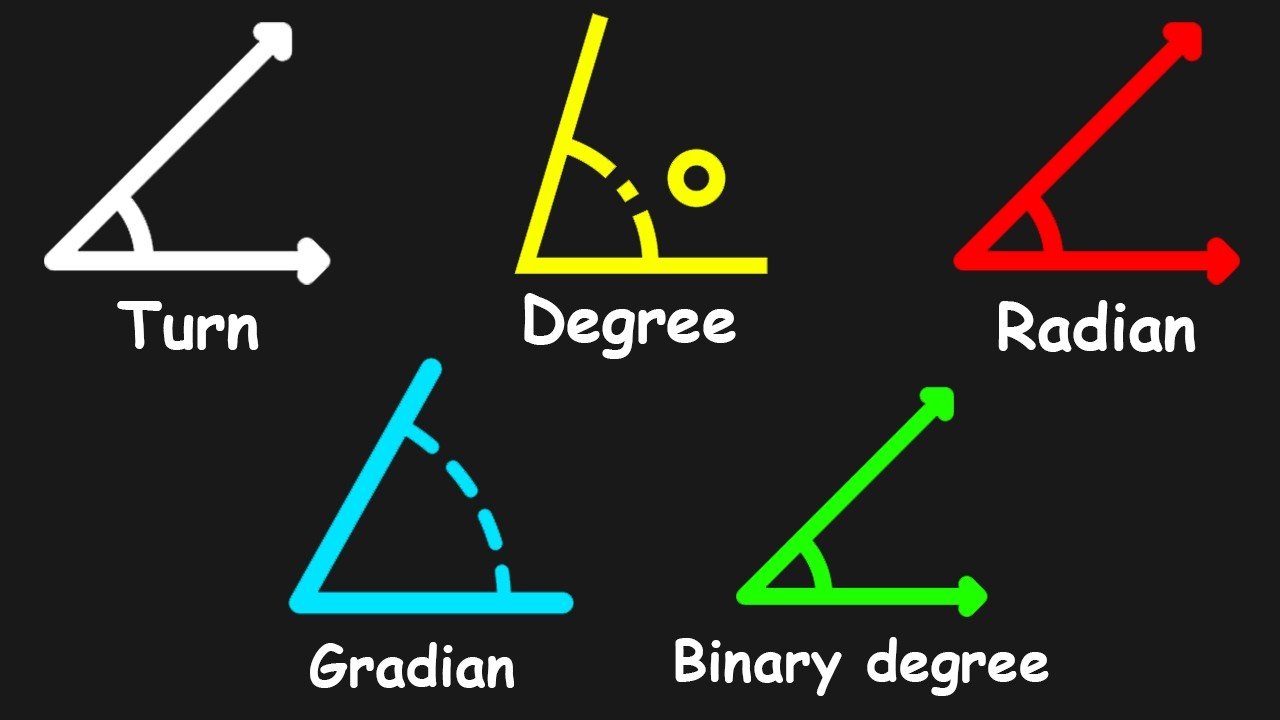
The Turn
An angle is formed between two rays that share an endpoint. The rays are called the angle’s sides, and the endpoint is called the angle’s vertex. Various units of measurement can be used to measure an angle.
The turn is the simplest unit of angle measurement. It is the measure of going all the way around, in other words, the measure of a complete angle. It is known by many other names, such as a cycle, a revolution, or a full rotation. The measure of an angle can be expressed as a fraction of a turn. For instance, the measure of a right angle (an angle formed by two perpendicular rays) is 1/4 turn.
The turn can also be divided using a metric prefix. Such a prefix is used in the metric system to multiply a unit of measurement by a power of 10. For instance, the prefix “centi” means 1/100th, so a centiturn is 1/100th of a turn. Similarly, a milliturn is 1/1000th of a turn. The turn can be represented by the symbol “tr,” and the prefixes centi and milli by the symbols c and m respectively. Therefore the centiturn is written as ctr and the milliturn as mtr.
Some protractors, which are measuring instruments used to measure angles, have measurements in centiturns. Such a protractor is called a percentage protractor, because a centiturn is 1% of a turn.
The Degree
The degree is a unit of angle measurement where one turn is 360°. The degree can also be called the degree of arc or the arc degree to distinguish it from temperature degrees. It is usually denoted by a small raised circle (the degree symbol) and can also be abbreviated as “deg.” It is the most popular unit of angle measurement.
One benefit of using the number 360 is that it’s easy to divide by many numbers. In fact, 360 is an example of a highly composite number, which is a positive whole number with more divisors than each smaller positive whole number. In particular, 360 has 24 divisors. This includes every whole number from 1 to 10 except 7. So for example, it is easy to find the number of degrees in 1/8 of a turn: 360°/8 = 45°.
Historians are uncertain why the number 360 was originally chosen. Besides the easy divisibility, one possible factor is the number of days in a year. It takes Earth around 365.24 days to orbit the Sun, and that number is close to 360. Another hypothesis is that the ancient Babylonians used the measure of an angle of an equilateral triangle (which is 60°) as their base unit, then divided that into 60 parts based on their sexagesimal (base 60) system.
The degree of arc can be subdivided into the minute and second of arc (also known as the arcminute and arcsecond). One arc degree is 60 arcminutes, and one arcminute is 60 arcseconds. These are denoted by the prime symbol (′) and the double prime symbol (″) respectively. We know that the ancient Babylonians used these units, and they’re used for very small angles in fields like astronomy, navigation, and marksmanship. For example, geographic coordinates are usually given in degrees, minutes, and seconds.
The Radian
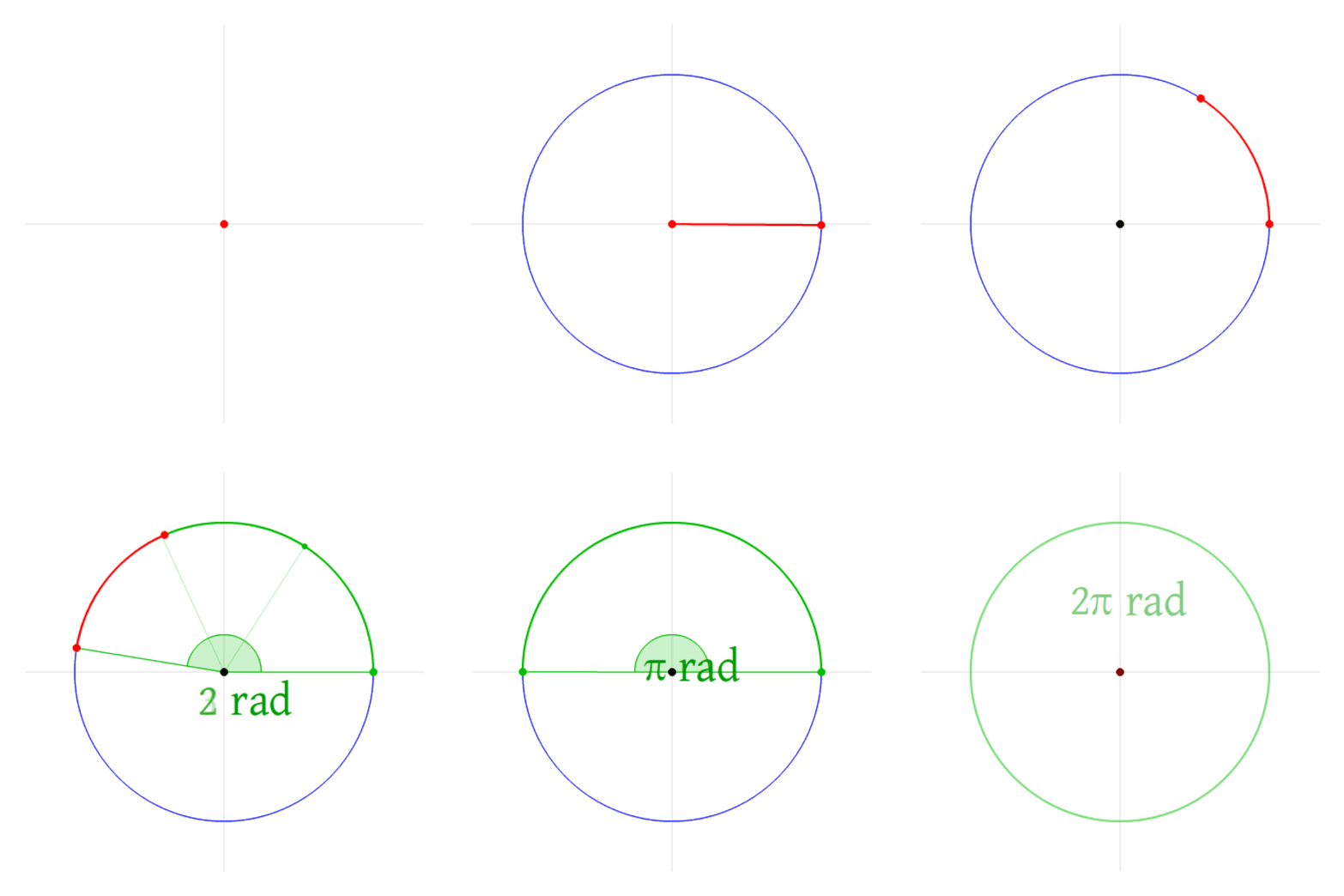
The radian is the most important unit of angle measurement. To understand it, let’s start with an angle formed by two rays. We’ll draw a circle centered at the angle’s vertex. The angle encloses a curved path along the circle called a circular arc. We say that the circular arc subtends the angle (the word “subtend” means “extend under”).
Our circle has a certain radius, which is the distance from the center to a point on the circle. We’ll call this radius r, and we’ll call the arc length of the circular arc s. Let’s consider the ratio of the arc length to the radius: how many times the radius fits into the arc length. We’ll denote this ratio using the Greek letter θ.
As it turns out, no matter the size of the circle we drew, this value will always be the same for a given angle. So the ratio of arc length to radius is a constant, meaning the arc length is proportional to the radius. Because of this, you can find the measure of an angle by drawing a circle centered at the angle’s vertex and then finding how many times the radius fits into the enclosed arc length. The angle measure is simply the value of θ. This is called radian angle measurement.
One radian (abbreviated “rad”) is the measure of an angle subtended by a circular arc whose length is equal to the radius. It is about 57°. As an example of radian measure, consider an angle where the radius fits into the enclosed arc length 2.5 times. The angle measure is 2.5 radians.
A full circle subtends a complete angle at its center. To find its radian measure, we take the ratio of the circle’s circumference C to its radius. This is a special number called τ (tau). It is about 6.28 and is equal to 2π. In radians, a fraction of a turn can be expressed as that fraction of τ. For example, 1/8 of a turn is τ/8 radians, about 0.79 radians.
Radians are ubiquitous in mathematics, where they are the default unit of angle. If an angle measure is written without units, such as in a trigonometric function, it is assumed to be in radians. This is because radians have a mathematical naturalness that makes them nice to use, particularly regarding calculus and complex numbers.
A related unit is the milliradian, sometimes called a mil, which is 1/1000th of a radian. It is used for firearms due to a useful property: the angle subtended by 1 meter at a distance of 1,000 meters measures almost exactly 1 milliradian.
The Gradian
Take 1/100th of the measure of a right angle, and you have the gradian. One turn is equal to 400 gradians. This unit is also called the grad or grade, and its modern standard abbreviation is “gon” (from the ancient Greek word gonia, meaning angle). For instance, the measure of a straight angle (an angle between two rays pointing in opposite directions) is 200 gon.
The gradian was introduced as part of the metric system to replace the degree. This occurred during the French Revolution, a time when France underwent drastic societal upheaval from 1789 to 1799. In the preceding centuries, many had proposed the standardization of a decimal-based system. The metric system was the culmination of these proposals, designed to be easy to use in base 10, and was officially established in French law on the 7th of April, 1795, though it was much different than the metric system we know today.
While the decimal nature of the metric system would prove successful for most types of measurement, the gradian would unfortunately suffer a slow (dare I say gradual) downfall. It did enjoy a degree of popularity in northern Europe in the 19th century, but its shortcomings became more apparent over time. It did not have the radian’s mathematical naturalness or the degree’s easy division.
In 1960, the radian, not the gradian, was adopted as the SI unit of angle. The gradian’s popularity has gradually declined. For example, despite being included in most scientific calculators from the 1970s to the 1990s, this is not the case today. Nonetheless, it lives on in land surveying, geology, and mining.
Binary Angular Measurement
Here’s one from computer science. In computing, the bit (meaning binary digit) is the smallest unit of information. It can take on one of two values, usually represented as 1 and 0, though others are common, like true/false. A byte is conventionally defined as 8 bits. The number of possible states of a byte is 2⁸ (the result of multiplying together eight copies of 2), which is 256.
A byte can be used to represent a number written in base 2, also known as binary. For example, the binary number 11011 is 16 + 8 + 0 + 2 + 1, which is 27 in decimal. In total, a byte can represent any whole number from 0 to 255. You can also do arithmetic with these numbers. For example, in binary: 1001 + 0110 = 1111. In decimal, that’s 9 + 6 = 15.
But what if a number is too big for a byte? Imagine a string of eight ones in binary, representing 255. If we increase this by one, the result has a 1 in the 9th binary place followed by eight zeros. But the byte doesn’t contain the ninth place, so we just get a string of eight zeros. This is an example of integer overflow, specifically wrapping, which can cause problems (see Pac-Man’s level 256 glitch).
However, wrapping is sometimes useful, specifically for modular arithmetic where wrapping around is intended. A byte can represent an angular measure by dividing the turn into 256 parts called binary degrees. The byte represents the number of binary degrees in the angle measure. If an integer overflow causes the byte to wrap around, that just means the angle wraps around exactly as it should.
For example, 192 binary degrees plus 128 binary degrees is 320 binary degrees. Dropping the digit representing 256, this wraps around to 64 binary degrees. Both measures correspond to the exact same ray, so we can safely treat the wrapping not as a bug, but as a feature.
Further Reading
- Radian on MathWorld
- Degree on MathWorld
- Gradian on Wikipedia
- Binary Angular Measurement on Wikipedia
- Tau (2π) on the Tau Manifesto
Leave a Reply