
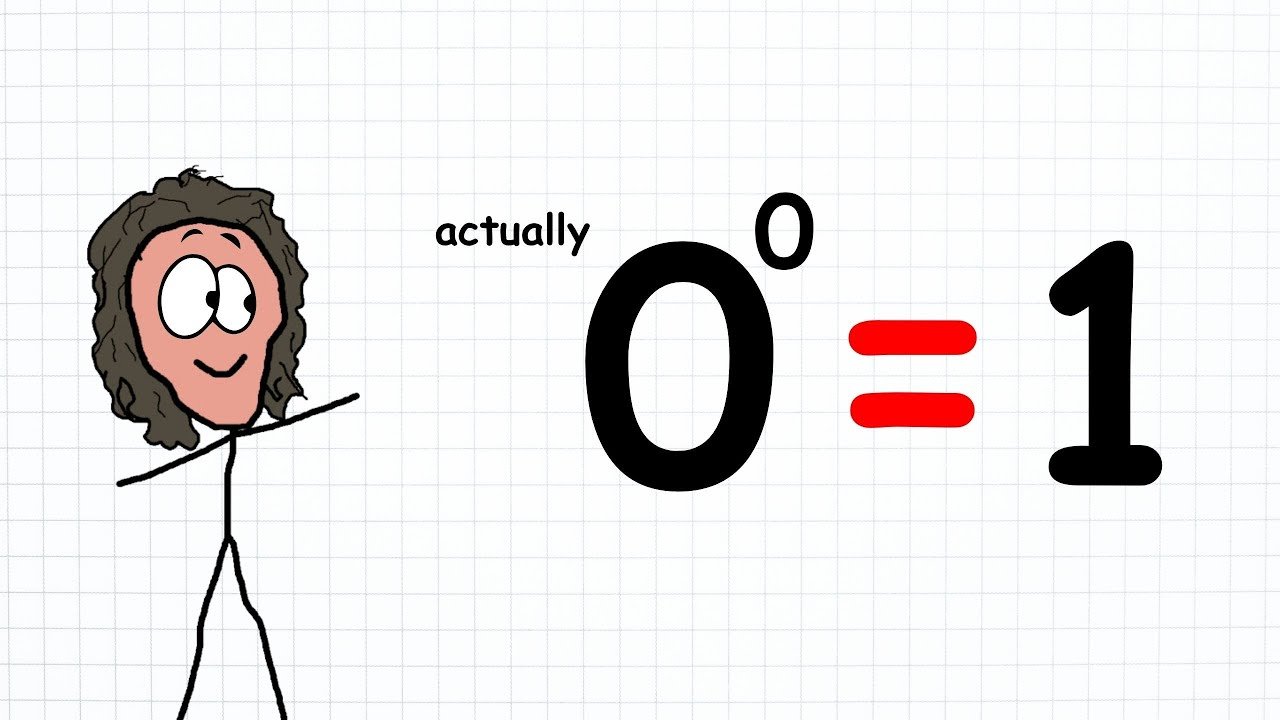
Why Mathematicians Often Define 0⁰ as 1
Throughout mathematics, 0⁰ is a notoriously problematic expression. Is it defined to have a value of 1, or does it have no mathematical meaning at all? Mathematicians have found it useful to define 0⁰ = 1 in certain contexts. This is not a universal standard. In other places the expression remains undefined. The choice to set 0⁰ = 1 appears mainly when we work exclusively with natural number exponents, which are discrete rather than the continuous real or complex numbers.
Many arguments over this topic come down to the different needs of different areas of math. People will still argue anyway, but there is not much we can do about that.
The Empty Product
What is the product of no numbers? It sounds like a bad riddle, but it is a genuine mathematical question that we often need to answer.
Exponentiation is repeated multiplication. So 2³ means multiply three copies of 2. Does 2⁰ mean multiply zero copies of 2?
Think about exponentiation another way. We can view 2³ as start with 1, then multiply by 2 three times: 1 × 2 × 2 × 2 = 8.
2² is 1 × 2 × 2 = 4.
2¹ is 1 × 2 = 2.
With that pattern in mind, what is 2⁰? We start with 1 and multiply by nothing. So we end up with 1. This is why 2⁰ = 1.
Notice that each time we decrease the exponent by 1, it is the same as dividing the previous result by 2. For example, 8 ÷ 2 = 4, so 2³ ÷ 2 = 2². Following this, 2¹ ÷ 2 = 2⁰, which again gives 1.
The number 1 is called the empty product, the result of multiplying no numbers at all. It is also the multiplicative identity, because multiplying any number by 1 leaves it unchanged.
Now apply the same logic with base 0. We can build a similar sequence that leads to the conclusion 0⁰ = 1. We were not forced to make this pattern hold, but defining 0⁰ = 1 is convenient here. It is the simplest case where the definition proves useful.
Unfortunately this breaks the other pattern, because decreasing the exponent by 1 would require dividing by 0, and division by 0 is undefined. For similar reasons, many exponent rules fail when the base is 0, so we simply exclude those cases from the usual properties.
Combinatorics and Tuples
Here is a simple combinatorics question. Imagine an alphabet with just four letters: A, B, C, and D. If order matters and you can repeat letters, how many different three-letter sequences can you make?
For the first position you have four choices. The same for the second, and again for the third. Multiply them together: 4 × 4 × 4 = 64. In mathematical terms, that is 4³.
We can generalize. Let S be a set with m elements. A tuple is an ordered list of elements, written with parentheses. The order matters, and repeats are allowed. The number of tuples of length n that we can form from S is exactly mⁿ.
What if S is the empty set (zero elements) and we try to form a tuple of length 3? We cannot, because there are no elements to choose from. So the count is 0, which matches 0³ = 0.
Now consider tuples of length 0, the empty tuple. There is exactly one empty tuple, no matter what set we start with. We simply put nothing in it. This tells us that any number to the power 0 equals 1: 1⁰ = 1, 2⁰ = 1, 3⁰ = 1, and so on.
The logic even holds for the empty set and the empty tuple. We can form the empty tuple from the empty set without trouble. So the number of such tuples is 1. For the formula mⁿ to remain consistent when m = 0 and n = 0, we need to define 0⁰ = 1.
Again, the math does not force us. We adopt the rule that is most useful in this context.
Functions and the Empty Set
In math, a function is a rule that takes an input and produces an output. The same input always gives the same output. The set of allowed inputs is the domain. The set that contains all possible outputs is the codomain.
Suppose we have a domain with three elements, say {1, 2, 3}, and a codomain with four elements, say {a, b, c, d}. For each input we must choose exactly one output. There are four choices for the image of 1, four for 2, and four for 3. Total: 4 × 4 × 4 = 64 possible functions. In general, the number of functions from a domain with n elements to a codomain with m elements is mⁿ.
What if the domain has three elements but the codomain is empty? We cannot assign an output to any input, because nothing exists to choose from. So there are zero possible functions, matching 0³ = 0.
Now suppose the domain is empty and the codomain has four elements. There are no inputs left to assign, so the function is already fully defined. This is the empty function, and it is a valid object in set theory. We get exactly one such function, which matches 4⁰ = 1.
We can even take the codomain to be the empty set as well. Both domain and codomain are empty. There is still exactly one empty function. According to the counting formula this should equal 0⁰. Since we know there is one possible function, defining 0⁰ = 1 keeps everything consistent.
Mathematicians require empty functions to exist so that the whole framework of set theory holds together. For every set there is exactly one empty function into that set.
Further reading
- Zero to the power of zero on Wikipedia
- Empty product on Wikipedia
- Combinatorial interpretations on MathWorld
Leave a Reply