
Little-Known Scientific Units That Are Still Surprisingly Useful
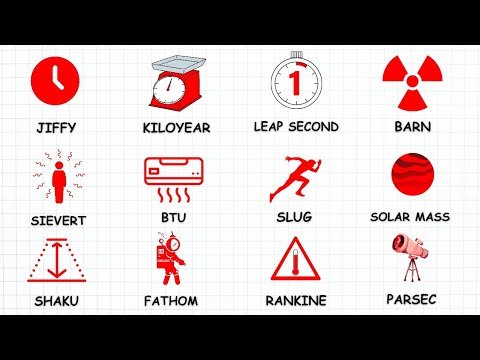
There are little-known units of time that still have relevant technical applications. Among them are the jiffy, the kiloyear, and the leap second.
Units of Time
The jiffy was proposed in 1926 by chemist and physicist Gilbert N. Lewis as a unit of time defined by the interval it takes for light to travel 1 cm in a vacuum. This value is approximately 33.3564 picoseconds. Although originally formulated in the context of physics, the term was later adopted in computing with a different meaning: a small time interval determined by the system clock cycle, typically 1/60th or 1/100th of a second. Its value varies across disciplines, but in all contexts it remains a useful way to describe extremely short time intervals.
The kiloyear, abbreviated as kyr, is a scientific unit of time equal to 1,000 years. It is used in geology, paleontology, and climatology because it fits decimal scales cleanly, unlike the word millennium which belongs more to history and culture. For example, the last major glaciation ended approximately 11.7 kyr ago. Kiloyears make descriptions of climate change or species evolution clearer and more precise.
A leap second is a one-second adjustment occasionally added to coordinated universal time (UTC) to keep it in sync with Earth’s rotation. This correction is necessary because Earth’s rotation is not constant, while atomic clocks that define international atomic time (TAI) run with extreme precision. Small differences build up between civil time and astronomical time. When the gap approaches 0.9 seconds, the International Earth Rotation and Reference Systems Service (IERS) adds one extra second to UTC so civil time stays aligned with actual Earth rotation as measured by universal time (UT1).
Units in Nuclear Physics, Radiation, and Thermal Energy
In nuclear physics and thermal engineering, specialized units describe phenomena invisible to the human eye yet essential to modern technology. Among these are the barn, the sievert, and the BTU.
The barn is a unit of area used in nuclear physics to quantify the effective cross-section of a particle — the theoretical area that represents the probability of interaction between an incoming particle and an atomic nucleus. It is defined as 1 barn = 10−28 m², which equals 100 square femtometers (fm²). This unit is essential for modeling nuclear reactions, particle scattering, and high-energy physics.
The sievert is the SI unit for equivalent dose of ionizing radiation, a measure of the biological impact radiation can have on human tissue. It accounts for both the energy absorbed and the type of radiation. One sievert equals 1 joule per kilogram (1 Sv = 1 J/kg). It is calculated as H = D × Q, where H is the equivalent dose, D is the absorbed dose in grays (Gy), and Q is the radiation quality factor. The sievert is central to radiation protection in medicine, industry, and nuclear settings.
The BTU (British Thermal Unit) is a unit of thermal energy used in heating and air-conditioning systems. It is defined as the energy required to raise the temperature of one pound of water by 1 °F. One BTU is approximately 1055 J.
Units of Mass
Units of mass cover the enormous range of scales science works with. Some measure tiny quantities, others describe entire stars. Among the most unusual still in regular use are the carat, the slug, and the solar mass.
In gemology the carat is a unit of mass for gemstones, defined exactly as 1 carat = 200 mg. A 2-carat diamond therefore has a mass of 0.4 g. The value was standardized internationally in 1907 and is based on the average mass of carob seeds, which were once used as a natural balance weight because of their uniformity.
In goldsmithing the same word carat indicates purity of gold in an alloy. One carat means 1/24 of the total mass, or about 4.167 %. An 18-carat piece is therefore 75 % pure gold (18/24), while 24-carat gold is considered pure.
The slug is a unit of mass in the imperial system used in classical dynamics. It is defined as the mass that accelerates at 1 ft/s² when a force of 1 pound-force is applied, which equals approximately 14.59 kg. It still appears in U.S. physics and engineering textbooks.
The solar mass is an astronomical unit used to compare the mass of stars, galaxies, or black holes to that of the Sun. Its value is approximately 1.989 × 1030 kg, or about 332,946 times the mass of Earth.
Units of Length
Lengths have historically been measured with units adapted to local needs. Some persist because of tradition or specific technical value. The shaku and the fathom are good examples.
The shaku is a traditional Japanese unit of length equal to approximately 30.3 cm. Its origin is based on human body proportions, like the foot or cubit elsewhere. Japan officially adopted the metric system and banned the shaku for official use on March 31, 1966, yet it survives in traditional carpentry, architecture, and kimono making. The size of a tatami mat, for instance, is still defined in multiples of the shaku, preserving proportions and techniques passed down for generations.
The fathom is a nautical unit of depth equal to 6 ft or about 1.8288 m. It comes from the average span of a person’s outstretched arms. It is still used to express ocean depths in navigation and nautical charts, especially in countries that keep the imperial system. In military and maritime work it remains a practical, visual measure that needs no immediate conversion.
Temperature and Astronomical Units
In physics and astronomy some units are indispensable in narrow technical fields. The Rankine degree and the parsec are classic cases.
The Rankine degree is an absolute temperature scale used mainly in U.S. thermal engineering. Proposed in 1859 by Scottish engineer William Rankine, it measures temperatures in Fahrenheit degrees starting from absolute zero, so there are no negative values. The conversion is simple: degrees Rankine = (9/5) × Kelvin. Thus 0 °R equals −273.15 °C or 0 K. Rankine is convenient for thermodynamic calculations in aerospace and power-plant design where the imperial system is still common.
The parsec is a unit of length used in professional astronomy. It equals approximately 3.2616 light years. The name comes from “parallax of one arcsecond.” It is defined as the distance at which one astronomical unit subtends an angle of one arcsecond. Mathematically, 1 parsec ≈ 3.08568 × 10¹⁶ m. Astronomers prefer the parsec over the light-year for high-precision work because it is directly tied to the geometric method of stellar parallax.
Why These Units Stick Around
These units survive because they make daily work smoother in their own fields. The barn turns nuclear probabilities into comfortable numbers. The parsec turns a telescope measurement straight into distance. The jiffy fits both light-speed calculations and computer timing. They may look odd from the outside, but once you use them they feel exactly right.
Further reading
- Jiffy (time) on Wikipedia
- Kiloyear on Wikipedia
- Leap second on Wikipedia
- Barn (unit) on Wikipedia
- Sievert on Wikipedia
- British thermal unit on Wikipedia
- Carat (mass) on Wikipedia
- Slug (unit) on Wikipedia
- Solar mass on Wikipedia
- Shaku on Wikipedia
- Fathom on Wikipedia
- Rankine scale on Wikipedia
- Parsec on Wikipedia
Leave a Reply