
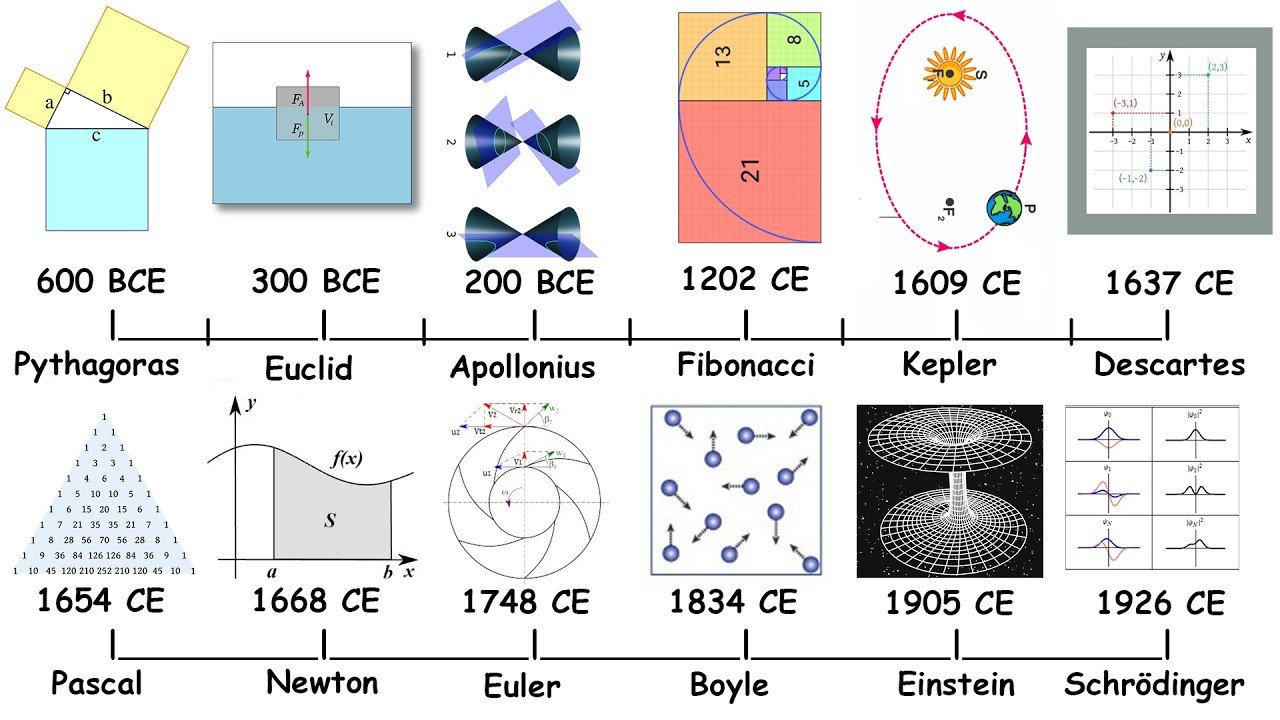
Timeline of Equations That Changed the World
6th Century BC: Thales’ Theorem
Thales’ theorem establishes proportional relationships in triangles, facilitating precise calculations and constructions. The theorem states that if a line is drawn parallel to one side of a triangle and intersects the other two sides, then it divides those sides proportionally. It is fundamental to the understanding of classical geometry and has applications in navigation, architecture, and spatial problem solving.
6th Century BC: Pythagorean Theorem
The Pythagorean theorem relates the sides of a right triangle, allowing us to calculate distances and solve geometric problems. It has applications in mathematics, physics, engineering, architecture, and navigation, and is key to solving spatial problems.
300 BC: Euclid’s Theorem
Euclid of Alexandria was a mathematician who made important contributions to geometry. For example, the equalities that are fulfilled in the right triangle. In his work The Elements, he compiles more than three centuries of mathematical research into 13 books that explain topics such as plane geometry, solid geometry, proportion, and number theory.
250 BC: Archimedes’ Principle of Flotation
Archimedes’ principle of buoyancy explains why objects float or sink based on the buoyant force. The principle states that when an object is fully or partially submerged in a fluid, the upward buoyant force acting on it is equal to the weight of the fluid displaced by the object. It is fundamental in physics, naval engineering, and ship design, influencing the construction of ships and submarines.
200 BC: Conic Sections
The study of conic sections describes shapes such as circles, ellipses, parabolas, and hyperbolas. It has key applications in astronomy, optics, engineering, physics, and geometry, helping to model natural and technological phenomena such as trajectories and lenses.
First Century AD: Heron’s Formula
Heron’s formula allows the area of a triangle to be calculated from its three sides without needing to know its height. It is fundamental in geometry, trigonometry, and practical applications such as engineering and topography.
1202: Fibonacci Sequence
The Fibonacci sequence appears in many natural phenomena, such as the distribution of leaves or the formation of structures in organisms. It also has applications in mathematics, computer science, art, architecture, and modeling of complex systems and growth.
1609: Kepler’s Laws of Planetary Motion
Kepler’s laws accurately describe the motion of the planets, challenging the geocentric view. Their discovery allowed us to understand gravity and laid the foundations for Newton’s theory, transforming modern astronomy and physics.
1614: Logarithms
Logarithms simplify complex calculations, especially multiplication and division. They are applied in exponential growth, equation solving, and large-scale data analysis.
1637: Cartesian Plane
The Cartesian coordinate plane provides a reference system for locating points in space using numerical coordinates. It is fundamental in mathematics, physics, engineering, and computer science, facilitating the representation and resolution of geometric and algebraic problems.
1637: Fermat’s Last Theorem
Fermat’s Last Theorem challenged mathematicians for centuries and remained unproved until 1995, when a paper by Andrew Wiles was released after 8 years of work. His paper marked a milestone in number theory. Its proof advanced the field and consolidated key concepts in modern mathematics.
Fermat’s Last Theorem states that for the equation aⁿ + bⁿ = cⁿ, where n is some whole number greater than two, there exists no integer solution for a, b, and c. Basically, there are an infinite number of integer solutions for n = 2, and then absolutely no solutions for any other number.
1654: Pascal’s Triangle
Pascal’s triangle shows key mathematical patterns such as binomial coefficients and combinatorial properties. It has applications in algebra, probability, number theory, and analysis, facilitating the resolution of problems involving combinations and polynomials.
1668: Fundamental Theorem of Calculus
The fundamental theorem of calculus establishes the relationship between the derivative and the integral, two central concepts of calculus. It facilitates the calculation of areas, volumes, and rates of change, being essential in mathematics, physics, and engineering.
1687: Newton’s Law of Universal Gravitation
Newton’s law of universal gravitation explains how all bodies with mass attract each other, determining the movement of planets and satellites. It was key to modern physics, influencing astronomy, mechanics, and space research.
1687: Newton’s Second Law
Newton’s second law establishes the relationship between force, mass, and acceleration of an object. It is fundamental in classical mechanics, allowing the prediction and analysis of the motion of bodies under constant forces.
1738: Bernoulli’s Principle
Bernoulli’s principle describes how the velocity of a fluid is related to its pressure, which is crucial in fluid dynamics. It has applications in aviation, hydraulic engineering, medicine, and the design of flow systems such as in pipes and airplanes.
1747: Wave Equation
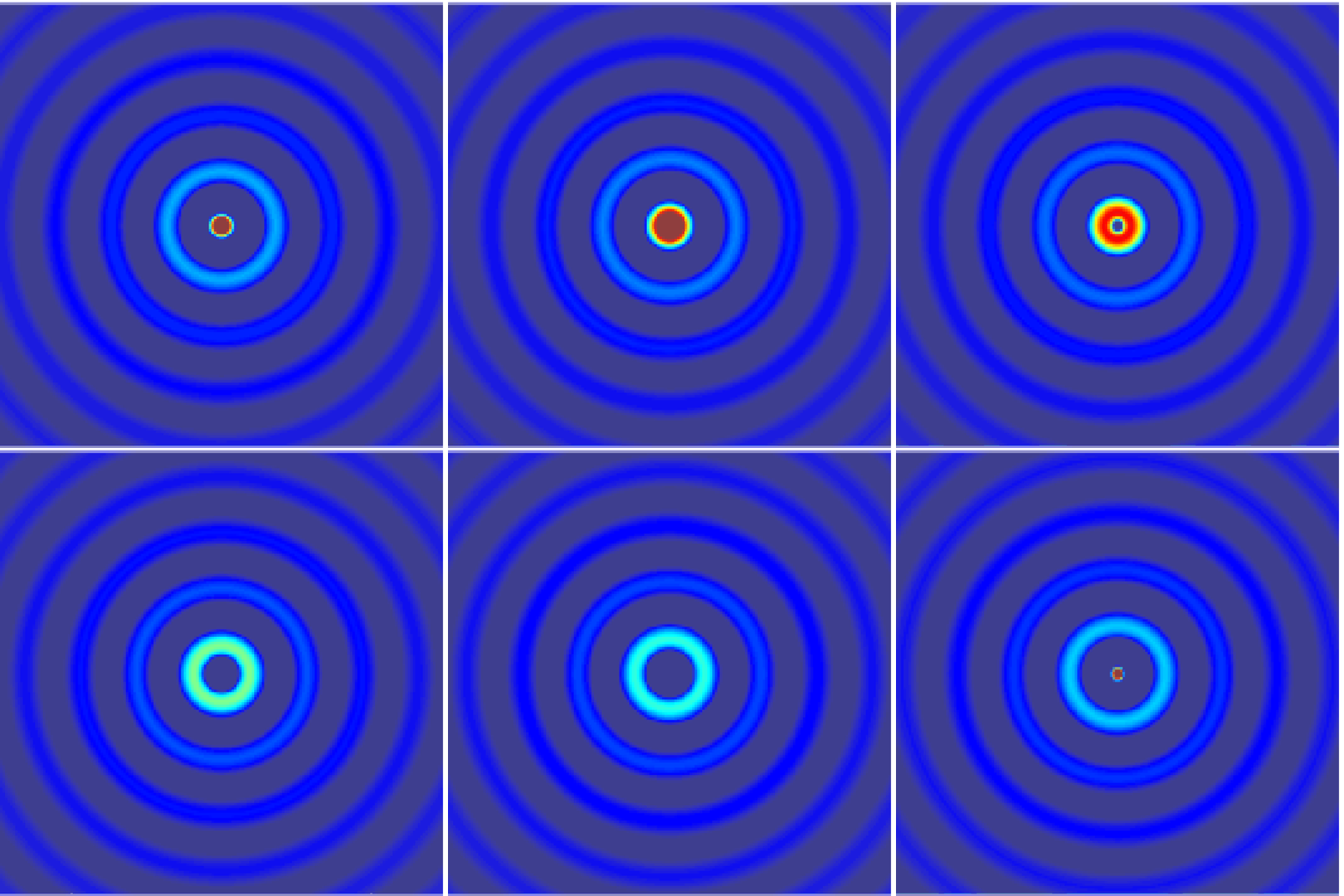
Jean le Rond d’Alembert’s wave equation describes the behavior of waves such as sound and electromagnetic waves in media. It is key in physics, engineering, and telecommunications, allowing us to understand and model wave propagation phenomena.
1748: Euler’s Identity
Euler’s identity connects five fundamental constants of mathematics. It is a symbol of the beauty and depth of mathematics.
1758: Euler’s Formula for Polyhedrons
Euler’s polyhedron formula connects the geometric properties of convex polyhedra, making their classification easier. It is also essential in topology, where it helps to analyze surfaces and spatial structures.
1763: Bayes’ Theorem
Bayes’ theorem allows the probabilities of an event to be updated based on new evidence. It is fundamental in statistics, artificial intelligence, and machine learning, as it facilitates decision-making and prediction in uncertain situations.
1785: Laplace Transform
The Laplace transform facilitates the resolution of differential equations, transforming problems in the time domain into the frequency domain. It is essential in engineering, physics, and automatic control, helping in the analysis of dynamic systems.
1788: Lagrange Multipliers
Lagrange multipliers allow solving optimization problems with constraints. They are fundamental in applied mathematics, economics, and physics, since they facilitate the maximization or minimization of functions under specific conditions, such as in problems of limited resources.
1809: Normal Distribution
The Gaussian normal distribution describes the distribution of many natural and social variables. It is essential in statistics, data analysis, and hypothesis testing, allowing for modeling random phenomena and making inferences about large populations.
1822: Fourier Transform
The Fourier transform decomposes functions into their frequency components, facilitating signal analysis. It is fundamental in signal processing, physics, engineering, telecommunications, and image analysis, allowing for the efficient resolution of complex problems.
1834: Equation of State of Ideal Gases
The ideal gas equation of state was derived from the contributions of Robert Boyle, Jacques Charles, and Joseph Louis Gay-Lussac. The equation describes the behavior of gases under ideal conditions, relating pressure, volume, temperature, and amount of substance. It is fundamental in thermodynamics, chemistry, and gas physics.
1845: Navier-Stokes Equations
The Navier-Stokes equations model the flow of viscous fluids, describing phenomena such as the motion of air, water, and other fluids. They are fundamental in engineering, meteorology, oceanography, and physics, with applications in system design and prediction of fluid behavior.
1864: Maxwell’s Equations
Maxwell’s equations unify electrical and magnetic phenomena into a single theory of electromagnetism. They are essential to understanding light, electromagnetic waves, and have key applications in technology, telecommunications, energy, and modern physics.
1872: Second Law of Thermodynamics
The second law of thermodynamics is mainly attributed to Rudolf Clausius and William Thomson (Lord Kelvin), who formulated it in the 19th century. Clausius introduced the concept of entropy and expressed it mathematically, while Kelvin formulated the law in terms of the impossibility of constructing a perpetual motion machine of the second kind.
However, the statistical interpretation of this law through the concept of entropy was later developed by Ludwig Boltzmann, who connected it to the microscopic behavior of particles. Boltzmann’s second law of thermodynamics connects entropy to microscopic probability, explaining how systems evolve toward equilibrium. It is key to understanding irreversibility, natural processes, and the statistical basis of thermodynamics.
1905: Theory of Relativity
Einstein’s theory of relativity revolutionized our understanding of space, time, and gravity. It explains phenomena such as time dilation, space-time curvature, and mass-energy equivalence, making it essential to modern physics, cosmology, and advanced technology.
1905: Planck-Einstein Relation
The Einstein-Planck relation connects the energy of a photon with the frequency of electromagnetic radiation. It underpins quantum mechanics, explaining phenomena such as the photoelectric effect, and is essential in quantum physics and modern technology.
1926: Schrödinger’s Equation
The Schrödinger equation describes the quantum behavior of particles such as electrons through the wave function. It is essential for understanding atomic, molecular, and subatomic phenomena, and it is key in quantum physics, chemistry, and modern technology.
1928: Dirac Equation
The Dirac equation unifies quantum mechanics and special relativity, predicts the existence of antimatter, and establishes a solid foundation for modern physics and quantum field theory.
1948: Information Theory
Claude Shannon’s information theory lays down the foundations for data transmission and compression. It revolutionized telecommunications and computing, providing the mathematical foundations for coding, cryptography, and signal processing.
1963: Lorenz Equation
The Lorenz equation models deterministic chaos, showing how small changes in initial conditions can lead to unpredictable behavior. It is fundamental to chaos theory, with applications in meteorology, physics, and dynamical systems.
1973: Standard Model of Particles
The standard model of particles is a quantum field theory that describes the behavior of elementary particles. The standard model was developed over several decades with the participation of many scientists. The model describes subatomic particles and their fundamental interactions (electromagnetic, weak, and strong), forming the basis of modern particle physics. It explains experimentally observed phenomena and even predicts new particles such as the Higgs boson.
1973: Black-Scholes Model
The Black-Scholes equation revolutionized finance by providing a formula for pricing options, promoting efficient markets, managing risks, and inspiring the development of advanced mathematical models to understand and predict the behavior of financial assets.
1976: Chaos Theory
Robert May’s logistic equation shows how simple systems can generate complex behaviors, including chaotic patterns, helping to understand population dynamics, ecosystems, and nonlinear systems in various disciplines from biology to economics. It implies that small variations in initial conditions can imply large differences in future behavior, making long-term prediction impossible.
Leave a Reply