
The Geometry Behind 3D Printing
3D printing would not exist without geometry. Each generated object begins as a three-dimensional representation constructed from vertices, edges, and faces. This structure defines a mesh, which can be mathematically expressed as M = (V, E, F), where V represents the vertices, E the edges, and F the faces of the model.
But this definition goes beyond a simple enumeration of elements. It encompasses the spatial logic that allows an object to occupy a volume and exist within a Cartesian system. Each vertex is precisely positioned using coordinates in ℝ³, and the connectivity between them gives rise to a controlled topology. These models are projected onto a three-dimensional coordinate system (x, y, z) and then sectioned horizontally to build the object layer by layer. Each layer represents a planar intersection of the solid, like a set of segments that define its contour.
Printed shapes must be continuous and closed, or they cannot be physically constructed. This requirement makes principles such as topology, continuity, and connectivity essential. Every 3D printer executes precise geometric transformations. Geometry does not merely serve an aesthetic function, but rather a structural and functional one. It is the operational language that translates mathematical formulas into matter.
2D Profiles and Extrusion
Every three-dimensional form begins on the plane. In 3D printing, two-dimensional figures such as circles, squares, and polygons are the basic profiles from which solids are constructed through geometric operations.
For example, applying a vertical extrusion to a circle produces a cylinder. Extruding an equilateral triangle generates a triangular prism. This principle is formalized using Cartesian products. If A ⊂ ℝ² is a figure in the plane, then the Cartesian product A × [0, h] ⊂ ℝ³ represents its extrusion to a height h.
3D printers operate by interpreting these profiles as contours in each horizontal layer. Even complex shapes such as gears or organic structures start from 2D profiles defined by mathematical functions or discretized polygons. The precision of these shapes is critical, as each cross-section of the model is a plane figure. Without precise 2D geometry, the 3D construction falls apart, literally and mathematically.
Platonic Solids
The Platonic solids are models of perfect symmetry, ideal for understanding how geometry regulates stability and aesthetics in 3D design. These five solids, the tetrahedron, cube, octahedron, dodecahedron, and icosahedron, are defined by having congruent faces, equal angles, and equivalent vertices.
Each one satisfies Euler’s formula for convex polyhedra: V − E + F = 2, where V is the number of vertices, E the number of edges, and F the number of faces. This topological relationship is key to ensuring that a model is printable and structurally coherent.
In 3D printing, these solids are used in both educational models and architectural structures. The cube is the most common due to its simplicity and volume efficiency. The icosahedron, on the other hand, allows spheres to be approximated with minimal distortion. These figures not only represent mathematical perfection but also concrete three-dimensional functionality.
Prisms and Pyramids
Prisms and pyramids are essential in 3D design due to their ease of modeling and structural efficiency. A prism is defined as a solid with two congruent polygonal bases and rectangular lateral faces. Its volume is calculated as V = A_b × h, where A_b is the area of the base and h is the height. Pyramids, on the other hand, have a single base and triangular faces that converge at a vertex. Their volume is determined by V = (1/3) × A_b × h.
Both shapes are easy to print thanks to their flat, well-defined structure. In practical applications, architectural models and functional supports employ right prisms and truncated pyramids, as they efficiently distribute stress and minimize material usage without compromising stability.
Furthermore, their digital representation requires few vertices and faces, which reduces the topological complexity of the model. This not only speeds up the slicing process but also reduces the risk of geometric errors during file preparation.
Solids of Revolution
Solids of revolution are shapes generated by rotating a flat figure around an axis. In 3D printing, these structures, such as cylinders, cones, and spheres, offer geometric efficiency and ideal symmetry for functional components.
Mathematically, if a curve y = f(x) is rotated around the x-axis, the volume of the generated solid is calculated as V = π ∫ₐᵇ [f(x)]² dx. This principle allows smooth shapes such as threads, pulleys, or nozzles to be modeled with great precision.
The sphere (rotating a semicircle) and the cone (rotating an inclined line) are classic examples of solids of revolution. In 3D design, these shapes are represented using 2D profiles and revolution operations, reducing modeling complexity. They also allow for controlling mass distribution and structural balance, essential for moving or centered parts. The mathematical rotation of curves converts simple trajectories into functional, balanced volumes ready for precision printing.
The Torus
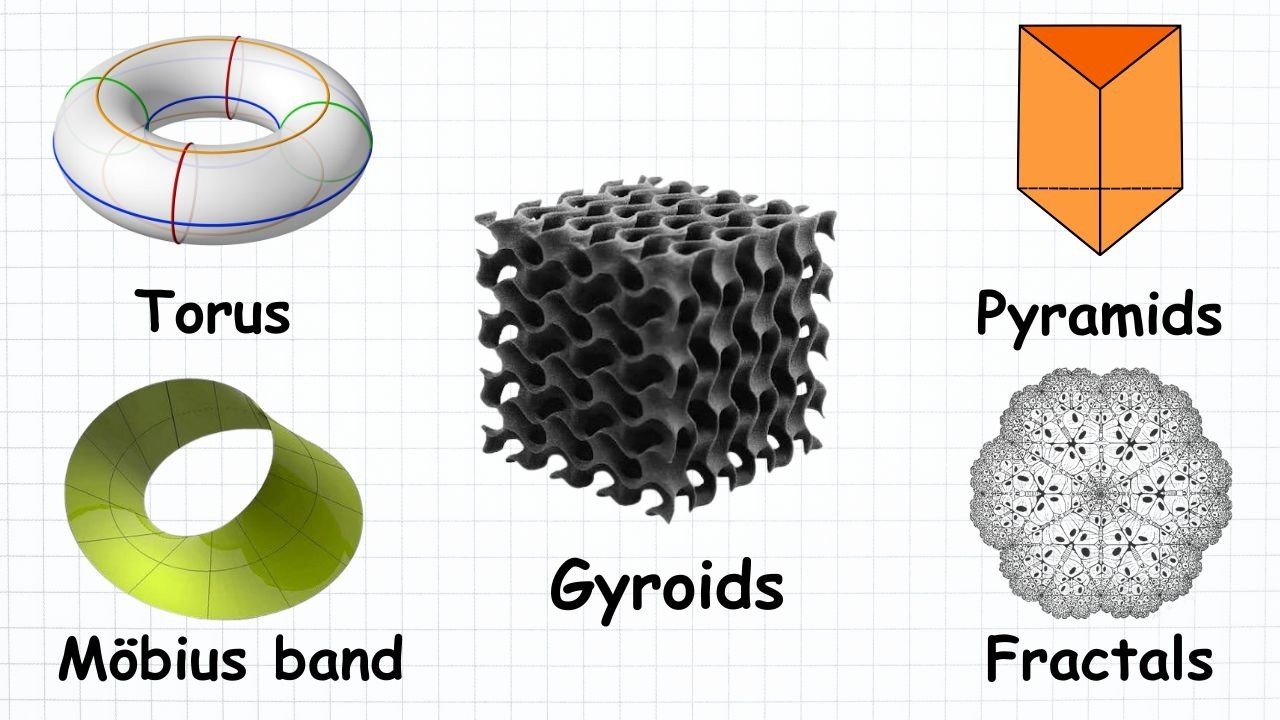
The torus is one of the most fascinating shapes in 3D modeling, both for its continuous structure and its topological properties. It is generated by rotating a circle around an axis that does not intersect it. Its equation in Cartesian coordinates is (x² + y² + z² + R² − r²)² = 4R²(x² + y²), where R is the major radius (from the central axis of the torus to the center of its circular cross-section) and r is the minor radius (the radius of the tube being rotated).
In topology, the torus has genus 1, meaning it has a single perforation, unlike the sphere, which has genus 0. This property allows for the modeling of cyclic and continuous structures without edges, useful in closed systems such as gears, tubes, and pneumatic components. Advanced 3D printing allows for the exploration of complex topological shapes such as surfaces with multiple holes or bands like the Möbius band, valued for their unique properties of continuity, symmetry, and geometric behavior.
Boolean Operations
In 3D design, Boolean operations allow you to combine or modify solid bodies mathematically. These operations (subtraction, intersection, and union) are based on set logic. Subtraction (A − B) removes B from A. Intersection retains only the shared volume. Union combines both volumes.
These transformations allow complex geometries to be constructed from simple solids. For example, subtracting a sphere from a cube creates a hollow spherical cavity. The logic behind this action follows the principle of set algebra, where each operation results in a new polyhedron.
In 3D printing, these operations are implemented using constructive solid geometry, or CSG, which defines objects by their construction history rather than their final meshes. This allows for precision in assemblies, mechanical adjustments, and absolute control over the resulting shape before the slicing process.
Parametric Surfaces
Parametric surfaces allow complex shapes to be described using equations dependent on one or more parameters. Unlike polygon-based models, these surfaces are defined by continuous functions. For example, a Möbius strip can be represented parametrically, where u and v are parameters within certain ranges.
These representations allow the creation of geometries such as gyroids, fractals, and algebraic surfaces, widely used in advanced 3D printing due to their unique combination of structural complexity and mathematical continuity.
Gyroids, discovered by Alan Schoen, have a triply periodic structure without flat surfaces or sharp edges, making them ideal for lightweight, strong materials with excellent internal stress distribution. Fractals offer infinitely self-similar shapes that can be truncated to practical levels for printing, generating highly efficient textures or internal structures.
The precision of these shapes directly depends on the density of the parametric sampling. The higher the parameter resolution, the more faithful the printed shape will be to the original mathematical surface. Poor sampling can produce discontinuities, artifacts, or topological errors that compromise both the aesthetics and functionality of the printed object.
Furthermore, many of these shapes cannot be constructed manually but can be printed. Parameterization not only opens up new aesthetic possibilities but also allows for the construction of structures that are mathematically impossible to achieve by other means.
Further Reading
- Euler’s Polyhedron Formula on MathWorld
- Platonic Solids on MathWorld
- Constructive Solid Geometry on Wikipedia
- Gyroid on Wikipedia
- Solid of Revolution on MathWorld
Leave a Reply